
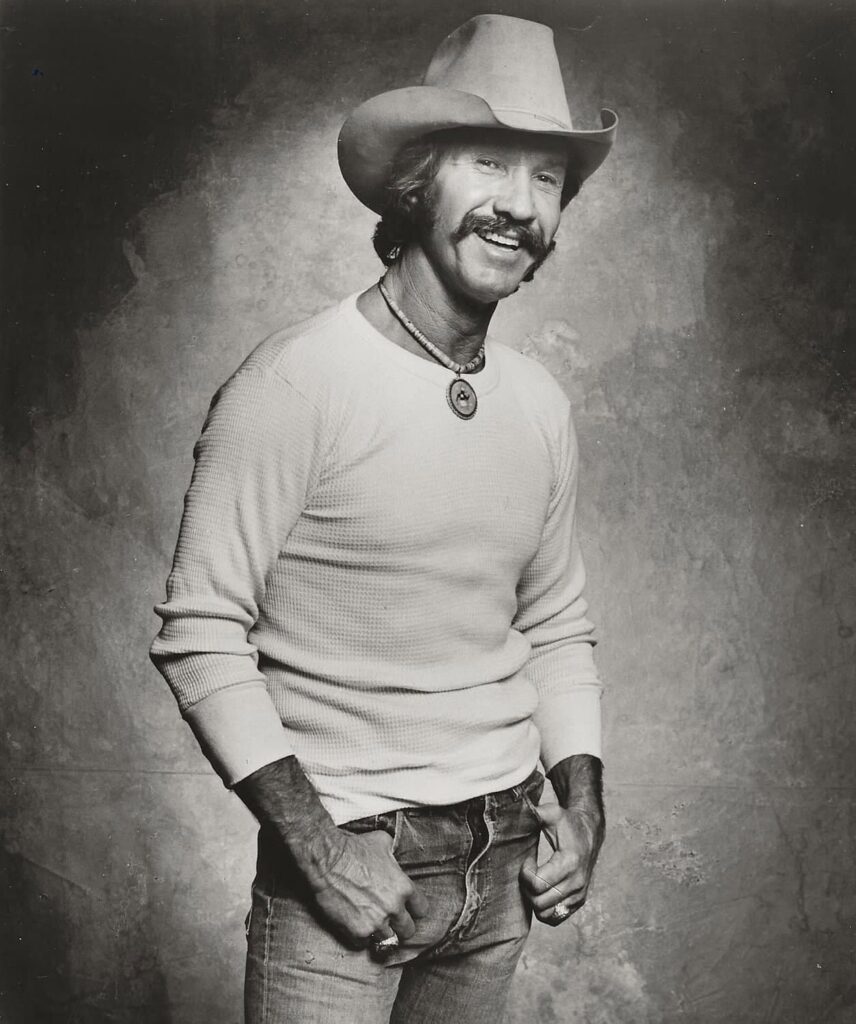
A farewell written in dust and melody, “Some Memories Won’t Die” echoes the enduring legacy of a voice that once carried the soul of the American West.
There are lives that unfold like quiet songs, and then there are those that blaze across the horizon like a desert sunset—brief, brilliant, and impossible to forget. The story of Marty Robbins belongs to the latter. When the news spread in late 1982 that he had passed away, it did not feel like the end of a career. It felt like the closing of a chapter in American music itself.
They gathered in Nashville, the city that had both shaped and celebrated him, to say goodbye. Nearly 1,500 people filled the room, a sea of familiar faces and silent admirers. Some had driven through the night, not for spectacle, but for something quieter—to sign a guestbook, to leave a name behind as proof that they had been touched by his voice. There was no need for grand gestures. The weight of the moment spoke for itself.
By then, Marty Robbins had long secured his place in history. With 18 No. 1 country hits, he was not merely successful—he was foundational. In 1959, his signature song “El Paso” achieved something remarkable: it reached No. 1 on both the Billboard Country Chart and the Billboard Hot 100, a rare crossover that brought the storytelling tradition of country music into the heart of mainstream America. It was a cowboy ballad, yes—but it was also a cinematic narrative, unfolding with the patience and detail of a novel. Robbins himself would later recall writing it while driving through the desert, unsure of how the story would end until the final lines revealed themselves. That sense of spontaneity, of discovery, became part of its magic.
Beyond chart success, there were milestones that spoke to his broader impact. He became the first country artist to win a Grammy Award, a recognition that affirmed what many already knew—that his artistry transcended genre boundaries. Over the course of his career, he recorded more than 500 songs, each carrying a piece of his voice, his vision, his quiet understanding of human longing.
And yet, for all the accolades, there was something deeply personal about his music. Robbins did not simply perform songs; he inhabited them. Whether singing of love, loss, or the wide, unforgiving landscapes of the West, he brought a sincerity that felt almost conversational. It was as though he were sitting across from you, telling a story not for applause, but for connection.
On October 11, 1982, just weeks before his passing, Marty Robbins was inducted into the Country Music Hall of Fame—a moment that, in retrospect, feels both celebratory and poignantly timed. He was 57 years old, still vibrant in spirit, yet unknowingly nearing the end of his journey. Eight weeks later, he was gone.
At his funeral, the room was filled not only with fans, but with the very figures who had shaped the golden age of country music. Little Jimmy Dickens, who had once helped discover him, was overcome with emotion. Brenda Lee spoke softly of his warmth, of how he made everyone feel included in his world. Johnny Cash, June Carter, Roy Acuff, Charley Pride—they stood together, united not by fame, but by shared respect. In that moment, the industry seemed to pause, as though acknowledging that something irreplaceable had been lost.
Amid all this, there was one final, almost poetic detail. His last single, released in 1982, was titled “Some Memories Won’t Die.” It is difficult to imagine a more fitting farewell. The song itself did not dominate the charts, but its title carried a truth that would only grow stronger with time.
Because memories, especially those tied to music, have a way of enduring. They linger in the melodies we revisit, in the stories we retell, in the quiet moments when a familiar voice returns uninvited, yet deeply welcome. Marty Robbins understood this, perhaps more than most. His songs were never just about the present; they were about what remains after the moment has passed.
Listening today, one can still hear the echo of that desert wind in “El Paso,” still feel the gentle pull of nostalgia in his later recordings. Time may move forward, as it always does, but his music stands still in the best possible way—waiting, patient, unchanged. And so, as the mourners filed past that silver casket in Nashville, as names were written in ink that would fade long before the memories themselves, there was an unspoken understanding. This was not an ending, not in the way that truly matters.