
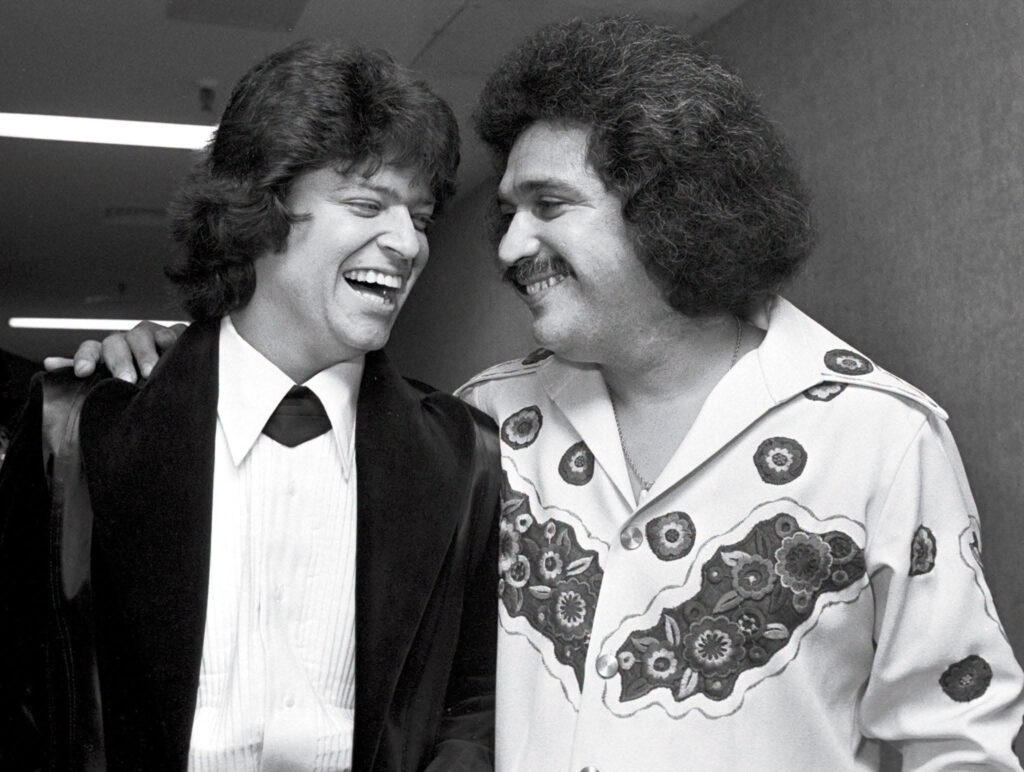
Two voices, one quiet revolution—Johnny Rodriguez and Freddy Fender reshaped country music by bringing heritage, heart, and new identity into its mainstream
There are moments in music history when change does not arrive with noise or resistance, but with a gentle, undeniable presence. The mid-1970s offered one such moment, carried not by movements or manifestos, but by the voices of Johnny Rodriguez and Freddy Fender—two artists whose success quietly redefined what country music could sound like, and perhaps more importantly, who it could belong to.
By 1973, Johnny Rodriguez had already begun an extraordinary ascent. His debut album, Introducing Johnny Rodriguez, produced chart-topping singles such as “You Always Come Back (To Hurting Me)” and “Ridin’ My Thumb to Mexico”, both of which reached No. 1 on the Billboard Hot Country Singles chart. These were not merely commercial achievements; they signaled the arrival of a new voice—one that carried both the traditional storytelling of country music and the subtle, unmistakable influence of his Mexican-American roots. Rodriguez did not announce this difference; he lived it through phrasing, tone, and an emotional authenticity that felt both familiar and quietly new.
At nearly the same time, Freddy Fender emerged with a story that seemed almost improbable. After years of obscurity and personal hardship, he returned to the spotlight with “Before the Next Teardrop Falls” in 1975—a song that would go on to reach No. 1 on both the Billboard Hot Country chart and the Billboard Hot 100. Sung in both English and Spanish, the track carried a tenderness that transcended language, offering a kind of emotional clarity that needed no translation. It was followed by “Wasted Days and Wasted Nights”, another major hit that reaffirmed his place in the musical landscape.
What made these successes remarkable was not only their chart positions, but the way they subtly shifted the boundaries of country music. Until then, the genre had largely been defined by a narrow cultural lens. Yet here were two artists, standing at the center of its commercial peak, bringing with them a different heritage, a different cadence, and a different emotional palette. They did not seek to challenge tradition; instead, they expanded it.
There is a quiet courage in that kind of transformation. Johnny Rodriguez, with his smooth baritone and effortless blend of country and Latin phrasing, offered songs that felt like open roads stretching across borders—both geographic and cultural. Meanwhile, Freddy Fender brought a sense of lived experience into his recordings, a kind of emotional wear that gave his voice a fragile honesty. When he sang, there was always the sense that he understood loss not as an abstract idea, but as something deeply personal.
Listening now, decades removed from that era, one can hear how naturally their music fits within the broader tapestry of country history. And yet, at the time, their presence marked a turning point. They opened doors without ever appearing to push them. Their success made space for others, even if that impact was not immediately recognized.
There is also something deeply reflective in their stories—an understanding that success in music is not always a straight path. For Freddy Fender, it was a return after years of silence, a second chance that carried both gratitude and quiet resilience. For Johnny Rodriguez, it was the sudden realization of a voice that had long been forming, now finally heard.
The mid-1970s, often remembered for its polished productions and evolving sounds, holds within it this quieter narrative—one of inclusion, of identity, and of music’s ability to transcend boundaries without losing its soul. In the songs of Johnny Rodriguez and Freddy Fender, there is no sense of division, only connection.
And perhaps that is what lingers most. Not the chart numbers, though they were significant. Not even the crossover success, though it was groundbreaking. What remains is the feeling—that somewhere in those melodies, something shifted gently but permanently. A space widened. A voice once considered outside the center was now unmistakably within it.
In that sense, their legacy is not only heard—it is felt, like a familiar song carried on the wind, reminding us that music, at its best, belongs to everyone willing to sing it.