
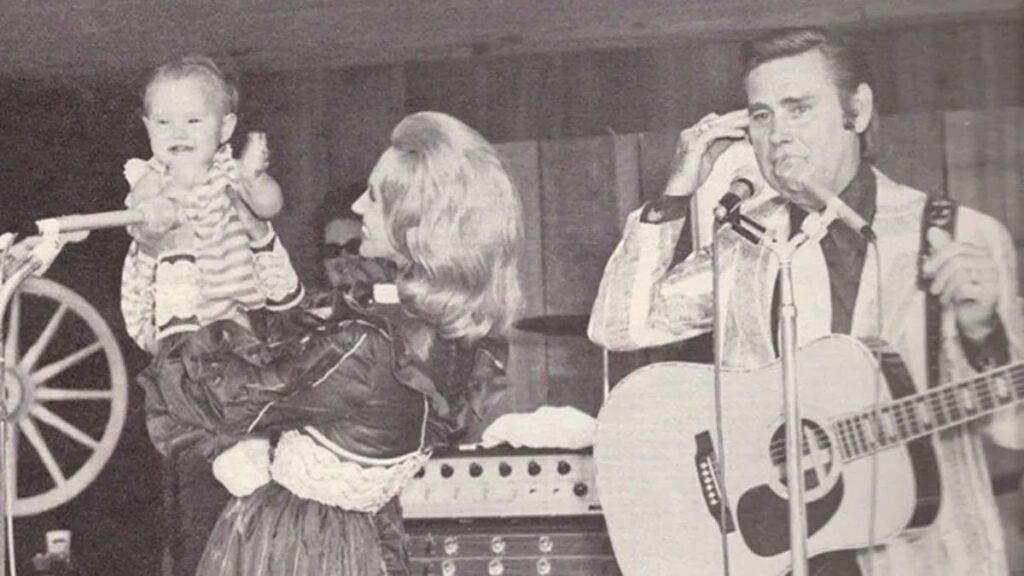
A love born in chaos, carried through music, and sealed in memory George Jones and Tammy Wynette turned heartbreak into something eternal
There are stories in country music that feel written long before the first note is ever sung—stories where love, pain, and destiny intertwine so tightly that separating them becomes impossible. The journey of George Jones and Tammy Wynette is one such story, and it remains among the most compelling ever lived within the genre. It is not merely a tale of two legendary voices, but of a bond that shaped the very sound and soul of country music itself.
By the late 1960s, both artists were already carving their places in history. George Jones, often referred to as one of the greatest voices country music has ever known, had built a formidable career with hits like “She Thinks I Still Care” and “The Race Is On.” Meanwhile, Tammy Wynette had risen rapidly with emotionally charged songs such as “Stand by Your Man,” which would go on to become one of the most iconic country recordings of all time, reaching No. 1 on the Billboard Hot Country Singles chart in 1968 and crossing into the pop charts as well.
It was in that same year—1968—that their lives changed forever.
Their meeting did not begin with grand declarations or dramatic gestures. It unfolded quietly, through shared tours and fleeting moments backstage. Yet beneath that calm surface, something undeniable was forming. Jones, already captivated, found himself drawn to Wynette in a way that went beyond admiration. And Wynette, despite the life she had built with Don Chapel, felt that same unspoken connection. As she would later reflect, her affection for him began almost immediately—an emotional truth that would soon become impossible to ignore.
Then came a moment that seemed to crystallize everything.
When one of Wynette’s young daughters fell gravely ill after a trip, it was George Jones who appeared—not as a star, but as a presence of unwavering support. In the sterile, uncertain space of a hospital, far removed from the stage lights, he remained by her side. It was not a performance. It was something far more revealing. In that quiet act of care, the boundaries between friendship and love dissolved.
What followed was as sudden as it was inevitable. When confronted by her husband, the truth could no longer be contained. Jones, never one to disguise his emotions, spoke plainly: he loved her. And in that fragile, irreversible moment, Wynette answered with equal clarity. That single word—“Yes”—would alter the course of both their lives. She gathered her children, left behind everything familiar, and stepped into a future that was as uncertain as it was deeply felt.
Their relationship would go on to define an era. Together, they recorded a series of unforgettable duets, including “We’re Gonna Hold On” and “Golden Ring,” both of which reached No. 1 on the country charts in the 1970s. These songs were not simply collaborations; they were reflections of a relationship lived in real time—filled with devotion, conflict, tenderness, and truth. Audiences did not just hear their music; they believed it.
Years passed, and like many great love stories, theirs was not without its fractures. Yet even as life pulled them in different directions, the connection never fully disappeared. It lingered—in memory, in music, in the spaces between what was said and what remained unspoken.
In 1995, that connection found its final musical expression in the album One. It was not a grand comeback, nor a reinvention. Instead, it felt like a quiet closing chapter—two voices, older now, carrying the weight of everything they had lived through. The album did not chase the charts, but its significance ran far deeper. It was a reconciliation not just with each other, but with the past itself.
Only three years later, in 1998, Tammy Wynette passed away at the age of 55. Her voice, once so full of longing and strength, fell silent. But the story did not end there. In his 1996 autobiography, I Lived to Tell It All, George Jones made it clear that what they shared had never truly faded. It remained—quiet, enduring, and impossible to replace.
When the final notes of One drift into silence, there is a sense that something has been completed. Not resolved, perhaps, but understood. Their love—complicated, imperfect, and deeply human—became inseparable from the music they created.
And that is what lingers.
Not just the songs, though they remain timeless. Not just the chart-topping success, though it was remarkable. But the feeling that somewhere within those recordings, something real was captured—something that could not be staged or repeated.
In the end, the story of George Jones and Tammy Wynette is not simply about two legends. It is about how love, in all its complexity, can echo far beyond the lives that first gave it voice.