
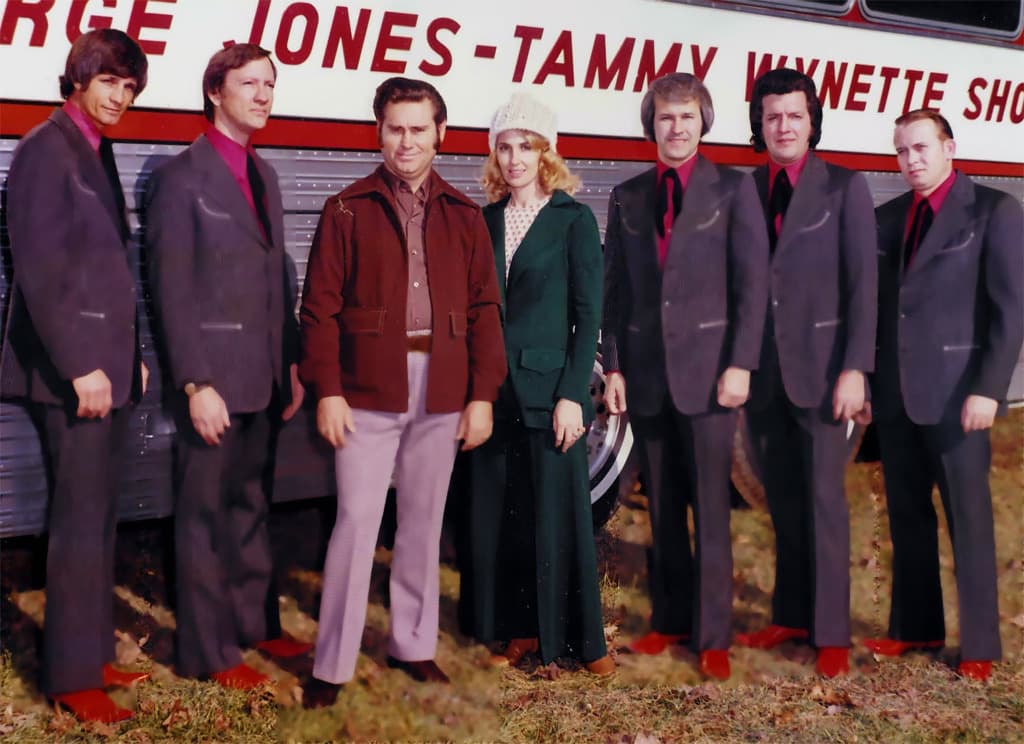
A Love Larger Than Life, Etched in Chrome and Song—Where Glory and Fragility Rode Side by Side
In 1969, as Tammy Wynette and George Jones stood at the peak of their individual brilliance, country music witnessed the birth of something that felt almost mythic. This was not merely a marriage—it was the union of two towering forces whose voices had already begun shaping the emotional vocabulary of an entire genre. By the time they said “I do,” “Stand By Your Man” had already crowned Wynette as country music’s reigning queen, reaching No. 1 on the Billboard Hot Country Singles chart in late 1968 and crossing into the pop charts with remarkable impact. Meanwhile, Jones, with a voice soaked in heartbreak and truth, had long secured his place as one of the most revered interpreters of country music, with hits like “The Race Is On” and “White Lightning” defining an era.
Together, they became more than artists. They became a symbol.
The press, ever eager for comparisons, called them the Elizabeth Taylor and Richard Burton of country music—a pairing as passionate as it was unpredictable. Audiences were captivated. Their duets—particularly “Take Me” (1971, No. 1 on Billboard Country) and later “We’re Gonna Hold On” (1973, No. 1)—felt less like recordings and more like confessions exchanged in melody. Every note they sang together carried the weight of something deeply personal, something real.
And then came the tour bus.
A staggering $100,000 investment at the time—an almost unimaginable sum for a touring act in the late 1960s—the bus was not just transportation. It was a declaration. Outfitted with 12 sleeping berths, it rolled across America like a moving palace, a chrome-plated testament to their dominance. But what truly defined it was not the luxury inside, but the words engraved boldly on its exterior:
“MR. & MRS. COUNTRY MUSIC.”
It was a title they embraced with pride.
And perhaps, with a touch of defiance.
Because in that phrase lived both triumph and illusion. To the world, they were untouchable—larger than life, wrapped in success, their love seemingly as expansive as the highways they traveled. Night after night, they performed to sold-out crowds who believed they were witnessing not just music, but destiny unfolding under stage lights.
Yet, as history has taught us, the brightest constellations often carry the deepest fractures.
What made their story endure was not simply the grandeur of their rise, but the quiet inevitability of its unraveling. Behind the polished image, there were tensions—creative, emotional, deeply human. The same intensity that fueled their music also complicated their lives. Their marriage, once heralded as royalty within the genre, began to show signs of strain long before the public fully understood.
Still, the bus kept moving.
Across state lines, through roaring applause and silent hotel nights, it carried with it the echoes of a love that was both extraordinary and fragile. A love that could fill arenas, yet struggle in the quiet spaces in between.
By the time their relationship came to an end in 1975, the legend had already been written. Not as a fairy tale, but as something far more enduring—a reminder that even the most celebrated unions are, at their core, deeply human.
And years later, when George Jones reflected in his 1996 autobiography “I Lived to Tell It All”, his words carried a lingering truth: that what they shared never truly faded. It simply changed form—living on in vinyl grooves, in radio waves, in the collective memory of those who once believed in “Mr. & Mrs. Country Music.”
Because in the end, it was never just about the songs.
It was about the space between them—the glances, the harmonies, the unspoken understanding. The kind of connection that no amount of success could guarantee, and no amount of time could fully erase.
And somewhere, in the imagination of those who remember, that grand tour bus is still rolling—its bold inscription gleaming under distant lights—carrying with it a story that remains, even now, impossibly alive.