
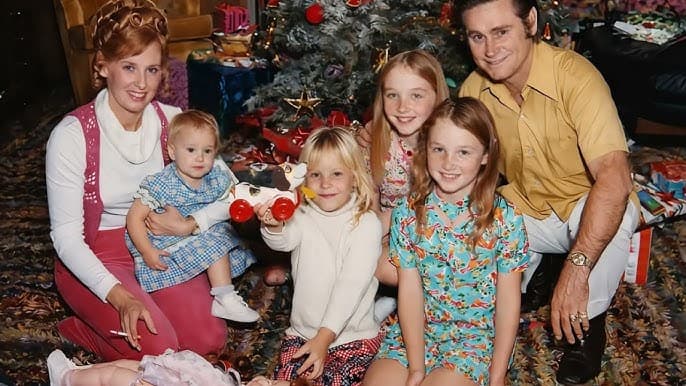
A Child Born Between Two Voices That Defined Love, Pain, and the Soul of Country Music
On October 5, 1970, in the quiet space between relentless touring schedules and chart-topping success, Tammy Wynette and George Jones welcomed a daughter into the world—Tamela Georgette Jones. It was a moment that felt almost sacred, a pause in the whirlwind of fame where life offered them something deeply personal, something untouched by applause or expectation. In a career defined by heartbreak songs and emotional truth, this was perhaps their most complete harmony—a living, breathing testament to a love that had already become legend.
At that time, both artists were not only at the height of their popularity but were also shaping the very identity of country music. Tammy Wynette, crowned by her monumental hit “Stand By Your Man” (No. 1 on the Billboard Hot Country Singles chart, 1968, and a crossover success on the Billboard Hot 100), had become the voice of devotion and quiet resilience. Her 1969 album “Stand By Your Man” further solidified her as a defining figure of the genre. George Jones, on the other hand, carried a different emotional gravity—his voice trembling with authenticity in songs like “The Race Is On” (Top 5 Country, 1964) and later “A Good Year for the Roses” (Top 10 UK Singles Chart, 1970), proving his rare ability to transcend borders with pure feeling.
By the time Georgette was born, both had already experienced the complexities of life. Each brought three children from previous marriages, creating a blended family shaped not just by love, but by experience, resilience, and second chances. Yet, the arrival of Georgette felt different. She was not merely another chapter—she was the bridge, the shared heartbeat between two towering souls.
In many ways, her name itself carried a quiet poetry. “Georgette”—a feminine echo of her father’s name—was both a tribute and a symbol, a delicate thread binding their identities together. And as time would reveal, she did not simply inherit their name, but also their gift.
Growing up surrounded by music that carried the weight of lived experience, Georgette Jones naturally stepped into the same world that had defined her parents. She became a singer and songwriter, her voice shaped by echoes of the past yet distinctly her own. There is something profoundly moving in that continuity—the idea that music, like memory, does not disappear but transforms, finding new expression through the next generation.
Years later, her life would reflect a quieter kind of stability. In 2022, she marked 11 years of marriage with her husband, Jamie Lennon—a milestone that, in its quiet endurance, seemed to answer many of the questions left unresolved in her parents’ story. Where theirs was intense and often turbulent, hers carried a different rhythm—steady, grounded, perhaps shaped by everything she had witnessed.
But what makes her story especially meaningful is her role in preserving the legacy of Tammy Wynette and George Jones. By participating in projects that seek to retell and honor their lives, she has become more than a daughter—she is a guardian of memory. Through her presence, the past is not simply remembered; it is carefully, respectfully re-lived.
And perhaps that is the most enduring meaning behind that October day in 1970.
Because while the songs of George Jones and Tammy Wynette continue to echo through time—filled with longing, devotion, and heartbreak—it is in Georgette that their story finds its most human continuation. Not in the charts, not in the awards, but in something far more lasting: the quiet persistence of love, carried forward in a voice that once belonged to both of them.
In the end, music may capture a moment—but life, as they unknowingly proved, writes the melody that lingers long after the final note fades.