
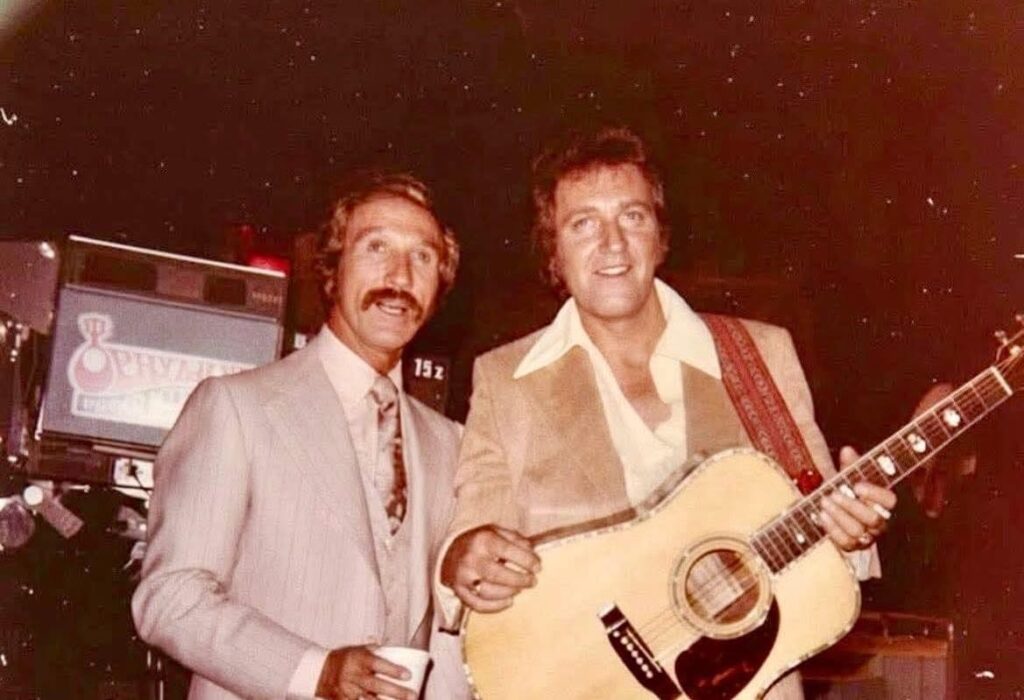
Two Voices, One Stage—Where Country Storytelling Met Rockabilly Fire Under the Studio Lights
There are moments in music history that do not arrive with grand announcements, yet linger quietly in memory like a familiar melody drifting through time. The appearance of Marty Robbins and Bob Luman on “Spotlight TV” is one such moment—an encounter not defined by charts alone, but by the meeting of two distinct musical spirits shaped by the same restless American landscape.
By the time of that television performance, both men had already carved their names into the fabric of country and rockabilly music, each in his own unmistakable way. Marty Robbins, with his smooth, narrative-driven style, had reached extraordinary heights with songs like “El Paso”, which soared to No. 1 on the Billboard Hot 100 in 1960—a rare achievement for a country song at the time—and also topped the Hot Country Singles chart. His 1959 album “Gunfighter Ballads and Trail Songs” remains one of the most influential country records ever released, a masterclass in storytelling that blurred the line between folk legend and personal confession.
Bob Luman, on the other hand, brought a different kind of energy. Rooted in rockabilly but deeply connected to country traditions, he found success with hits like “Let’s Think About Living”, which reached No. 7 on the Billboard Hot 100 in 1960 and climbed to No. 9 on the Hot Country chart. His voice carried a certain urgency—youthful, vibrant, and unafraid to push against the boundaries of genre. Where Robbins was reflective and cinematic, Luman was immediate and electric.
And so, when they stood together under the modest glow of a television studio on “Spotlight TV,” what unfolded was more than a performance—it was a quiet dialogue between two musical worlds.
There is something deeply evocative about televised performances from that era. No elaborate staging, no digital polish—just artists, microphones, and the unfiltered presence of music itself. In that simplicity, every nuance becomes visible: the way a singer leans into a phrase, the subtle exchange of glances, the unspoken respect between performers who understand the weight of what they carry.
For Marty Robbins, music was always about storytelling. Even in a live setting, one could sense that he was not merely singing, but reliving each line. His voice, steady and warm, had the rare ability to make time feel suspended—as if the past were unfolding again in real time. Bob Luman, standing beside him, brought contrast and balance. His delivery was more immediate, more grounded in the present moment, yet never overshadowing the shared space between them.
What makes this performance particularly meaningful is not tied to a specific chart position or a newly released single, but rather to the convergence of legacies. Both artists had already experienced the heights of commercial success. They had seen their songs climb charts, heard their voices echo through radios across the country. And yet, here they were—stripped of all that context—returning to the essence of music itself.
It is in such moments that one begins to understand the deeper meaning behind their work.
Because beyond the numbers, beyond the accolades, what remains is the connection. The ability of a song to bridge differences, to bring together contrasting styles into something cohesive and deeply human. Watching Marty Robbins and Bob Luman share that stage, one senses not competition, but camaraderie—a mutual acknowledgment of the roads they had traveled, both separately and within the same musical tradition.
And perhaps that is why performances like this endure.
Not because they were the biggest, or the loudest, but because they captured something fleeting and real. A moment where two voices—each shaped by different experiences—found common ground in melody and memory.
Long after the studio lights dimmed, and long after the charts moved on to new names, that quiet exchange continues to resonate. Not as a relic of the past, but as a reminder of what music has always been at its core: a conversation between souls, carried gently on the strength of a song.