
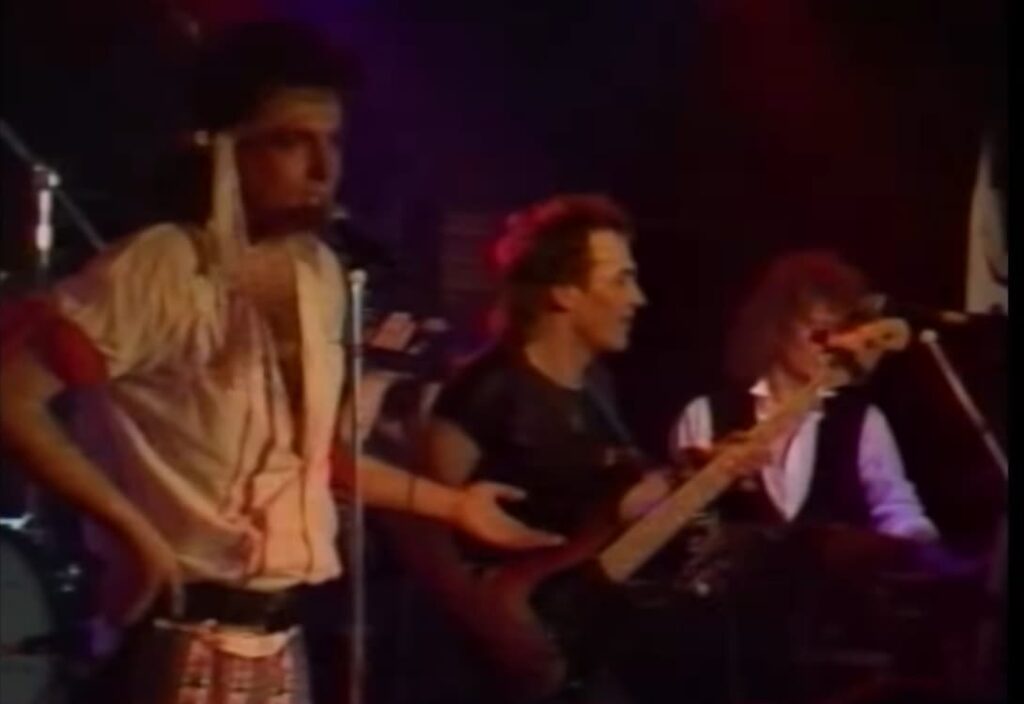
A Night When Glam Rock Refused to Fade—Sweet Reignite Their Fire at the Marquee, London 1986
By the time Sweet took the stage at the legendary Marquee Club, London, in 1986, the musical world around them had changed dramatically. Punk had come and shaken the foundations, new wave had redrawn the landscape, and synth-pop was dominating the charts. Yet, on that particular night, none of it seemed to matter. Because what unfolded was not merely a concert—it was a reaffirmation that the spirit of glam rock, once ignited in the early 1970s, still burned with surprising intensity.
To understand the weight of this performance, one must look back to the peak of Sweet’s success. Formed in the late 1960s, the band became one of the defining acts of the glam era, delivering a string of unforgettable hits. Songs like “Block Buster!” (which reached No. 1 on the UK Singles Chart in 1973) and “The Ballroom Blitz” (No. 2 in the UK, 1973; No. 5 on the Billboard Hot 100 in 1975) captured a raw, electrifying energy that felt both rebellious and theatrical. Their album “Desolation Boulevard” (1974) further cemented their international appeal, especially in the United States, where it showcased a harder-edged sound beneath the glitter.
But like many bands of that era, Sweet faced internal struggles and shifting musical trends. Lineup changes, creative differences, and the passing of time gradually moved them away from the spotlight. By the mid-1980s, they were no longer chart-toppers, but something arguably more compelling—survivors of an era that refused to be forgotten.
And that is precisely what makes “Live at the Marquee, London – 1986” so meaningful.
The Marquee Club itself was no ordinary venue. It was a sacred ground for British rock, having hosted legends from The Rolling Stones to David Bowie. To perform there in 1986 was not about reclaiming fame—it was about reconnecting with roots. The intimacy of the venue allowed Sweet to strip away the excess of their earlier image and focus on what truly mattered: the music.
From the very first notes, there is a sense of urgency in the performance. The guitars feel sharper, the rhythms tighter, and the vocals—though matured by time—carry a depth that studio recordings often cannot capture. When they revisit classics like “Fox on the Run” (No. 2 UK, 1975; No. 5 US Billboard Hot 100) or “Love Is Like Oxygen” (No. 8 UK, 1978; No. 8 US), the songs no longer sound like artifacts of a bygone era. Instead, they feel lived-in, reshaped by years of experience.
There is also a subtle shift in tone.
In their early days, Sweet thrived on flamboyance—platform boots, glitter, and a sense of playful extravagance. But in this 1986 performance, that flamboyance gives way to something more grounded. The energy is still there, but it is tempered by reflection. It is the sound of musicians who have seen the rise and fall of trends, who no longer need to prove anything, yet still choose to play with conviction.
One cannot ignore the emotional undercurrent running through the concert.
Because for those who had followed Sweet since the 1970s, this was more than a live show—it was a reunion with a part of life that once felt immediate and unending. The songs carried memories of radio days, of crowded dance floors, of moments when music was not just background noise but a defining presence.
And perhaps that is the lasting power of this performance.
It reminds us that music does not belong to a single moment in time. Even as the charts move on and new sounds emerge, certain songs—and certain bands—retain their ability to connect. Not because they remain unchanged, but because they evolve alongside those who listen.
In “Live at the Marquee, London – 1986,” Sweet do not attempt to recreate the past exactly as it was. Instead, they embrace it, reinterpret it, and carry it forward. The result is a performance that feels both nostalgic and immediate—rooted in history, yet alive in the present.
And when the final notes fade, what lingers is not just the echo of guitars or applause, but a quiet realization:
That some music never truly fades.
It simply waits… for the right moment to be heard again.