
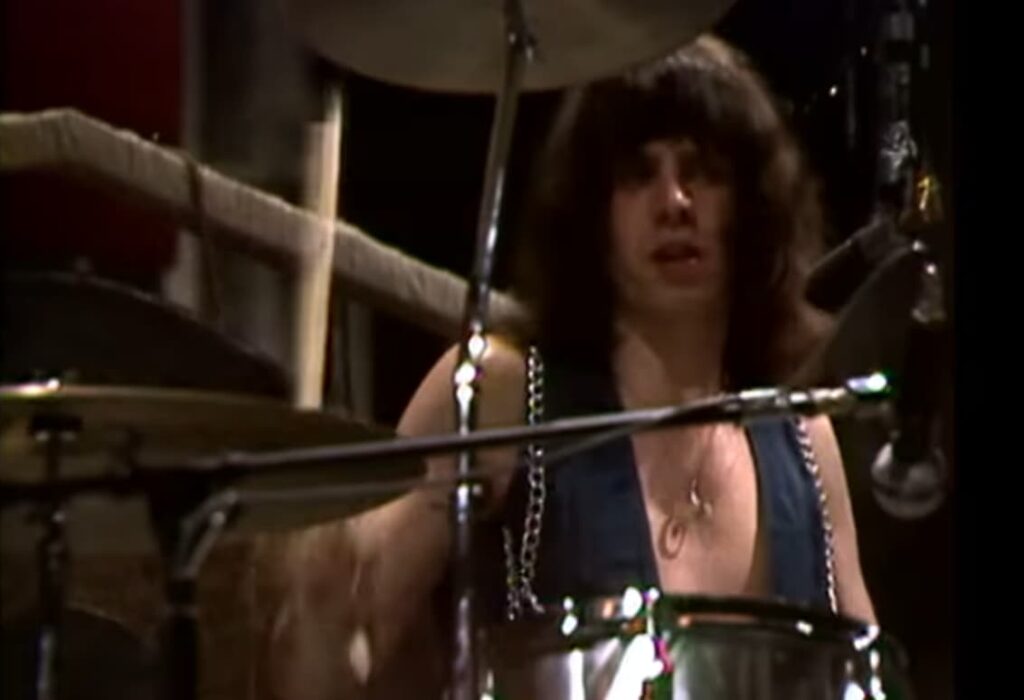
A powerful reflection of inner collapse and emotional release, where glam rock bravado gives way to something raw, urgent, and strikingly human
By the time Sweet performed “Breakdown” on Musikladen (11.11.1974), they were no longer simply a chart-driven glam pop act—they were a band in transition, searching for depth beneath the glitter. Unlike their earlier hits such as “Block Buster!” (UK No. 1) or “The Ballroom Blitz” (UK No. 2, US Top 10), “Breakdown” was never released as a major standalone single, and therefore did not achieve a notable chart position of its own. Instead, it found its place within the album “Sweet Fanny Adams” (1974)—a record that marked a decisive shift toward a heavier, more self-defined sound, moving away from the polished formulas of the Chinn-Chapman songwriting era.
This context is essential. Because to understand “Breakdown”, one must first understand where Sweet stood in 1974. Beneath the success and flamboyance, there was a growing desire for artistic independence. The band—particularly members like Brian Connolly, Andy Scott, Steve Priest, and Mick Tucker—began asserting their own musical identity, writing and shaping material that reflected something more personal, more grounded. “Breakdown” is a direct product of that evolution.
From the very first moments of the song, there is a noticeable departure from the buoyant energy of their earlier work. The rhythm feels heavier, more deliberate. The guitars carry a certain weight—not just sonically, but emotionally. This is not a song built for immediate hooks or sing-along choruses. Instead, it unfolds gradually, like a conversation that becomes more revealing with each passing line.
The Musikladen performance captures this transformation with remarkable clarity. German television audiences, often known for their attentiveness to musical authenticity, witnessed a band shedding its purely commercial image in real time. There is a seriousness in the way Sweet approach the stage here—a sense that they are not merely performing, but expressing something that cannot be packaged or simplified.
Lyrically, “Breakdown” touches on themes that were rarely explored so openly in glam rock at the time. It speaks of emotional strain, of reaching a point where the façade can no longer be maintained. While the exact narrative remains somewhat abstract, the feeling is unmistakable: a quiet unraveling, an acknowledgment that strength has its limits. In this way, the song stands in stark contrast to the confident swagger that defined much of early 1970s pop-rock.
There is also an underlying tension in the song—between control and release. The verses feel contained, almost restrained, while the instrumental passages hint at something trying to break free. It is in these moments that Sweet reveal their musicianship most clearly. The interplay between instruments is no longer about creating a polished surface; it is about building atmosphere, about allowing emotion to guide structure.
The meaning of “Breakdown” can be interpreted in many ways, but at its heart, it is a reflection on vulnerability. It acknowledges that even those who appear strong, vibrant, and untouchable can experience moments of collapse. And rather than hiding that truth, the song brings it forward—quietly, but unmistakably.
Looking back, the significance of “Breakdown” lies not in commercial success, but in artistic intent. It represents a turning point—a moment when Sweet began to redefine themselves, stepping beyond the expectations placed upon them. The Musikladen 1974 performance, preserved in time, allows us to witness that shift with a rare sense of immediacy.
There is something deeply compelling about revisiting such moments. Not because they are perfect, but because they are honest. In “Breakdown,” Sweet offer a glimpse behind the curtain, revealing a side of themselves that is often overshadowed by their more famous hits. It is a reminder that music, at its most powerful, does not always seek to impress—it seeks to express.
And in that expression, stripped of glamour and pretense, lies a quiet kind of brilliance. A song like “Breakdown” may not echo loudly across charts and headlines, but it lingers in a different way—settling into memory, waiting to be rediscovered, carrying with it the unmistakable sound of a band finding its true voice.