
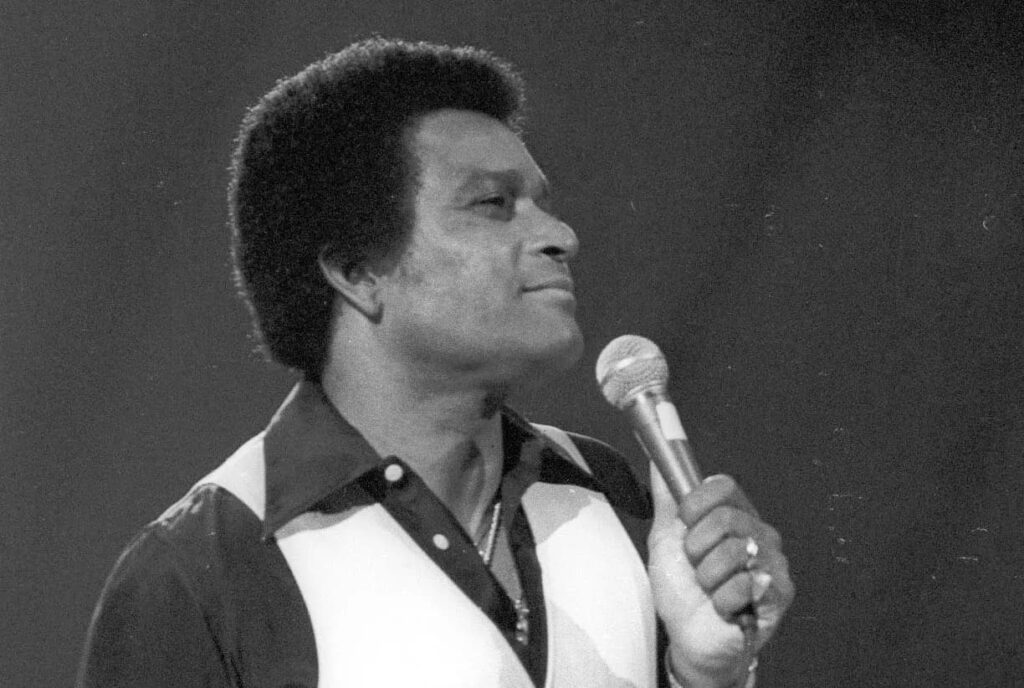
A Voice That Refused Boundaries, Singing Beyond Labels Into Pure Country Truth
One of the most enduring signatures in American country music belongs to Charley Pride, a man who never asked to be defined by anything other than the songs he sang. When he stood beneath the lights at the CMA Awards in November 2020, delivering a final, warm-hearted rendition of Kiss an Angel Good Mornin’, it felt less like a farewell and more like a quiet reaffirmation of a life’s work—one built not on defiance alone, but on grace, persistence, and melody. The song itself, originally released in 1971, had already secured its place in history, reaching No. 1 on the Billboard Hot Country Singles chart and crossing over to No. 21 on the Billboard Hot 100, a rare achievement that spoke to Pride’s broad and deeply human appeal.
There was always something disarmingly sincere about Charley Pride’s voice. It did not strain to impress, nor did it hide behind ornamentation. It told stories plainly, as if sitting across from you on a quiet evening. That sincerity was perhaps what allowed him to transcend barriers that, at the time, seemed immovable. Born in Sledge, Mississippi, the son of sharecroppers, Pride’s early dreams were rooted not in music but in baseball. For a time, he chased that dream with determination, even playing in the Negro Leagues. Yet destiny, as it often does, shifted course quietly. A guitar, a song, and a voice that carried both ache and hope would lead him somewhere far more enduring.
By the late 1960s, Charley Pride had begun carving out a place in Nashville—a city that had never seen anyone quite like him rise through its ranks. His breakthrough came not through spectacle, but through consistency. Song after song climbed the charts, eventually culminating in 30 No. 1 country hits. Tracks like “Is Anybody Goin’ to San Antone” and “Mountain of Love” didn’t just succeed commercially; they became part of the emotional fabric of listeners who found themselves reflected in his stories of longing, love, and simple joys.
Yet behind the statistics lies a quieter narrative—the one hinted at in the words he shared with his son, Dion Pride. For all the accolades—his induction into the Country Music Hall of Fame in 2000, his millions of records sold—what mattered most to Charley Pride was never the spotlight itself. It was the endurance of the song. He wanted the music to live on in kitchens, in cars, in the quiet corners of everyday life. He wanted to be remembered not as a symbol, but as a singer whose voice accompanied people through their own stories.
The line he once expressed—his resistance to being labeled a “Black country singer”—was not a rejection of identity, but rather a plea for universality. He understood, perhaps better than anyone, that music loses its power when confined to categories. And so he sang as simply a country singer, trusting that the honesty in his voice would speak louder than any label ever could.
When he passed away on December 12, 2020, at the age of 86, the loss felt deeply personal to many. Not because he demanded attention, but because he had quietly earned a place in people’s lives over decades. His final performance now carries a weight that no one in that room could have anticipated—a closing chapter written in the very language he spent a lifetime perfecting.
In the end, Charley Pride’s legacy is not just measured in chart positions or awards, though those are undeniably significant. It lives in something more elusive: the way a song lingers long after it ends, the way a voice can feel both distant and intimately close at the same time. His was a voice that refused to be boxed in, that insisted on being heard simply as it was—steady, warm, and unmistakably human.
And perhaps that is what he meant all along. Not to stand apart, but to belong everywhere a good song still matters.