
A Quiet Vow of Endurance — When Love Chooses to Stay, No Matter How Heavy the Years Become
There are duets in country music, and then there are moments where two voices seem to carry the full weight of a shared life. “We’re Gonna Hold On”, performed by George Jones and Tammy Wynette, is one of those rare recordings where the line between song and reality almost disappears. Released in 1973 as the title track of their duet album “We’re Gonna Hold On”, the song climbed to No. 1 on the Billboard Hot Country Singles chart, becoming one of the defining duets of that era. But its true significance lies far beyond the numbers—it lives in the fragile, determined promise embedded within every line.
By the time this song reached audiences, George Jones and Tammy Wynette were already more than musical partners. They were husband and wife, bound together by a relationship as passionate as it was turbulent. Their lives offstage were marked by intense love, frequent struggles, and a constant push and pull that seemed almost too raw to contain. And yet, when they stood side by side—whether in the recording studio or on the stage of Hee Haw in 1973—what emerged was something undeniably authentic.
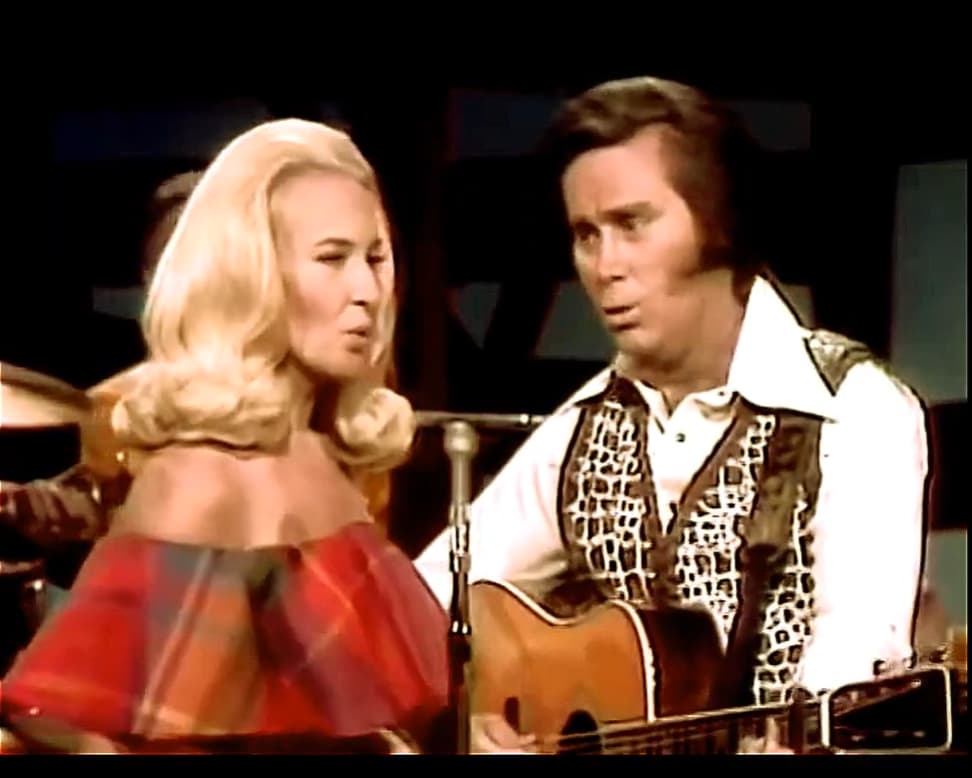
The Hee Haw performance, presented in stereo and preserved through time, offers a particularly intimate window into that dynamic. There is no theatrical excess, no elaborate staging—just two figures, standing close, singing words that feel less like lyrics and more like a shared confession. When Tammy’s voice rises with quiet strength and George answers with that unmistakable, weathered tone, the listener senses something deeper than harmony. It is as if they are reassuring not only each other, but themselves.
Written by George Jones and Earl “Peanutt” Montgomery, “We’re Gonna Hold On” speaks directly to the kind of love that has already been tested. This is not the bright optimism of new romance. Instead, it acknowledges hardship—the sleepless nights, the doubts, the emotional distance that can creep into even the strongest bonds. And yet, the chorus stands firm, almost stubborn in its resolve: we’re gonna hold on. Not because it is easy, but because it is necessary.
In many ways, the song mirrors the broader landscape of country music in the early 1970s—a period when artists were beginning to embrace more complex emotional narratives. Gone were the days of simple heartbreak or uncomplicated joy. In their place came stories that reflected real life in all its contradictions. And few artists embodied that shift more fully than George Jones and Tammy Wynette. Their music did not shy away from pain; it leaned into it, finding beauty in the struggle.
What makes this particular performance so enduring is the sense of immediacy. Knowing what history would later reveal—that their marriage would not ultimately survive—adds a layer of poignancy that is impossible to ignore. But even without that knowledge, there is something deeply moving about the way they deliver the song. It feels like a moment suspended in time, where hope still outweighs doubt, where the promise to “hold on” is spoken with genuine belief.
Tammy Wynette, often called the “First Lady of Country Music,” brings a quiet resilience to the performance. Her voice, clear yet emotionally charged, carries the strength of someone who understands both vulnerability and endurance. George Jones, on the other hand, offers a contrast—his phrasing slightly rougher, his tone imbued with a sense of lived experience that few could replicate. Together, they create a balance that feels almost symbolic: strength and fragility, certainty and hesitation, woven into a single narrative.
Listening now, decades later, “We’re Gonna Hold On” feels less like a declaration and more like a question left lingering in the air. Can love truly endure everything? Is holding on always enough? These are not questions the song answers outright. Instead, it invites the listener to sit with them, to reflect on their own understanding of commitment and resilience.
And perhaps that is why the song continues to resonate. It does not offer easy conclusions or neatly tied endings. It simply presents a moment—two voices, standing together, choosing to believe in something that may or may not last. In that choice, there is a quiet kind of courage.
In the end, “We’re Gonna Hold On” is more than a No. 1 hit from 1973. It is a snapshot of love in its most honest form—imperfect, uncertain, but still willing to try. And sometimes, that is the most powerful story a song can tell.