
A quiet conversation with time—where a timeless voice reflects on a life of melody, discipline, and enduring grace
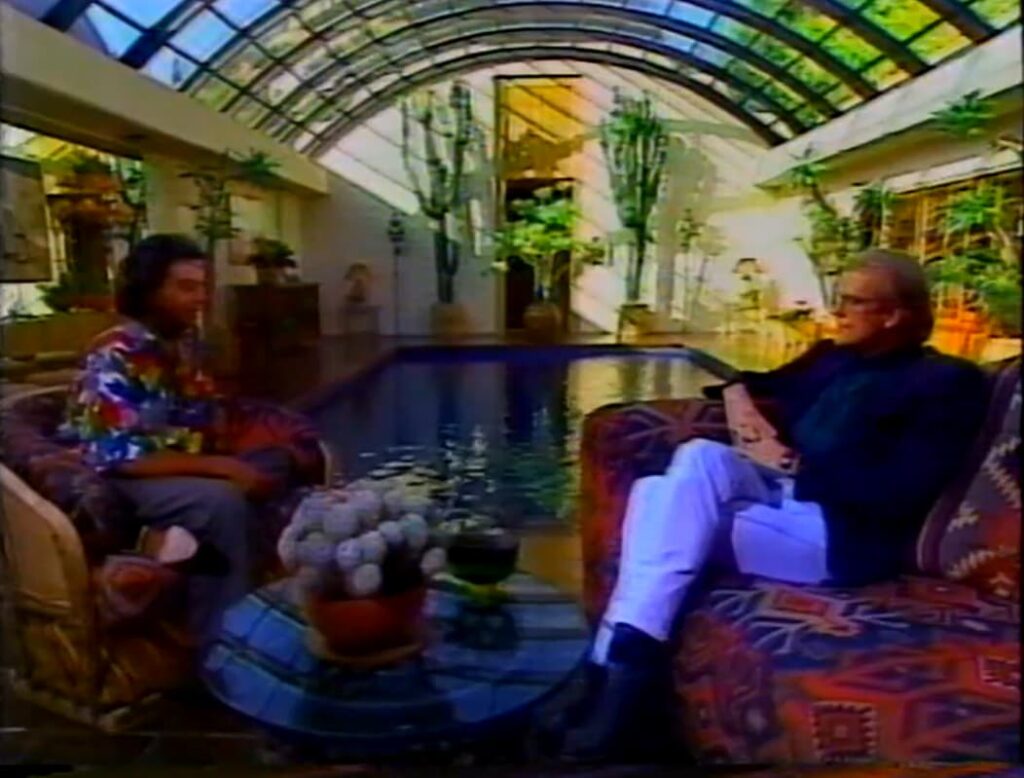
In 1991, long after the golden glow of his earliest chart triumphs had settled into legend, Johnny Mathis sat for an intimate interview in the comfort of his own home—a setting far removed from the grand concert halls and recording studios that had defined his career. This moment, unassuming on the surface, offers something far more revealing than any chart position or commercial milestone ever could: a glimpse into the inner life of an artist whose voice had become synonymous with romance, refinement, and emotional sincerity.
By 1991, Johnny Mathis was already an institution. His breakthrough single, “Chances Are” (1957), had reached No. 1 on the Billboard Most Played by Jockeys chart, while also securing a place in the Top 10 of the Billboard Hot 100. That early success was soon followed by a string of enduring classics—“Misty” (1959), “It’s Not for Me to Say” (1957)—songs that did not merely chart, but lingered, becoming part of the emotional vocabulary of an entire generation. His album Johnny’s Greatest Hits (1958) would go on to spend an astonishing 490 consecutive weeks on the Billboard 200, a record that stood for years as a testament to his lasting appeal.
And yet, in this 1991 interview, there is little sense of triumph in the conventional sense. Instead, what emerges is something quieter—an artist reflecting not on fame, but on continuity. The home setting itself feels symbolic. It is a space of familiarity, of memory, of reflection. Here, the voice that once filled vast auditoriums speaks softly, conversationally, as though addressing not an audience, but a trusted companion.
What becomes immediately apparent is the discipline behind the elegance. Johnny Mathis had always been known for his smooth, almost effortless vocal delivery, but in conversation, he reveals the years of dedication that made such effortlessness possible. There is talk of practice, of care, of maintaining not just the voice, but the integrity of the music itself. It is a reminder that behind every seemingly natural performance lies a lifetime of quiet commitment. The interview also touches, indirectly, on the changing landscape of music. By the early 1990s, the industry had shifted dramatically from the era in which Mathis first rose to prominence. Styles had evolved, audiences had changed, and yet his voice remained—unchanged in its essence, still capable of conveying the same depth of feeling that had defined his earliest recordings. This continuity becomes a central theme, echoing through both his words and his legacy.
There is a certain poignancy in hearing an artist reflect from this vantage point. The urgency of youth has long since given way to a more measured understanding. Success is no longer defined by chart positions, though those achievements remain remarkable. Instead, it is found in endurance—in the ability to continue, to remain relevant not through adaptation alone, but through authenticity. One cannot help but think of songs like “Misty” when listening to him speak. The same warmth, the same gentle phrasing that defined his singing seems to carry into his speech. It is as though the boundary between the man and the music has dissolved over time, leaving only a singular presence—calm, assured, and deeply expressive.
What makes this 1991 interview particularly resonant is its sense of perspective. There is no attempt to recapture the past, no longing for what once was. Instead, there is an acceptance—a recognition that each phase of life brings its own meaning. The music remains, not as a relic, but as a living thread that continues to connect past and present. In the quiet cadence of Johnny Mathis’s reflections, one hears more than just memories. One hears gratitude—for the songs, for the audiences, for the journey itself. It is a reminder that the true measure of an artist is not found solely in their greatest hits, but in the way they carry those moments forward, shaping them into something enduring. And so, this simple interview, set within the walls of a home, becomes something far greater. It becomes a meditation on time, on artistry, and on the quiet, persistent beauty of a voice that has never needed to shout to be heard.