
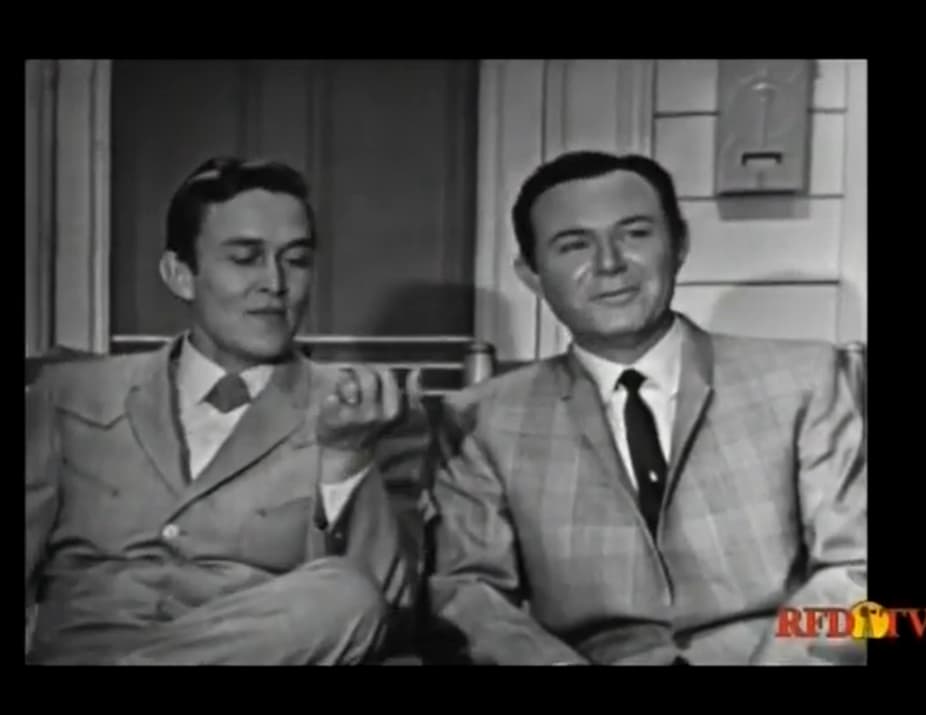
A quiet moment before farewell, Jim Reeves on the Jimmy Dean Show stands as a tender reminder of grace, voice, and a life that would soon be gone too soon
There are performances that linger not because of spectacle, but because of what we come to understand afterward. The appearance of Jim Reeves on The Jimmy Dean Show in February 1964 is one such moment—unassuming at first glance, yet now wrapped in a profound sense of finality. Just five months later, in July 1964, Reeves would tragically lose his life in a plane crash near Nashville, alongside his trusted pianist Dean Manuel. Knowing this, the performance takes on a weight that transcends music; it becomes a farewell we did not know we were witnessing.
By early 1964, Jim Reeves was already a towering figure in country music. Known as “Gentleman Jim,” he had redefined the genre with his smooth baritone and polished style, helping to usher in what would later be called the Nashville Sound. His recordings such as “He’ll Have to Go” (which reached No. 1 on the Billboard Country Chart and crossed over to No. 2 on the Billboard Hot 100) had made him an international star. Unlike many of his contemporaries, Reeves brought a quiet sophistication to country music—his voice never strained, never hurried, always measured, as if each note had been carefully considered before it was allowed to exist.
The Jimmy Dean Show, hosted by fellow country artist Jimmy Dean, was a popular television program that blended music with warm, conversational charm. It was the kind of stage where artists revealed not just their talent, but their character. And in that February broadcast, Jim Reeves embodied everything audiences had come to admire: composure, humility, and an almost effortless vocal control.
Watching that performance today, there is something striking in its simplicity. There are no grand gestures, no theatrical flourishes. Reeves stands calmly, delivering his song with a sincerity that feels almost intimate. His voice carries that familiar velvet tone—soft, resonant, and deeply reassuring. It is the kind of voice that does not demand attention, but gently holds it. What makes this moment especially poignant is the knowledge of what lies ahead. In July 1964, while piloting his private aircraft through a thunderstorm, Reeves lost control of the plane. The crash not only ended his life at the age of 40 but also took Dean Manuel, whose piano accompaniment had been an integral part of Reeves’ sound. The loss sent shockwaves through the music world, cutting short a career that still had so much to offer.
And yet, in the months following his passing, Reeves’ music seemed to grow even stronger in its presence. Posthumous releases such as “Distant Drums” would go on to top the UK Singles Chart in 1966, proving that his voice had not been silenced, only transformed into something enduring. It is a rare thing, for an artist to leave behind not just recordings, but a feeling—a sense of calm, of steadiness, that continues to resonate long after the final note. The February 1964 appearance now feels like a preserved fragment of time. There is no hint of tragedy in Reeves’ demeanor, no shadow in his expression. If anything, there is a quiet contentment, a man fully at ease with his craft. Perhaps that is what makes it so moving. It reminds us that life does not announce its turning points. The most ordinary moments can, in hindsight, become the most meaningful.
In listening to Jim Reeves, one is often struck by the absence of urgency. His music does not rush; it lingers, allowing space for reflection. That quality is present in this performance as well. It invites the listener not just to hear, but to feel—to remember, to pause, to consider the passage of time. There is a certain stillness in revisiting that stage, that voice, that moment in February. A stillness that feels almost sacred. And in that stillness, Jim Reeves remains exactly as he was—composed, dignified, and unforgettable.
 Oldies Songs