
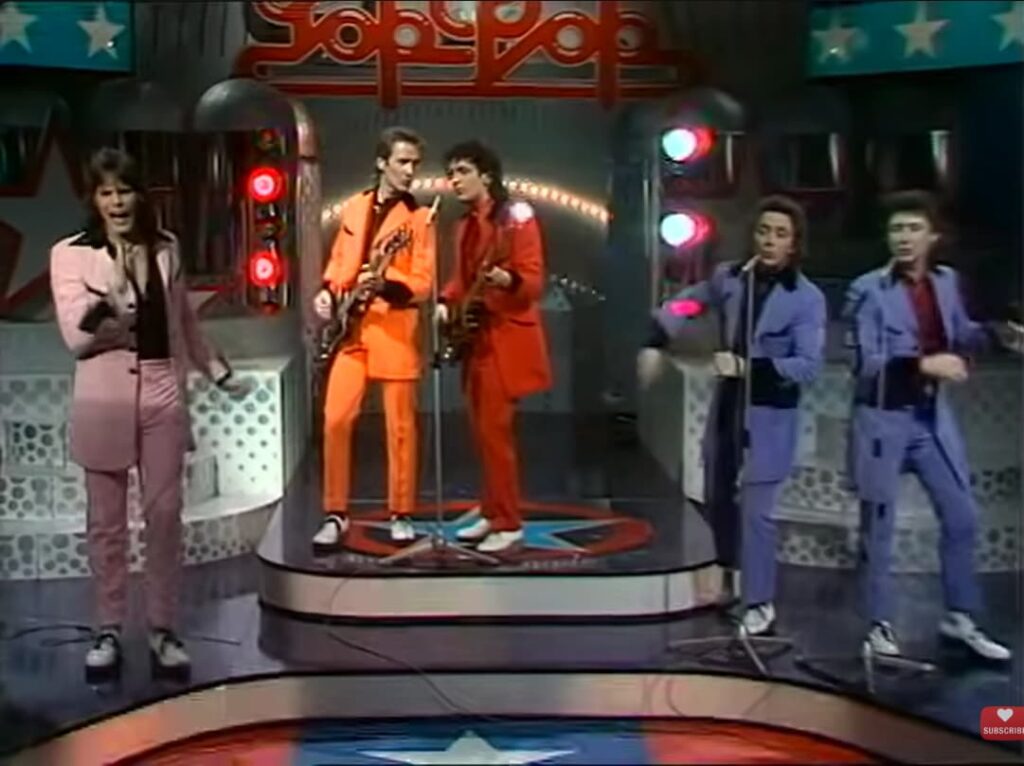
A tender echo from the golden age of romance, “When” by Showaddywaddy revives the innocence of first love and the timeless ache of longing for a promise once made
In the summer of 1977, Showaddywaddy brought an old melody back into the hearts of a new generation with their revival of “When.” Released as a single, the song soared to No. 2 on the UK Singles Chart, becoming one of the group’s most beloved hits. Though originally recorded by The Kalin Twins in 1958, whose version also reached No. 1 in the UK, it was Showaddywaddy who reintroduced its gentle yearning to audiences nearly two decades later—polished, nostalgic, yet still deeply sincere.
By the time “When” was released, Showaddywaddy had already established themselves as torchbearers of 1950s rock and roll revival. Formed in Leicester in the early 1970s, the band built their identity on harmony-driven vocals, retro style, and a genuine affection for the music of an earlier era. Their success was not merely built on imitation, but on interpretation—breathing new life into songs that might otherwise have faded quietly into memory.
Their rendition of “When” stays remarkably faithful to the original structure, yet there is a softness in their approach that feels almost reflective, as if the years between versions had added a layer of quiet understanding. The arrangement is simple—gentle guitar, steady rhythm, and harmonies that feel warm rather than ornate. It is a sound that does not seek to impress, but rather to comfort.
Lyrically, “When” is disarmingly straightforward. It tells the story of a love paused in time, held together by promises of reunion—“When you meet me, when you hold me…” These are not grand declarations, but small, intimate hopes. And perhaps that is why the song resonates so deeply. It speaks not of dramatic passion, but of patience, of waiting, of believing that something once shared might return again.
Listening to Showaddywaddy’s “When”, one cannot help but feel a quiet pull toward the past. There is a certain stillness in the melody, a sense of suspended time. It evokes images not through vivid storytelling, but through feeling—an old photograph, a letter carefully folded away, a voice remembered more clearly than expected. The song does not demand attention; it gently invites reflection.
Their performance on TopPop, the iconic Dutch television music show, further cemented the song’s charm. Standing under soft studio lights, dressed in their unmistakable retro attire, Showaddywaddy delivered the song with a sincerity that felt untouched by cynicism. There was no irony in their presentation, no distance between performer and material. What the audience saw was exactly what they heard—music offered with honesty.
What makes this version particularly enduring is its emotional restraint. In an age when music often leans toward intensity, “When” chooses a quieter path. It allows silence to exist between notes, gives space for the listener to bring their own memories into the song. It becomes less about the performers, and more about the listener’s own story.
And perhaps that is the true legacy of Showaddywaddy’s “When.” It is not simply a cover, nor merely a nostalgic exercise. It is a bridge between eras—a reminder that certain emotions do not belong to any one decade. Love, longing, the hope of return—these remain constant, even as everything else changes.
As the final notes fade, there is no dramatic conclusion, no resolution offered. Only a lingering question, softly asked: when? And in that question lies the quiet beauty of the song—a beauty that continues to echo, long after the music has ended.