
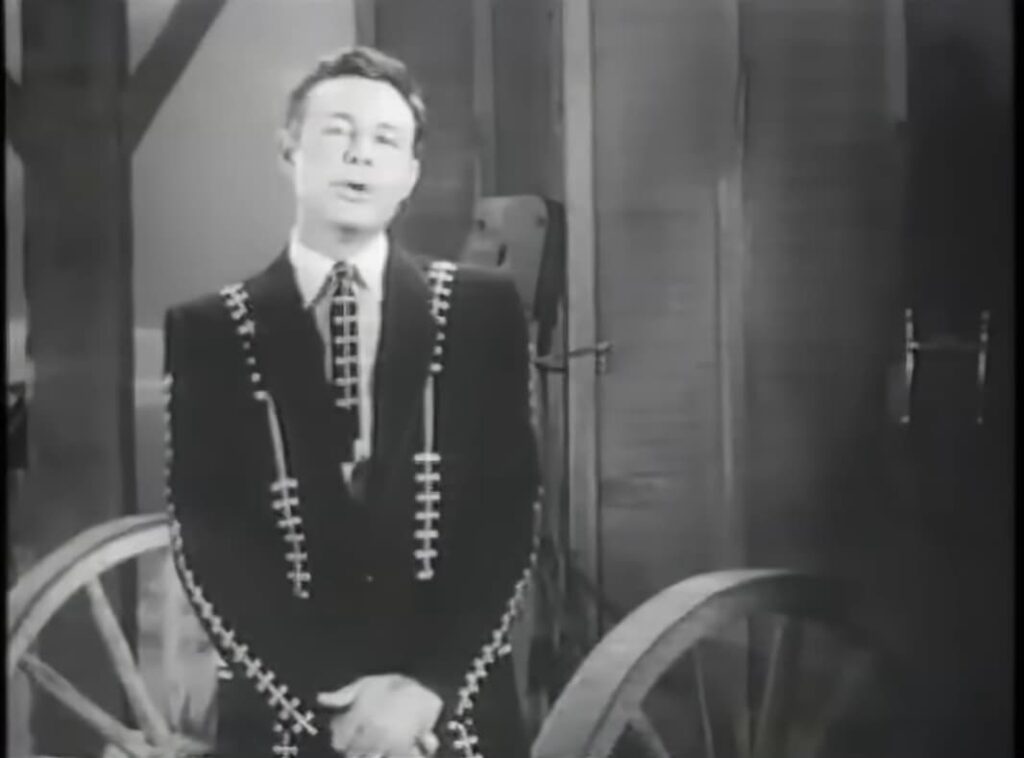
A tender whisper of devotion: “Have I Told You Lately That I Love You?” in the voice of Jim Reeves becomes a timeless reassurance that love, once spoken sincerely, never fades from the heart
Few voices in the history of country and popular music carry the same velvet warmth as Jim Reeves. His interpretation of “Have I Told You Lately That I Love You?” stands as a gentle testament to an era when emotion was conveyed not through grandeur, but through quiet sincerity. Though the song itself predates Reeves’ recording, his version remains among the most beloved—an enduring reminder of how a simple phrase, when delivered with honesty, can transcend time.
The song was originally written by Scotty Wiseman in 1944 and first recorded by his group, the Sons of the Pioneers. Over the years, it became a standard, covered by numerous artists across genres. However, it was Jim Reeves who gave the song a uniquely intimate quality. His recording, featured on albums such as “Girls I Have Known” (1961), did not storm the charts as a major standalone single, yet it found a lasting home in the hearts of listeners, becoming one of the defining pieces of his repertoire.
By the early 1960s, Jim Reeves had already established himself as a leading figure in the Nashville Sound—a smoother, more polished style of country music that bridged the gap between traditional country and pop audiences. His hits like “He’ll Have to Go” (1959), which reached No. 1 on the Billboard Country Chart and crossed over to No. 2 on the Billboard Hot 100, had demonstrated his remarkable ability to convey longing with understated elegance. In “Have I Told You Lately That I Love You?”, that same quality is distilled into its purest form.
What makes Reeves’ version so compelling is its restraint. There is no urgency in his delivery, no dramatic swell designed to overwhelm. Instead, his voice moves with a calm assurance, as though the words themselves are enough. And perhaps they are. The song’s central message—an affirmation of love, spoken plainly—resonates precisely because it avoids complexity. It reminds us that the most important sentiments are often the simplest ones.
Listening closely, one notices how Reeves shapes each line with careful precision. His phrasing is deliberate, allowing the melody to breathe naturally. There is a softness at the edges of his tone, a warmth that feels almost conversational. It is as if he is not performing for an audience, but speaking directly to someone who matters deeply. This sense of intimacy is what elevates the song beyond its straightforward lyrics.
There is also a quiet sense of nostalgia embedded within the performance. Even at the time of its recording, the song carried echoes of an earlier era. In Reeves’ hands, those echoes are preserved, gently polished, and offered anew. Today, listening to “Have I Told You Lately That I Love You?” feels like opening a letter written decades ago—its words unchanged, yet its meaning deepened by time.
The enduring appeal of this recording lies not in chart positions or accolades, but in its emotional honesty. While it may not have been a chart-topping single in Reeves’ catalog, its presence within his body of work is significant. It reflects the very qualities that made him a beloved figure: clarity, warmth, and an unwavering commitment to sincerity.
In a world that often grows louder and more hurried, songs like this serve as gentle reminders to pause. To speak what matters. To say what should never be left unsaid. Reeves does not ask for attention; he invites reflection. And in doing so, he creates a space where memory and feeling can quietly meet.
There is, too, an added poignancy when one considers the brevity of Jim Reeves’ life. His untimely passing in 1964, at the age of 40, lends an almost fragile beauty to his recordings. They feel preserved in time, untouched by the years that followed. His voice, forever steady and reassuring, continues to carry messages that remain as relevant now as they were then.
In the end, “Have I Told You Lately That I Love You?” is more than a song. It is a sentiment, a gesture, a reminder. Through Jim Reeves, it becomes something enduring—a quiet promise that love, once expressed with sincerity, never truly disappears. It lingers, softly, in the spaces between words, waiting to be heard again.
 Oldies Songs