
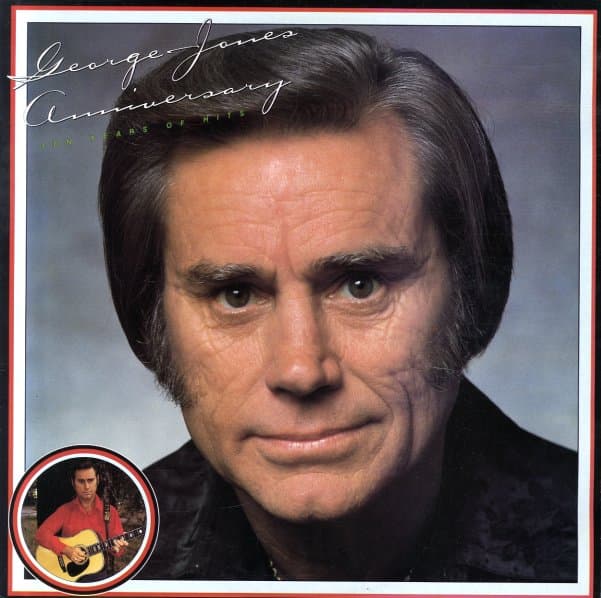
A sorrowful confession wrapped in steel guitar, “If Drinking Don’t Kill Me (Her Memory Will)” lays bare the quiet war between regret and remembrance.
Released in 1978, “If Drinking Don’t Kill Me (Her Memory Will)” by George Jones stands as one of the most haunting entries in his storied catalog. The song climbed to No. 8 on the Billboard Hot Country Singles chart, reaffirming Jones’s enduring connection with audiences who recognized authenticity when they heard it. It was included on the album “Bartender’s Blues” (1978), a record produced by Billy Sherrill, whose polished yet emotionally restrained style allowed Jones’s voice to carry the full weight of the narrative.
By the late 1970s, George Jones was no stranger to turmoil. His personal struggles—particularly with alcohol—had become almost inseparable from his public image. And yet, it is precisely this fragile boundary between life and art that gives “If Drinking Don’t Kill Me” its devastating power. The song does not feel written; it feels lived. Every note seems to echo with experience, every pause weighted with something unsaid but deeply understood.
The song itself tells a simple story, almost disarmingly so: a man turns to the bottle in an attempt to forget a lost love, only to realize that memory is far more persistent than any vice. The title alone is enough to stop one in their tracks—grim, direct, and painfully honest. There is no poetic disguise here, no clever metaphor to soften the blow. Instead, it offers a stark truth: some wounds cannot be drowned, only endured.
When George Jones delivers the opening lines, there is a weariness in his voice that cannot be imitated. It is not theatrical sadness, but something quieter—resignation, perhaps, or the kind of understanding that comes too late. His phrasing lingers just behind the beat, as though reluctant to move forward, as though each word carries a burden he must carefully set down. The steel guitar weaves gently around him, not overpowering, but echoing the ache in every syllable.
Behind the scenes, the collaboration with Billy Sherrill was crucial. Sherrill, known for his “countrypolitan” sound, could have easily dressed the song in lush orchestration. Instead, he exercised restraint, allowing space—space for reflection, space for silence, space for Jones’s voice to tremble and recover. That restraint becomes part of the song’s emotional architecture, giving it a timeless quality that resists the aging of production trends.
There is, too, an unspoken parallel between the song’s narrative and Jones’s own life. At the time, his battles with alcohol were well documented, often overshadowing even his immense musical achievements. Listening to “If Drinking Don’t Kill Me”, one cannot help but sense that the line between performer and protagonist has blurred. It is as if Jones is not merely telling a story, but confronting a mirror—one that reflects both his past and an uncertain future.
And yet, for all its darkness, the song does not descend into despair entirely. There is a strange kind of clarity within it, a recognition that pain, however persistent, is part of the human condition. The act of singing becomes, in itself, a form of survival—a way to give shape to something otherwise overwhelming. In that sense, George Jones offers not just a lament, but a quiet testament to endurance.
Over time, “If Drinking Don’t Kill Me (Her Memory Will)” has come to be regarded as one of the defining performances of Jones’s later career. It may not have reached the very top of the charts, but its impact runs deeper than numbers can measure. It lingers in the listener’s mind, not as a fleeting melody, but as a feeling—heavy, persistent, and strangely comforting in its honesty.
Listening now, decades removed from its release, the song feels like a conversation carried across time. It speaks of love lost, of choices made, of the long shadows cast by memory. And perhaps that is why it endures: because it does not pretend to offer answers. Instead, it sits quietly with the listener, acknowledging that some questions remain unresolved.
In the end, “If Drinking Don’t Kill Me” is more than a country song. It is a confession, a reflection, and a reminder that even in the deepest solitude, there is a voice—cracked, weary, but still singing—that understands.