
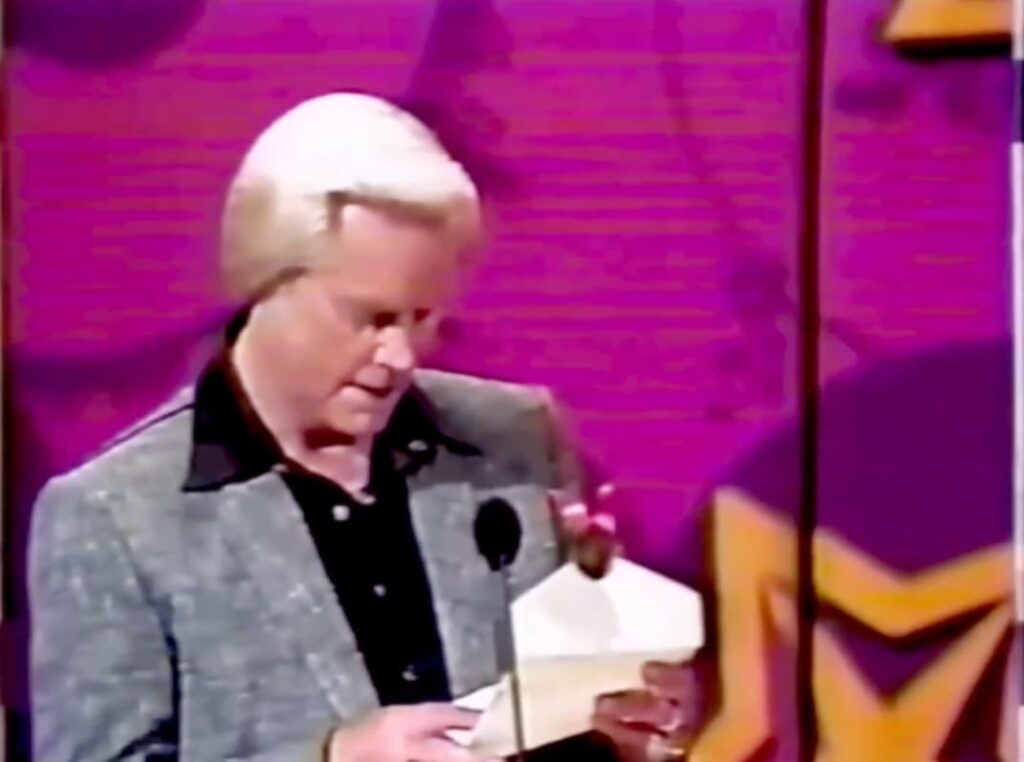
A passing of light from one voice to another, where legacy is not spoken loudly but quietly handed forward
In 1992, at the Music City News Awards, one of country music’s most enduring figures, George Jones, stepped onto the stage not to perform, but to present the “Star of Tomorrow” Award, a moment that, while brief in duration, carried the weight of something far greater than ceremony. By that time, Jones was already long established as one of the defining voices of country music, his catalog marked by songs like “He Stopped Loving Her Today”, which had reached No. 1 on the Billboard Hot Country Singles chart in 1980, widely regarded as one of the greatest country recordings ever made. His presence alone gave the award a sense of gravity, as though the future of the genre was being acknowledged by one of its most weathered storytellers.
The Music City News Awards, unlike many industry honors, were shaped by fan votes, making the “Star of Tomorrow” Award not just a recognition of industry promise, but a reflection of public belief. It was an award that often pointed toward artists on the brink of something larger, those whose voices had begun to resonate beyond the margins. When George Jones stood there to present it, the moment became layered, not simply a celebration of what was to come, but a quiet acknowledgment of everything that had come before.
There is something deeply symbolic in that image. Jones, whose career had been marked by both extraordinary success and well documented personal struggles, had endured the shifting tides of the music industry. From the honky tonk roots of the 1950s to the more polished sounds that followed, he remained a constant, his voice carrying a kind of emotional truth that resisted trends. By 1992, he was no longer the young man chasing recognition. He had become something else entirely, a figure whose very presence suggested history.
The act of presenting the “Star of Tomorrow” Award becomes, in this light, more than a formal duty. It feels almost like a gesture of continuity. The future of country music standing just within reach, while its past, embodied by George Jones, offers a silent endorsement. There is no need for elaborate words. The meaning is already there, carried in the space between generations.
What makes this moment linger is not spectacle, but restraint. There is no dramatic transition, no overt declaration of legacy. Instead, there is a quiet understanding that music, especially country music, has always been about stories passed along. Voices rise, voices fade, but the thread remains unbroken. In that brief exchange on stage, one can sense the weight of that thread.
The early 1990s were a period of change for country music, with new artists emerging and the genre expanding its reach. Yet moments like this reminded audiences that beneath the evolving sound, there was still a foundation built by those who had carried it through earlier decades. George Jones, in presenting that award, was not stepping aside. He was standing firmly within that foundation, allowing the next voice to step forward.
And perhaps that is where the true meaning lies. Not in the name of the award, nor in the identity of its recipient, but in the quiet act of recognition itself. It is a reminder that music does not move forward by forgetting, but by remembering. That every new voice carries echoes of those who came before, whether they realize it or not.
In the end, the image of George Jones at the 1992 Music City News Awards remains a gentle but powerful one. A moment where time seems to pause, just long enough to acknowledge both what has endured and what is yet to unfold. And in that pause, there is a kind of quiet grace, the kind that only comes from a lifetime spent giving voice to truths that never really fade.