
A quiet refuge in solitude—where a weary heart chooses stillness over healing, and the night becomes its only companion
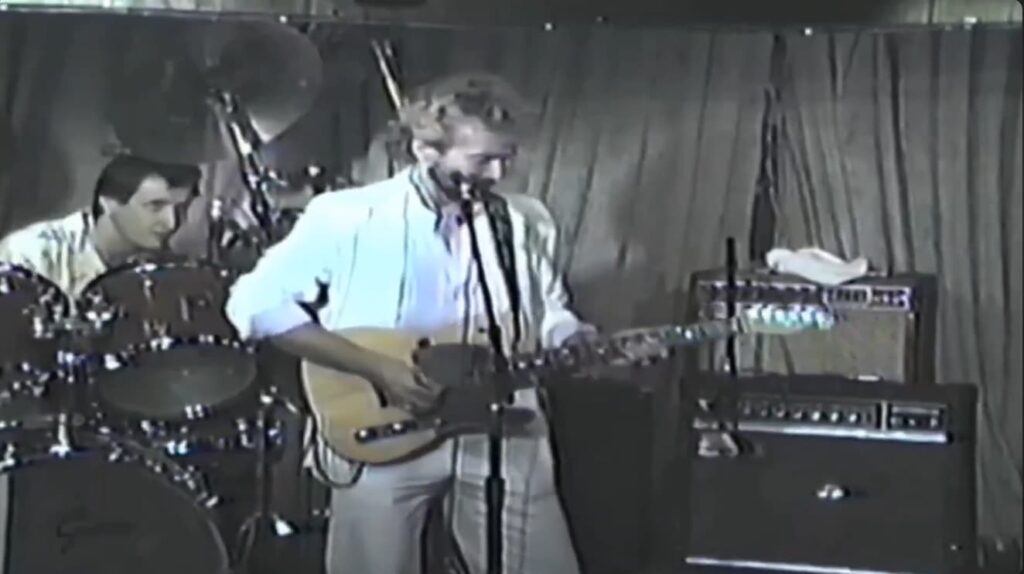
When Keith Whitley stepped onto the stage in 1985 to perform I Think I’ll Just Stay Here and Drink, he was not introducing a new hit to the charts, but rather breathing fresh life into a song already steeped in country tradition. Originally written and recorded by Merle Haggard, the song was released in 1980 as part of the album Back to the Barrooms, where it reached No. 2 on the Billboard Hot Country Singles chart. By the time Whitley performed it live in the mid-1980s, the song had already established itself as a quiet anthem of resignation—but in his voice, it took on an entirely different shade of vulnerability.
This performance comes from a period before Keith Whitley would achieve his own chart-topping success with songs like “Don’t Close Your Eyes” or “When You Say Nothing at All.” In 1985, he was still emerging, still finding his place within the broader landscape of country music. Yet even then, there was something unmistakable in his delivery—a softness, a sincerity, and an emotional clarity that set him apart from many of his contemporaries.
“I Think I’ll Just Stay Here and Drink” is, on the surface, a simple song. The premise is almost disarmingly straightforward: rather than confront heartbreak or attempt to move forward, the narrator chooses to remain where he is, seeking comfort in familiar surroundings and a glass that never quite empties. But beneath that simplicity lies a deeper emotional truth. It is not just about drinking—it is about hesitation, about the quiet fear of facing what comes next when something meaningful has ended.
In Keith Whitley’s hands, this theme becomes even more poignant. Where Merle Haggard’s original carries a sense of seasoned resignation, Whitley’s interpretation feels more fragile, more immediate. His voice does not sound hardened by experience; it sounds as though it is still in the process of understanding it. There is a gentle ache in his phrasing, a subtle hesitation that suggests the decision to “stay here and drink” is not one of confidence, but of uncertainty.
The live setting enhances this emotional nuance. Unlike a studio recording, where every note is controlled and polished, a live performance allows for small imperfections—slight variations in tone, moments where the voice wavers just enough to reveal something real. In this 1985 rendition, those moments are what give the song its depth. The audience may be present, but the performance feels inward, almost private.
Musically, the arrangement remains faithful to the traditional country style—steel guitar lines that drift like late-night thoughts, a steady rhythm that mirrors the passing of time, and instrumentation that supports rather than dominates. It is a sound rooted in the honky-tonk tradition, yet softened by Whitley’s more introspective approach.
There is also a quiet irony in the song’s message. The act of “staying” suggests a kind of stability, yet the emotional state it reflects is anything but stable. It is a pause, not a resolution—a moment suspended between what has been lost and what has yet to be faced. This tension is what gives the song its enduring resonance.
Listening to Keith Whitley perform this piece today, one cannot help but sense the beginnings of something that would later define his career: an extraordinary ability to convey emotion without excess, to let the smallest inflection carry the greatest meaning. It is a quality that would come to full fruition in his later recordings, but even here, it is already present, quietly shaping the performance.
In the end, this 1985 live rendition of “I Think I’ll Just Stay Here and Drink” is not about reinvention, but about interpretation. It shows how a song can evolve when passed from one voice to another—how its meaning can shift, deepen, and take on new life. And in Keith Whitley’s voice, the song becomes less about escape and more about reflection.
It lingers, not as a declaration, but as a feeling—one that settles in slowly, like the final hours of a long night, where silence speaks louder than words, and the choice to remain still carries more weight than any attempt to move on.