
A quiet greeting that carries a lifetime of regret—where a single “hello” becomes the echo of love that never truly left
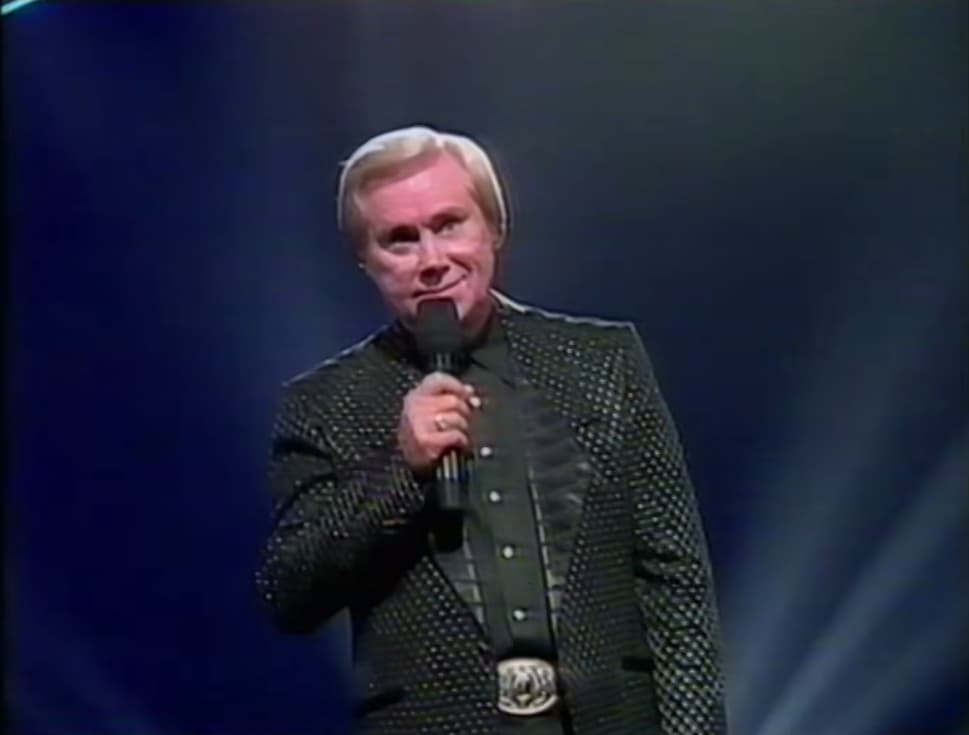
When George Jones stepped onto the stage in 1993 to perform Hello Darlin’, it was no longer just a song—it had become a living memory. Originally released in 1970 as part of the album I Made It All the Way Down, “Hello Darlin’” quickly rose to No. 1 on the Billboard Hot Country Singles chart, marking one of the defining moments of Jones’s illustrious career. More than two decades later, in that live performance, the song returned not as a chart-topping hit, but as something far more enduring: a quiet confession shaped by time itself.
From its very first spoken words—“Hello darlin’…”—the song establishes an intimacy that few recordings have ever matched. It feels less like a performance and more like an overheard moment, as though the listener has stepped into a private conversation. Written by George Jones himself, the song reflects a deeply personal understanding of love lost and the lingering presence it leaves behind. By 1970, Jones had already lived through enough emotional highs and lows to give the song a sense of authenticity that could not be imitated.
The original recording is sparse, almost restrained. A gentle steel guitar weaves through the arrangement, while the rhythm moves at an unhurried pace. But it is the voice—Jones’s unmistakable, aching voice—that carries the song. There is a vulnerability in his delivery, a subtle breaking in certain phrases that suggests the words are not merely sung, but felt in real time. This emotional honesty is what propelled “Hello Darlin’” to the top of the charts, and what has kept it there in the hearts of listeners ever since.
By the time of the 1993 live performance, that emotional weight had only deepened. George Jones was no longer the same man who first recorded the song. Years of personal struggle, professional triumph, and hard-earned resilience had left their mark—not just on his life, but on his voice. And in that voice, one could hear something new: not just heartbreak, but reflection.
The live setting adds a different dimension to the song. There is an audience present, yet the performance remains intimate, almost fragile. Jones does not rush the lines; he allows them to settle, to breathe. The pauses between phrases become as meaningful as the words themselves. It is in these pauses that the passage of time becomes most apparent—each silence carrying with it the weight of years gone by.
Lyrically, “Hello Darlin’” is deceptively simple. A man encounters a former lover and attempts to maintain composure, only to reveal that he has never truly moved on. There is no dramatic confrontation, no resolution—just an acknowledgment of lingering feeling. But within that simplicity lies a profound truth: that some connections, once formed, are never entirely broken.
What makes this 1993 rendition so compelling is the sense that the song has grown alongside its singer. The youthful sting of loss has softened into something more reflective, more accepting. There is still sadness, certainly, but it is tempered by understanding. It is the difference between feeling and remembering—and in that difference, the song finds new meaning.
For many, hearing “Hello Darlin’” in this later context evokes a powerful sense of continuity. It is a reminder that music does not remain fixed in time. It evolves, shaped by the lives of those who sing it and those who listen. A song that once captured a single moment can, over the years, come to represent an entire journey.
In the end, “Hello Darlin’” stands as one of George Jones’s most enduring achievements—not because of its chart success, though that was significant, but because of its emotional truth. It is a song that does not fade with time. Instead, it deepens, revealing new layers with each passing year.
And in that 1993 performance, as the final notes linger in the air, one is left with a quiet realization: that sometimes, the simplest words carry the greatest weight—and that a single greeting, spoken softly, can hold an entire lifetime within it.