
A solemn meeting of voices where faith, loss, and redemption echo through the mountains of memory
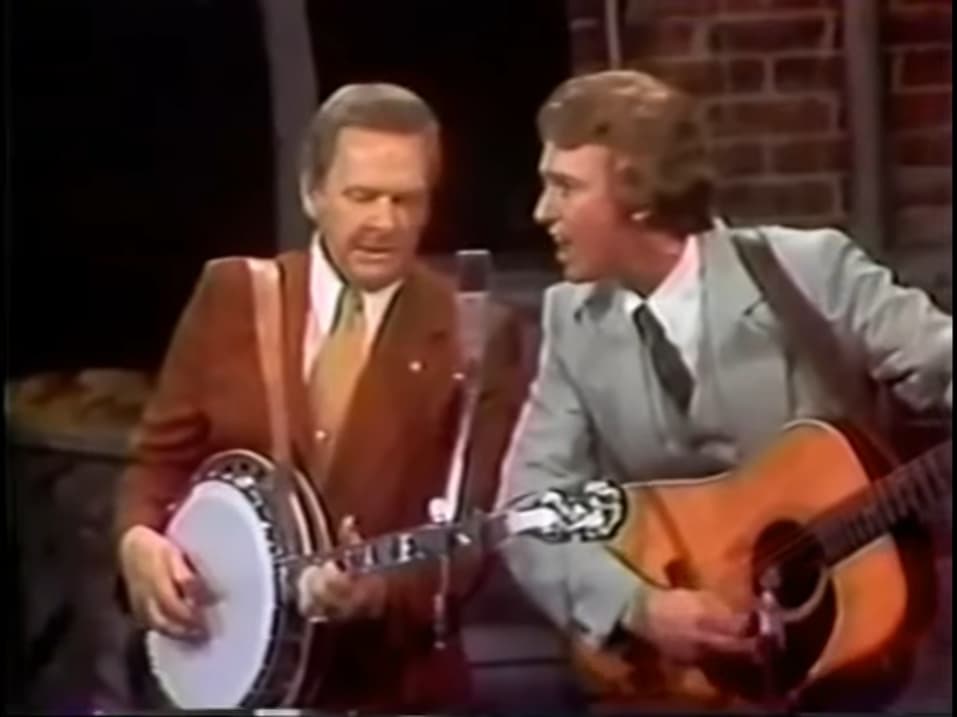
When Ralph Stanley joined with the young yet deeply expressive Keith Whitley to perform I’ve Just Seen the Rock of Ages, the result was not a chart-driven success, but something far more enduring—a spiritual moment preserved in sound. Unlike the commercial country hits that often defined radio playlists, this gospel performance did not enter the Billboard charts. Its significance lies instead in the tradition it represents and the emotional truth it carries, rooted deeply in the heritage of Appalachian bluegrass and sacred music.
The song itself is an old gospel piece, one that has traveled through generations, shaped by voices that understood both hardship and hope. In the hands of Ralph Stanley, a towering figure in bluegrass and a guardian of its most ancient sounds, “I’ve Just Seen the Rock of Ages” becomes something almost timeless. His high, lonesome vocal style—clear, piercing, and unadorned—has always carried a sense of spiritual urgency. It is not polished in the conventional sense; it is raw, direct, and deeply human.
Beside him, Keith Whitley brings a different, yet equally compelling presence. At the time of their collaborations, Whitley was still early in his journey, long before the mainstream success that would later define his career. Yet even then, there was a depth in his voice—a quiet ache, a sincerity that seemed to reach beyond his years. Singing alongside Stanley, he does not try to overshadow or reinterpret the tradition. Instead, he blends into it, adding warmth and emotional shading to Stanley’s stark intensity.
“I’ve Just Seen the Rock of Ages” is, at its core, a song of revelation. The imagery is rooted in Christian faith—the “Rock of Ages” symbolizing salvation, stability, and the promise of something eternal beyond the struggles of earthly life. But beyond its religious meaning, the song speaks to a broader human experience: the search for something solid in a world that often feels uncertain. It is about reaching a moment of clarity, however brief, where doubt gives way to understanding.
Musically, the arrangement is spare, almost austere. Traditional bluegrass instrumentation—banjo, fiddle, guitar—provides a framework, but never distracts from the voices. There is a sense of space in the performance, a deliberate simplicity that allows each note to resonate fully. This is not music designed to impress; it is music meant to be felt.
What makes this collaboration particularly moving is the contrast between the two singers. Ralph Stanley’s voice carries the weight of tradition, shaped by decades of devotion to the music. Keith Whitley, on the other hand, brings a youthful vulnerability, a sense of searching that complements Stanley’s certainty. Together, they create a balance that feels both grounded and reaching—one voice rooted in experience, the other still discovering.
There is also a quiet sense of place embedded in the performance. One can almost hear the hills and valleys of Appalachia in the background, the echo of voices that have sung these songs long before recording technology ever existed. It is music tied not just to individuals, but to a community, a culture, and a way of life that values sincerity above all else.
Listening to this recording today, it carries a different kind of weight. Both voices, in their own ways, have become part of history. Yet in this moment, preserved in song, they remain present—clear, immediate, and deeply affecting. It is a reminder that music, especially of this kind, does not fade. It endures, carried forward by those who continue to listen.
In the end, “I’ve Just Seen the Rock of Ages” as performed by Ralph Stanley and Keith Whitley is not about recognition or acclaim. It is about connection—between past and present, between tradition and interpretation, between the human voice and something greater than itself. It is a quiet, powerful testament to the idea that sometimes, the most meaningful music is the kind that asks for nothing more than to be heard… and felt.