
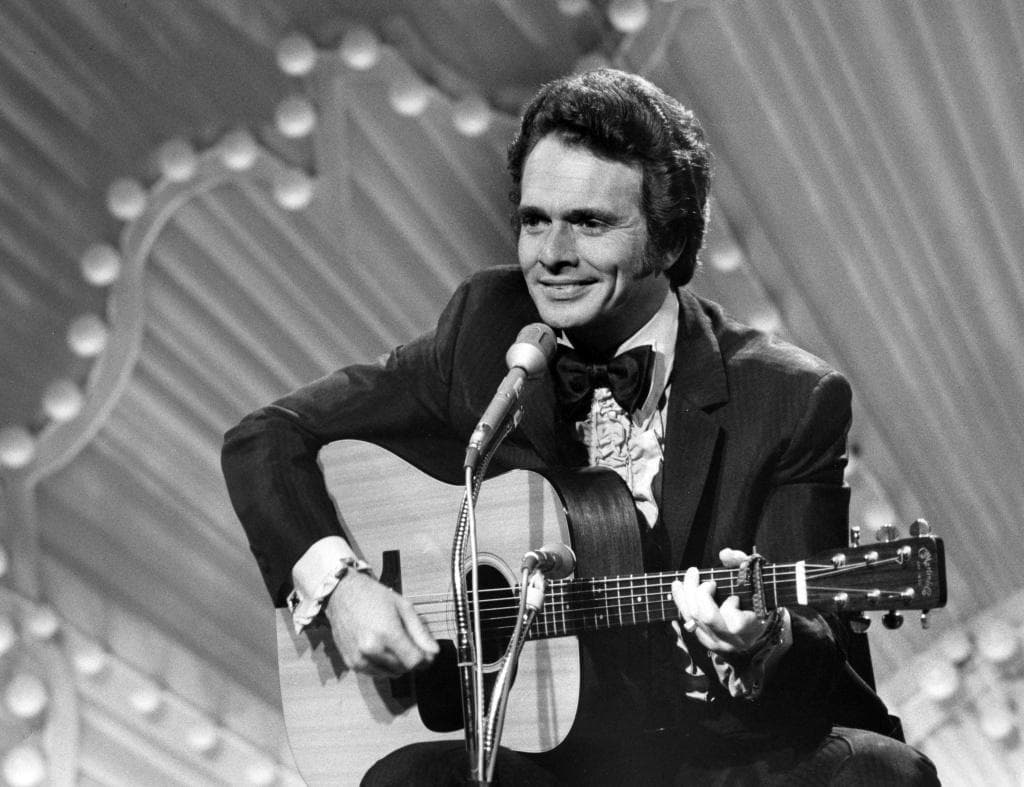
A restless soul on the run—a man shaped by regret, forever chasing a freedom he can never quite hold
Few songs in the history of country music carry the weight of lived experience quite like “The Fugitive” by Merle Haggard. Released in December 1966 and later included on the 1967 album “The Fugitive”, the song quickly rose to No. 1 on the Billboard Hot Country Singles chart in early 1967, marking one of the defining moments in Haggard’s ascent to prominence. Yet to speak of chart positions alone would be to miss the deeper truth of the song—because “The Fugitive” is not merely a hit record; it is a confession set to music, a portrait drawn from memory and consequence.
By the time this song reached the public, Merle Haggard was already beginning to emerge as a distinct voice in the Bakersfield Sound, standing apart from the polished productions of Nashville. But what truly set him apart was not just his musical style—it was his past. Having served time in San Quentin State Prison, Haggard understood the life he was singing about in a way few others could claim. That authenticity seeps into every line of “The Fugitive”, giving it a quiet authority that cannot be imitated.
The song tells the story of a man constantly on the move, looking over his shoulder, unable to escape the shadow of his own choices. “He’s a fugitive from love,” some listeners have said metaphorically, but in truth, the narrative feels far more literal—a man running not just from the law, but from himself. The brilliance of the songwriting lies in its restraint. There is no melodrama here, no attempt to romanticize the outlaw life. Instead, there is a steady, almost weary acknowledgment of what it means to live without roots, without peace.
Musically, “The Fugitive” is a masterclass in simplicity and tone. The instrumentation—anchored by sharp electric guitar lines and a firm rhythmic backbone—reflects the rawness of the Bakersfield Sound. It is direct, unpolished, and unapologetically honest. Haggard’s voice, still youthful yet already carrying the weight of experience, delivers the lyrics with a clarity that feels almost conversational. There is no need for vocal theatrics; the story speaks for itself.
What makes this song endure, however, is not just its technical or narrative strength—it is the emotional undercurrent that runs beneath it. There is a sense of inevitability in “The Fugitive”, as though the man at its center knows that no matter how far he runs, he cannot outrun his past. This is a theme that resonates deeply within the broader tradition of country music, where stories of redemption and regret often walk hand in hand.
The success of the song also helped solidify Merle Haggard’s identity as more than just a performer—he became a storyteller of uncommon depth. In an era when many artists leaned toward either sentimentality or spectacle, Haggard chose a different path. He offered truth, even when that truth was uncomfortable. And audiences responded, not because the story was glamorous, but because it felt real.
There is also an unspoken duality in the song’s legacy. On one hand, it reflects a specific moment in Haggard’s life—a time when the memories of confinement and consequence were still fresh. On the other, it speaks to something universal: the idea that everyone, in one way or another, carries a past that cannot be entirely escaped. The “fugitive” becomes more than a character; he becomes a symbol of that quiet, persistent tension between who we were and who we hope to become.
Listening to “The Fugitive” today, one is struck not by how much has changed, but by how much remains the same. The world may move faster, the sounds may evolve, but the human condition—the longing for freedom, the burden of memory—remains untouched by time. And in that sense, Merle Haggard did something remarkable: he captured a fleeting, deeply personal truth and gave it a form that would endure far beyond its moment.
In the end, “The Fugitive” is not about escape. It is about recognition—the quiet realization that some journeys are not meant to lead away, but inward. And it is in that realization that the song finds its lasting power, echoing softly long after the final chord has faded.