
How Buddy Holly Created A Quietly Rebellious Love Song That Revealed The Gentle Side Of A Rock And Roll Pioneer
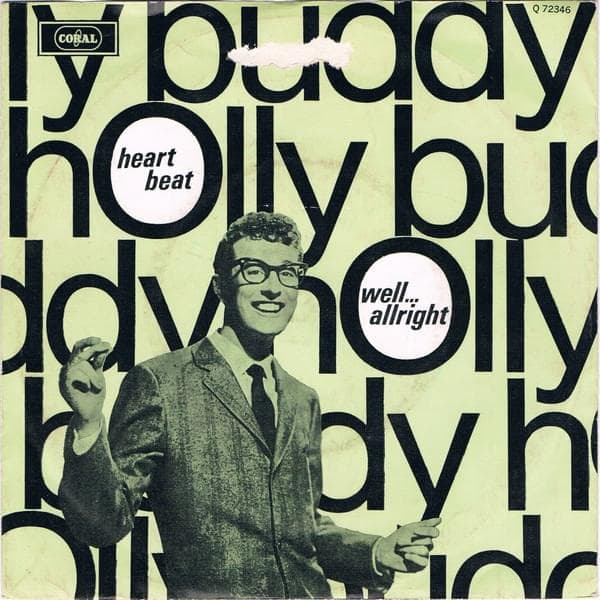
Not every great rock and roll song needs a pounding drumbeat or a guitar solo that demands attention. Sometimes, the most revealing recording is the one that sounds as though the singer is letting you in on a private thought. Buddy Holly’s “Well… All Right” was recorded on February 12, 1958, at Norman Petty’s studio in Clovis, New Mexico, and released later that year as the B side of “Heartbeat.” While “Heartbeat” carried the brighter, more familiar energy of Holly’s rock and roll sound, “Well… All Right” offered something different: a relaxed, acoustic driven performance with a gentle rhythm and an understated sense of romantic determination. It appeared on Holly’s self titled album, released in February 1958, during a period when he was helping reshape what a young rock musician could sound like.
The song was credited to Buddy Holly, Jerry Allison, Joe B. Mauldin and Norman Petty, reflecting the close musical circle surrounding Holly during his rise to fame. Allison played drums, Mauldin provided bass, and Holly’s guitar and voice formed the centre of the recording. The arrangement is striking for its simplicity. Rather than filling every moment with sound, the musicians leave room for the melody to breathe. Holly sings with a warmth that feels conversational, as if he is reassuring someone that love does not need to follow the rules other people expect. There is a youthful independence in the song, but it is not the defiance of a rebellious teenager trying to shock the world. It is the confidence of someone willing to follow his feelings, even when others might not understand.
By 1958, Holly was already one of the most influential young musicians in America. With “That’ll Be the Day,” “Peggy Sue,” “Oh, Boy!” and “Maybe Baby,” he had helped establish a new model for rock and roll: a singer who wrote his own material, played lead guitar and performed with a compact band whose sound could be both powerful and melodic. Holly and the Crickets also helped popularise the classic rock band lineup of guitars, bass and drums. Yet “Well… All Right” reveals another side of his musical imagination. Its quieter approach shows that he understood the emotional power of restraint, and that rock and roll could express tenderness as naturally as excitement. This versatility was part of what made his influence so lasting, even though his career as a major recording star lasted only about eighteen months.
The song’s story did not end with Holly’s original recording. In 1969, Eric Clapton’s group Blind Faith recorded a new version for its only studio album, transforming the acoustic original into a more electric, blues influenced performance featuring Steve Winwood on vocals. Nearly a decade later, Santana released its own interpretation, bringing the song to a different audience through its distinctive guitar sound. These versions demonstrated that Holly’s composition could travel far beyond the musical world in which it was created. The core of the song remained strong enough to survive changes in instrumentation, genre and generation. Its appeal lay not in elaborate production, but in the directness of the melody and the feeling at the heart of the lyrics.
Today, “Well… All Right” occupies a special place among Holly’s recordings because it reminds us that his legacy cannot be measured by his biggest hits alone. On February 3, 1959, Holly died in a plane crash near Clear Lake, Iowa, at just 22 years old, alongside fellow performers Ritchie Valens and J. P. “The Big Bopper” Richardson. The tragedy cut short a career that was still developing, leaving behind songs that would influence generations of musicians. When “Well… All Right” plays now, its gentle guitar and unhurried rhythm offer a different kind of remembrance. There is no grand farewell in the recording, no hint that its creator would soon become a symbol of lost youth. There is simply Buddy Holly, singing with quiet conviction, making a small love song feel honest, personal and entirely his own.