
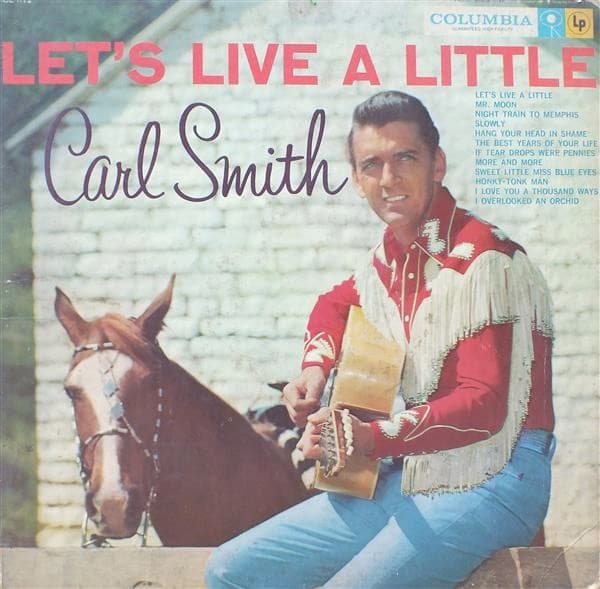
A Gentle Invitation to Pause, Love, and Savor Life’s Fleeting Joys
There are songs that arrive like a storm, and then there are those that settle quietly into the heart—“Let’s Live a Little” by Carl Smith belongs unmistakably to the latter. Released in 1951, during the golden age of classic country, the song climbed to No. 2 on the Billboard Country & Western Best Sellers chart, affirming Smith’s place among the most beloved voices of his era. At a time when honky-tonk grit often dominated jukeboxes, Smith offered something softer, more reflective—an invitation to slow down and cherish the simple act of living.
Carl Smith, often referred to as “Mister Country,” possessed a voice that balanced warmth with clarity, a kind of calm authority that never needed to shout to be heard. By the early 1950s, he was already a major figure in country music, with a string of hits that resonated deeply with audiences navigating the postwar years. America was changing—families rebuilding, dreams reshaping—and songs like “Let’s Live a Little” felt like gentle guidance through uncertain times.
What makes this song endure is not just its melody, but its message. Beneath its easy rhythm lies a quiet philosophy: life is fleeting, and love—however imperfect—is worth embracing fully. The lyrics encourage stepping away from worry, from regret, from the endless chase for more, and instead finding meaning in presence, companionship, and shared moments. It’s not grand or dramatic; it doesn’t try to be. And perhaps that’s precisely why it lingers.
There’s a story often told among country historians that Carl Smith recorded this track during a particularly busy stretch of touring and radio appearances. He was, by all accounts, a disciplined performer—professional, punctual, and deeply committed to his craft. Yet those who worked with him noted how songs like this seemed to reflect something personal: a quiet understanding that even success could become overwhelming if one forgot to simply live. In that sense, the recording carries a sincerity that cannot be manufactured.
Musically, “Let’s Live a Little” is rooted in the smooth, polished Nashville Sound before it fully took shape later in the decade. The arrangement is modest—steel guitar lines that weep gently in the background, a steady rhythm section, and Smith’s voice front and center. There’s no excess, no distraction. Every note serves the song’s central idea: simplicity is enough.
It’s also worth noting the broader cultural context. In 1951, country music was still defining its national identity. Artists like Hank Williams had brought emotional rawness to the genre, while others, including Carl Smith, leaned into refinement and accessibility. This balance helped country music reach wider audiences, bridging rural roots with urban listeners. Songs like “Let’s Live a Little” played a quiet but crucial role in that evolution.
Over the decades, the song has remained a touchstone for those who appreciate country music’s gentler side. It doesn’t demand attention; it earns it slowly. Listening today, one can almost picture a quieter world—front porches at dusk, radios humming softly, conversations unhurried. There’s a kind of grace in that image, a reminder of values that feel increasingly rare.
And perhaps that is the song’s greatest achievement. It doesn’t belong to any one time. Its message—simple, honest, deeply human—continues to resonate. In a world that often feels too fast, too loud, “Let’s Live a Little” offers a pause. A breath. A moment to remember that life, at its best, is not measured in achievements, but in the quiet joy of being present.
Carl Smith understood that. And through this song, he still gently reminds us.