
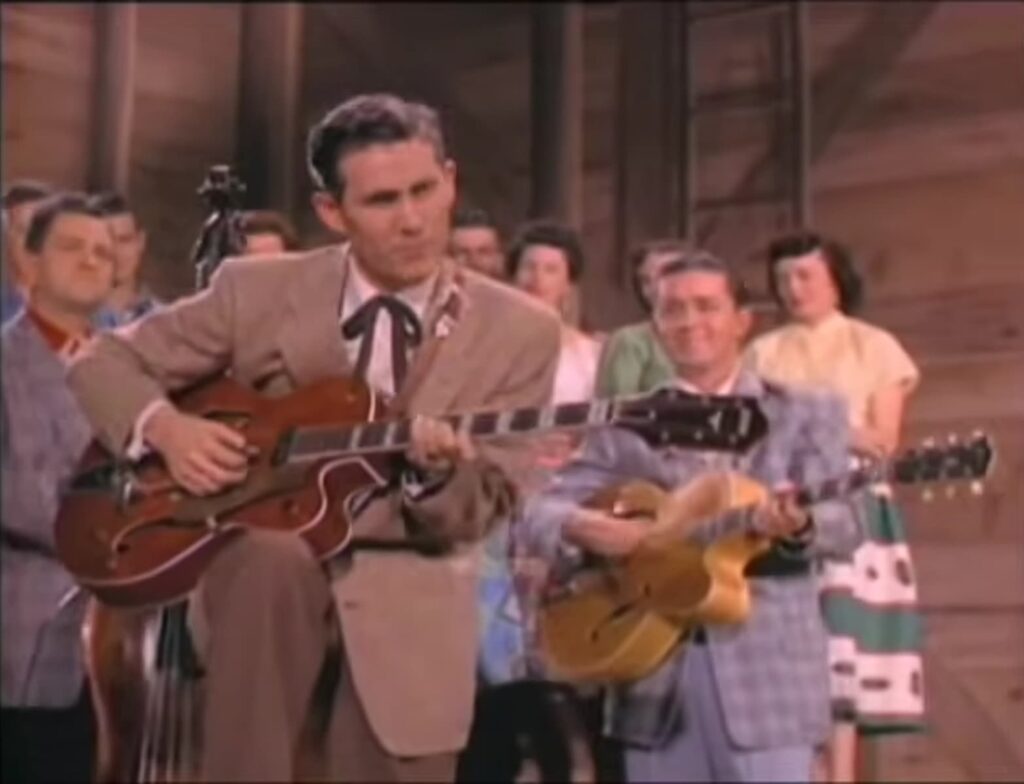
A familiar dream melody reshaped into quiet elegance, where craftsmanship turns a pop lullaby into a timeless instrumental reverie
When Chet Atkins released his instrumental interpretation of “Mister Sandman” in 1961, it stood as a subtle yet confident statement from an artist who never needed spectacle to leave a lasting mark. Originally written by Pat Ballard and made famous by The Chordettes in 1954, the song had already lived several lives as a vocal pop standard. Atkins’ version arrived with no lyrics, no harmonies, and no nostalgic gimmicks, yet it spoke just as clearly. His recording reached No. 23 on the Billboard Hot 100 and climbed to No. 3 on the Easy Listening chart, an impressive achievement for a guitar driven instrumental in a rapidly changing musical landscape.
By the early 1960s, Chet Atkins was far more than a virtuoso guitarist. He was a producer, a tastemaker, and a quiet architect of what would later be called the Nashville Sound. His take on “Mister Sandman” was released on RCA Victor and later appeared on the album Chet Atkins’ Workshop, a record that showcased his technical precision alongside his instinct for melody and restraint. This was not a performance designed to chase trends. It was a reflection of an artist confident enough to let space, tone, and touch carry the emotional weight.
The story behind Atkins choosing “Mister Sandman” is rooted in his long standing fascination with popular standards and his belief that a guitar could sing as convincingly as any voice. Where earlier versions relied on playful lyrics and close harmony, Atkins stripped the song down to its skeletal charm. His electric guitar takes on the role of narrator, delivering the melody with clarity and warmth, while subtle rhythmic accents give the piece forward motion without urgency.
The meaning of “Mister Sandman” shifts noticeably in Atkins’ hands. The song is no longer a whimsical request for dreams and romance. Instead, it becomes a meditation on familiarity. Without words, listeners are invited to fill in their own memories, their own images of nighttime radios, dimly lit rooms, and moments of quiet reflection. Atkins’ phrasing is conversational rather than dramatic. Each note feels placed rather than performed, suggesting patience, experience, and trust in simplicity.
Musically, the recording is a masterclass in control. Atkins uses a combination of fingerstyle technique and subtle muting to create a clean, bell like tone. The rhythm section remains understated, never intruding on the melody. The arrangement respects the song’s origins while gently elevating it into something more contemplative. This balance between accessibility and sophistication is precisely why the track resonated across charts that rarely embraced instrumentals so warmly.
Within Chet Atkins’ broader career, “Mister Sandman” represents a bridge between eras. It connects the pop sensibility of the 1950s with the more refined studio craftsmanship of the 1960s. At a time when louder and more aggressive sounds were beginning to dominate popular music, Atkins offered an alternative path, one rooted in tone, discipline, and emotional understatement.
The legacy of Atkins’ “Mister Sandman” lies not in reinvention but in preservation through transformation. He did not attempt to modernize the song by force. Instead, he allowed its melody to breathe, trusting that its strength would endure when presented with care. The result is a recording that feels unhurried and confident, inviting repeated listening rather than demanding attention.
Today, this version remains one of the most recognizable instrumental interpretations in popular music history. It reminds us that virtuosity does not require volume, and that memory often resides in the quietest moments. In Chet Atkins’ hands, “Mister Sandman” becomes less about sleep and more about reflection, a gentle reminder that some melodies never truly fade, they simply wait to be heard again.