
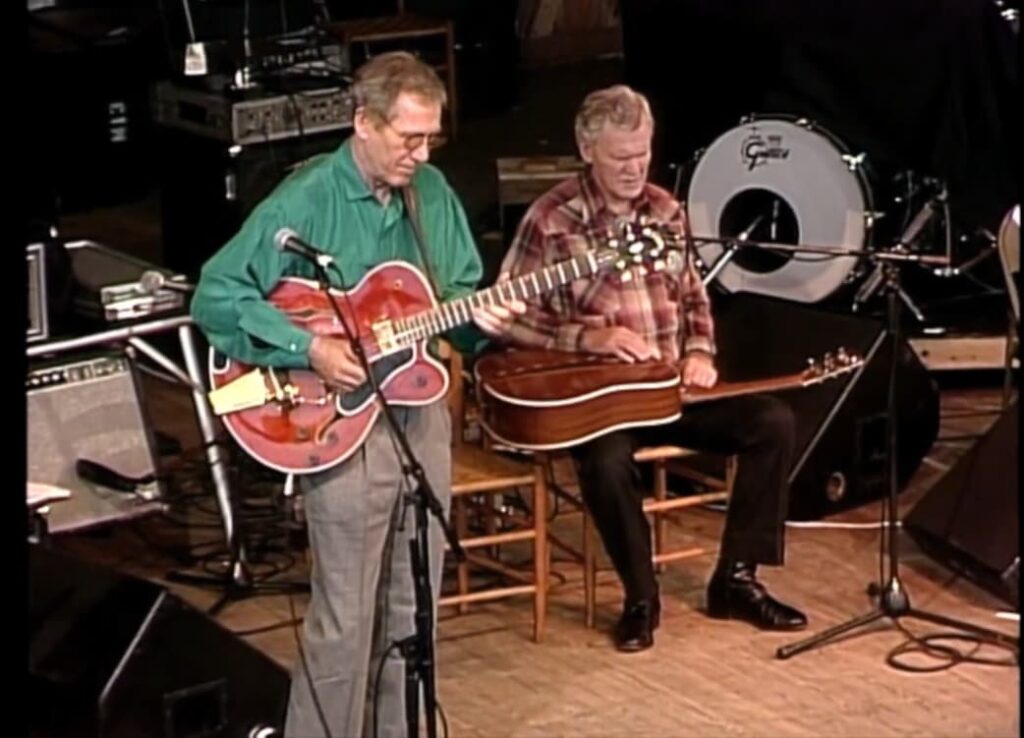
A Gentle Instrumental That Turns a Familiar Dream into a Quiet Reflection on Longing and Peace
When “Over the Rainbow” passed through the hands of Chet Atkins, it shed its lyrical form and became something more inward, more contemplative—an unspoken meditation carried entirely by the voice of a guitar. Originally composed by Harold Arlen with lyrics by Yip Harburg for the 1939 film The Wizard of Oz, and immortalized by Judy Garland, the song itself was already a cultural landmark, winning the Academy Award for Best Original Song and becoming one of the most enduring standards in American music. Its early success was reflected in chart performances of the era, with versions by artists like Judy Garland and others reaching the top tiers of Billboard’s early song charts.
Yet by the time Chet Atkins recorded his instrumental interpretation—featured across his mid-career recordings and performances—the song had already traveled far beyond its cinematic origin. What Atkins offered was not a reinvention, but a distillation. By removing the lyrics, he did not diminish the song’s meaning; instead, he revealed its emotional core in a way that felt almost more personal, as though the melody itself was remembering something it could no longer put into words.
Unlike chart-driven singles, Chet Atkins’ “Over the Rainbow” was never intended to compete for commercial rankings on the Billboard Hot 100. Instrumental recordings of this nature, particularly within the country and easy listening traditions of the 1950s and 1960s, often existed outside the mainstream pop charts. However, its significance lies not in chart placement, but in its role within Atkins’ broader body of work—appearing on albums such as “Chet Atkins’ Workshop” (1961) and later collections that showcased his refined fingerstyle technique and deep respect for classic American songcraft.
What distinguishes Atkins’ version is its restraint. Where the original vocal performance carries a sense of yearning through words—dreams of a place “where troubles melt like lemon drops”—Atkins allows the guitar to speak in subtler tones. His phrasing is deliberate, almost conversational, with each note given space to breathe. The melody unfolds slowly, without urgency, as if aware that its meaning has already been understood by those who listen closely.
There is a particular quality in Chet Atkins’ playing that transforms even the most familiar melody into something newly intimate. His signature fingerpicking style creates the illusion of multiple voices at once—the bass line steady and grounding, the melody floating gently above it. In “Over the Rainbow”, this interplay becomes especially poignant. The bass suggests continuity, the quiet persistence of time, while the melody drifts, searching, recalling, perhaps even reconciling.
Listening to this version today, one cannot help but feel a shift in perspective. The song, once associated with youthful hope and distant dreams, takes on a more reflective tone. It no longer feels like a wish for somewhere else, but rather a contemplation of where one has already been. The “rainbow” becomes less a destination and more a symbol—of moments that once felt out of reach, yet somehow shaped the journey nonetheless.
In the context of Chet Atkins’ career, recordings like this reveal a side of his artistry that extends beyond technical brilliance. While he is often celebrated for his role in shaping the Nashville Sound and for his extraordinary guitar technique, pieces like “Over the Rainbow” demonstrate his sensitivity as an interpreter. He understood that great songs do not need to be altered dramatically to be meaningful—they simply need to be approached with honesty and care.
There is also something quietly timeless about this interpretation. Without lyrics to anchor it to a specific narrative, the music becomes open-ended, allowing each listener to bring their own memories into it. It can accompany reflection, solitude, or even a sense of quiet gratitude. It does not demand attention; it invites it.
And perhaps that is why Chet Atkins’ “Over the Rainbow” continues to resonate. It reminds us that some melodies carry their meaning across generations, changing not in structure, but in the way they are felt. In the gentle touch of Atkins’ guitar, the song becomes less about escaping to a distant place and more about understanding the distance already traveled.
In that sense, the rainbow is no longer somewhere far away. It lingers softly in the notes themselves—familiar, enduring, and quietly at peace.