
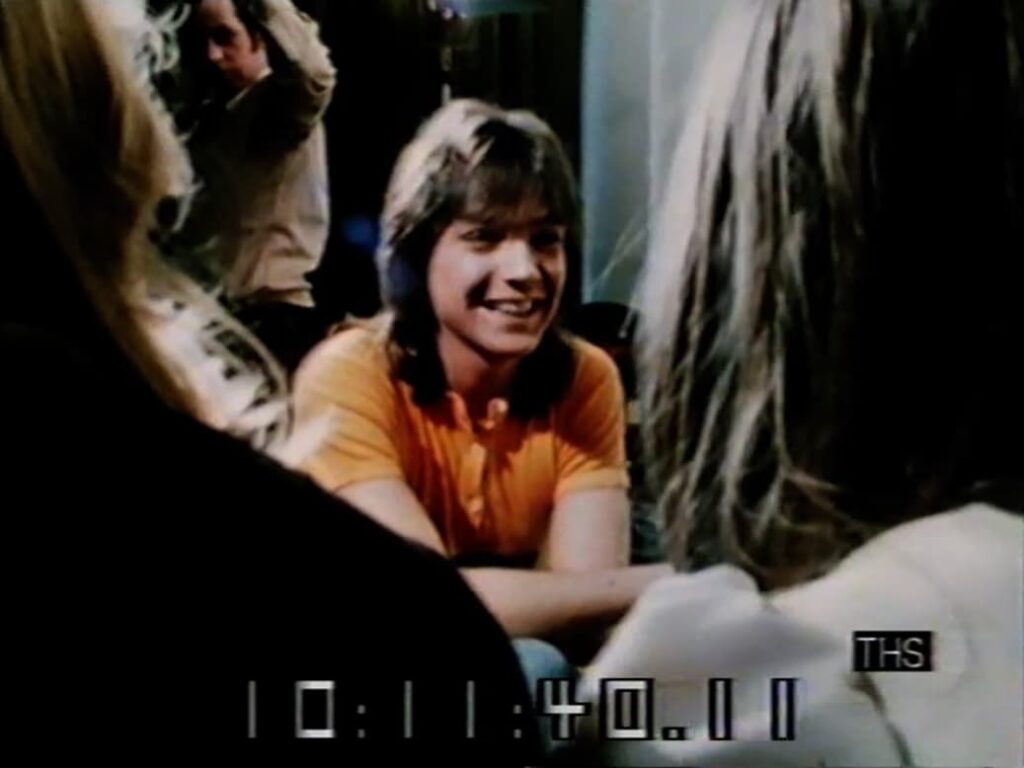
A Young Star at the Height of Fame, Standing in the Bright Light While Quietly Bearing Its Weight
In 1973, at the height of an almost overwhelming wave of global fame, David Cassidy appeared in an interview segment during “This Week: Weekend at Wembley”, offering a rare glimpse behind the carefully managed image of one of the most recognizable faces of early 1970s pop culture. This was not tied to a single chart entry, yet the timing of the interview places it squarely within the peak of his musical dominance — a period when songs associated with him and The Partridge Family, such as “I Think I Love You” (which had reached No. 1 on the Billboard Hot 100 in 1970) and subsequent solo hits like “How Can I Be Sure” (which climbed to No. 1 in the UK Singles Chart in 1972), were still echoing across radios, concert halls, and television screens.
The Wembley appearance is significant not for what it promotes, but for what it reveals. By 1973, David Cassidy was no longer simply a television personality or a pop singer. He had become a phenomenon — a figure whose image was reproduced endlessly in magazines, whose concerts drew crowds that bordered on hysteria, and whose personal life was increasingly difficult to separate from the expectations placed upon him. The interview, conducted in the context of a major public event, captures a young man navigating that reality with a mixture of composure and visible strain.
There is a particular stillness in the way he speaks, a careful selection of words that suggests an awareness of how closely he is being watched. Unlike the exuberant energy of his stage performances, this moment feels restrained, almost introspective. It is here that one begins to understand the contrast between the public image and the private experience. The same voice that could command thousands in a live performance now carries a quieter tone, one that hints at fatigue, at reflection, at the subtle cost of sustaining such an intense level of visibility.
The broader context of 1973 is essential. This was a year when the machinery of pop stardom was operating at full force, particularly in the UK, where David Cassidy enjoyed an almost unparalleled level of adoration. His concerts were events of near-mythic scale, yet they also marked the beginning of his conscious effort to redefine himself. He was already expressing a desire to be taken seriously as a musician, to move beyond the confines of teen idol status that had, in many ways, both created and limited him.
The interview at Wembley reflects this transition. There is a subtle shift in how he presents himself — less as a product of television success, more as an artist seeking longevity. He speaks not just about performance, but about the experience surrounding it, about the pressures that come with constant exposure. It is not a complaint, but an acknowledgment, delivered with a level of honesty that was not always expected in such settings at the time.
Musically, this period would soon lead to more mature recordings, including material that distanced him from the polished pop sound of The Partridge Family. Albums like “Dreams Are Nuthin’ More Than Wishes” and “The Higher They Climb” would reflect that evolution, though they would never quite escape the shadow of the earlier success that defined his public identity. The seeds of that transition, however, can be felt in moments like this interview — in the way he speaks, in the questions he chooses to engage with, and in the quiet determination beneath his words.
What makes this Wembley interview endure is not spectacle, but vulnerability. It offers a rare pause in the narrative of relentless success, allowing space for something more human to emerge. The bright lights of Wembley, the noise of the crowd, the expectations of an audience that seemed to grow larger with each passing month — all of it forms the backdrop to a moment that is, at its core, deeply personal.
Looking back now, the interview carries a different weight. It is no longer just a document of a particular moment in time, but a reflection of a larger story — one that speaks to the complexities of fame, the tension between public and private selves, and the quiet resilience required to navigate both. David Cassidy, in that brief exchange, does not attempt to resolve those tensions. He simply acknowledges them, allowing the audience, then and now, to see beyond the surface.
And perhaps that is what lingers most. Not the applause, not the headlines, but the image of a young man standing in the center of it all, speaking carefully, thoughtfully, aware that every word carries meaning. In that awareness, there is a depth that no chart position can measure, and a truth that continues to resonate long after the moment itself has passed.