
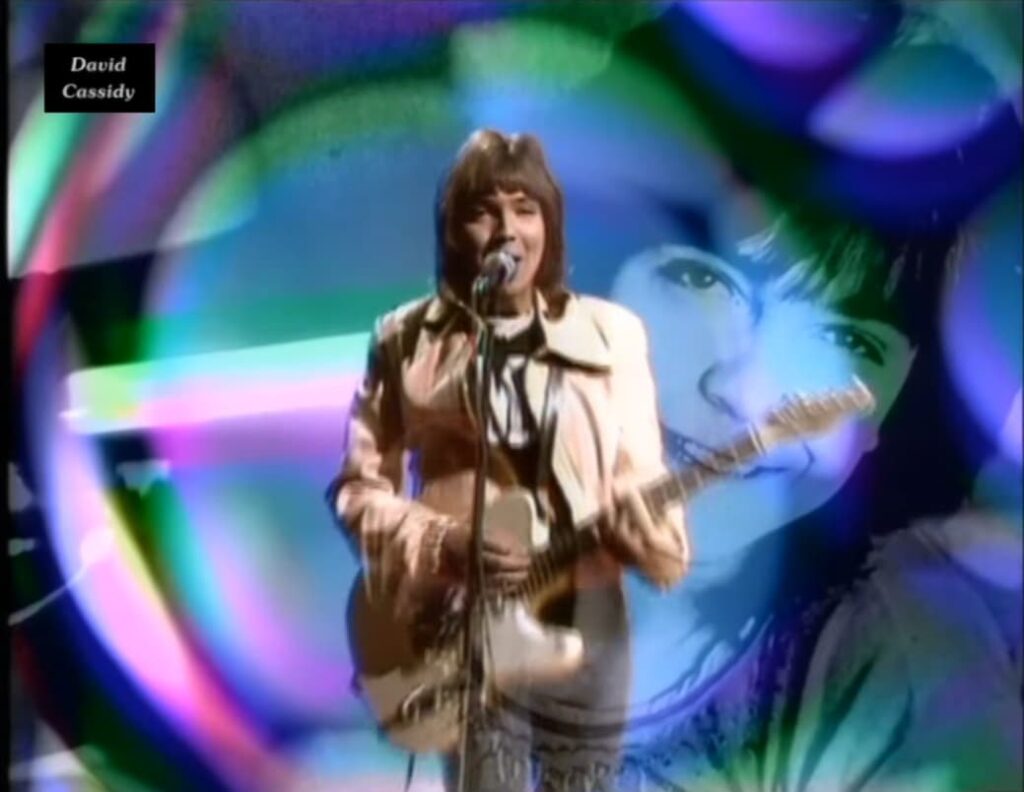
A restless heartbeat of youth and longing, where desire meets the fleeting glow of 1970s pop stardom
When speaking of “Rock Me Baby” (1974), one cannot separate the song from the dazzling yet complicated aura of David Cassidy at the height of his fame. Released during a pivotal moment in his career, the track appeared on the album Cassidy Live! (1974), a record that captured not only the electricity of his performances but also the emotional distance he was beginning to feel from the teen-idol image that had first defined him. Though not among his biggest chart-toppers, “Rock Me Baby” still resonated strongly with audiences, particularly in the UK and Europe, where Cassidy’s popularity remained immense. The live album itself achieved notable success, reaching No. 9 on the UK Albums Chart, a testament to his enduring appeal.
By 1974, David Cassidy was no longer simply the fresh-faced star of The Partridge Family. He was an artist searching—perhaps even struggling—for a more authentic musical identity. “Rock Me Baby” reflects this transitional phase. The song carries a more mature tone compared to his earlier bubblegum hits, blending elements of pop, soft rock, and a hint of soulful yearning. It is less polished in its innocence, and more textured with emotion, as though the performer himself is trying to break free from expectations.
The origins of the song are rooted in the broader musical landscape of the early 1970s—a time when pop music was evolving rapidly, absorbing influences from rock, rhythm and blues, and singer-songwriter traditions. In this context, “Rock Me Baby” feels like a bridge between two worlds: the carefully constructed pop idol persona and the emerging voice of an artist eager to be taken seriously. Cassidy’s delivery is telling—there is a subtle urgency in his voice, a desire to connect on a deeper level rather than merely entertain.
Listening closely, one can sense that the song’s meaning extends beyond its surface theme of romantic longing. The repeated plea to be “rocked” carries a dual significance: it is both a call for intimacy and a metaphor for reassurance in uncertain times. There is vulnerability here, an openness that contrasts with the polished confidence often associated with pop stardom. In many ways, the song becomes a quiet confession—an acknowledgment of the pressures, the expectations, and the fleeting nature of fame.
The live setting of Cassidy Live! adds another layer of poignancy. Recorded during performances in front of adoring crowds, the album captures the paradox of Cassidy’s career at that moment: immense public adulation paired with a growing personal introspection. When he sings “Rock Me Baby”, the energy of the audience is palpable, yet there is also a sense of distance—as if the artist is reaching out, hoping to be understood beyond the screams and applause.
Musically, the arrangement is warm and inviting. Gentle guitar lines, steady percussion, and soft backing vocals create a soundscape that feels both intimate and expansive. It is the kind of song that lingers, not because of dramatic crescendos, but because of its emotional sincerity. Cassidy’s voice, slightly weathered compared to his earlier recordings, carries a depth that hints at experiences not yet fully revealed.
In retrospect, “Rock Me Baby” (1974) stands as a subtle but significant chapter in David Cassidy’s musical journey. It may not have achieved the iconic status of his biggest hits like “I Think I Love You,” but it offers something arguably more valuable: a glimpse into an artist in transition, grappling with identity, artistry, and the passage of time.
There is a certain nostalgia that accompanies this song—not just for the era it represents, but for the emotions it evokes. It reminds us of moments when life felt both exhilarating and uncertain, when the future seemed wide open yet somehow fragile. And in that delicate balance, David Cassidy found a voice that was, perhaps for the first time, truly his own.