
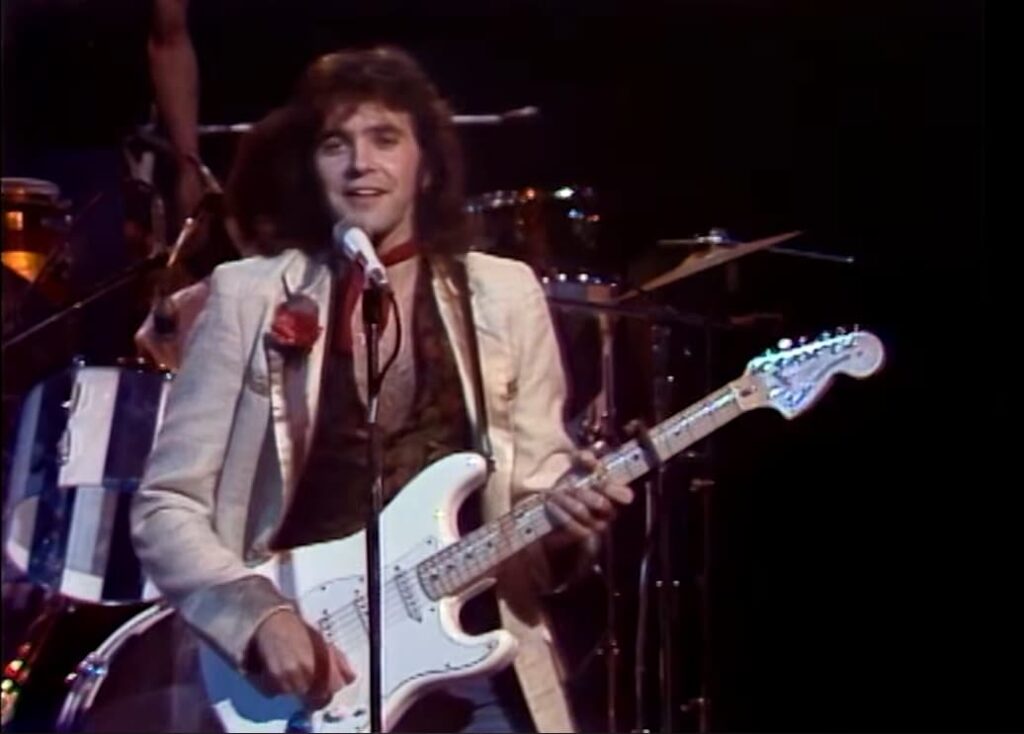
A restless cry against disillusionment, “Won’t Get Burned Again” reveals David Essex at his most reflective—guarded, yet still searching for meaning in the echoes of experience.
By the time David Essex appeared on The Midnight Special to perform “Won’t Get Burned Again”, he was no longer simply the bright, youthful face of early 1970s pop stardom. There was something more weathered in his presence—an artist who had tasted both adoration and the quiet weight of expectation, now navigating a more introspective phase of his career. Though this particular track did not achieve notable chart success as a standalone single, its significance lies not in numbers, but in tone: a subtle but unmistakable shift in artistic voice.
To understand the emotional undercurrent of “Won’t Get Burned Again”, one must consider the arc of David Essex’s journey. Rising to fame with hits like “Rock On” (No. 3 on the Billboard Hot 100 in 1974) and “Gonna Make You a Star” (No. 1 in the UK Singles Chart in 1974), Essex quickly became a defining figure of his era—equal parts pop idol and thoughtful performer. Yet, as with many artists who achieve rapid success, there comes a moment when the surface brilliance begins to give way to deeper reflection. This song belongs to that moment.
Performed live on The Midnight Special, a program known for capturing artists in a more immediate and unfiltered setting, “Won’t Get Burned Again” takes on an added layer of authenticity. The stage is modest, the arrangement restrained, allowing Essex’s voice—and the quiet tension within it—to take center stage. There is no sense of spectacle here, only a man standing before an audience, offering something more personal than polished.
The song itself carries a theme that feels both intimate and universal: the resolve not to repeat past mistakes, particularly in matters of trust and emotional vulnerability. The title alone—“Won’t Get Burned Again”—suggests a defensive stance, a protective shell formed after experience has left its mark. Yet, beneath that resolve, there is a lingering softness, an awareness that such defenses are never entirely impenetrable.
Musically, the composition leans toward a gentle, almost contemplative structure. It avoids dramatic crescendos, instead unfolding with a quiet persistence. This restraint mirrors the song’s message: growth not as a sudden revelation, but as a gradual, often hesitant process. Essex’s vocal delivery is key here. He does not push the emotion outward; he lets it settle, allowing the listener to lean in rather than be overwhelmed.
What makes this performance particularly compelling is its sense of honesty. There is no attempt to recapture the exuberance of earlier hits, no effort to chase the shifting trends of the late 1970s music scene. Instead, David Essex seems content to inhabit the space between certainty and doubt—a place many listeners come to recognize all too well over time.
In a broader context, songs like “Won’t Get Burned Again” reflect a recurring theme in popular music: the transition from youthful optimism to mature introspection. It is a theme that resonates not because it is dramatic, but because it is familiar. Life, after all, has a way of teaching its lessons quietly, often in ways that only become clear in retrospect.
Watching this performance today, one might be struck not by what is said, but by what is left unsaid—the pauses, the slight hesitations, the moments where the voice seems to carry more than the lyrics alone can express. These are the details that give the song its depth, transforming it from a simple declaration into something more layered and enduring.
And so, “Won’t Get Burned Again” remains a lesser-known but quietly significant piece within David Essex’s body of work. It does not seek to dazzle or dominate the airwaves. Instead, it offers something more lasting: a reflection on experience, a cautious hope, and the understanding that even as we promise ourselves not to be hurt again, we remain, in some quiet corner of the heart, open to feeling once more.