
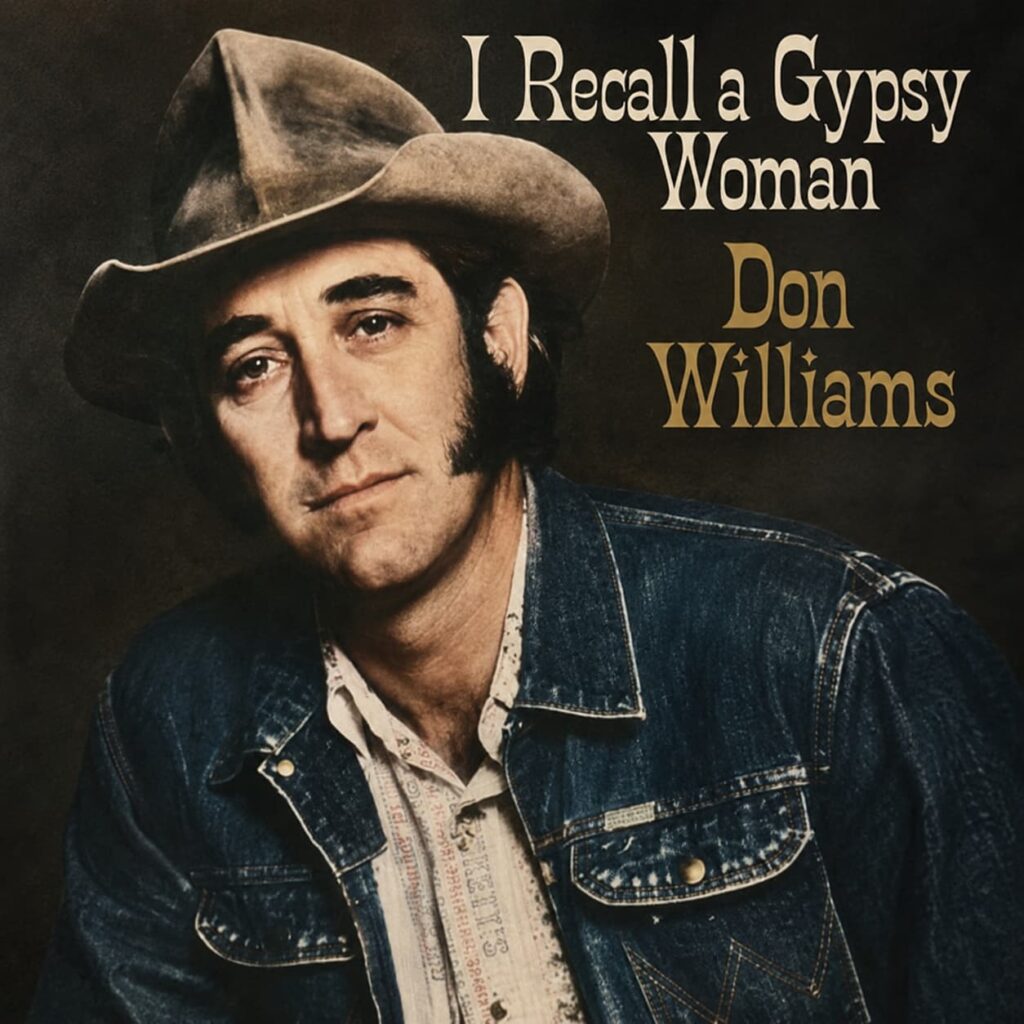
Some Loves Do Not End. They Simply Become Memories That Walk Beside Us for the Rest of Our Lives.
In 1978, at the height of his popularity, Don Williams stepped onto a stage and performed a song that remains one of the most quietly devastating recordings in country music. On the surface, “I Recall a Gypsy Woman” sounds like a gentle reflection on a youthful romance. Yet beneath its warm melody and tranquil atmosphere lies something far deeper: a meditation on memory, longing, and the parts of our lives that never completely leave us behind.
Few songs in country music capture the complexity of nostalgia as honestly as this one. The narrator is not a lonely drifter searching for lost love. He is a married man with a family, a stable life, and every reason to be content. Yet in the stillness of the night, his thoughts return to a mysterious woman from his youth. He does not speak of regret. He does not dream of abandoning the life he has built. Instead, he reveals something more subtle and more human. Some memories remain powerful not because we want them back, but because they helped shape who we became.
Written by celebrated songwriters Bob McDill and Allen Reynolds, the song surrounds its central figure with imagery that feels almost dreamlike. Silver coins jingle in the darkness. Moonlight illuminates ivory skin. Meadows glow with yellow clover and tangled blossoms. The woman herself seems suspended somewhere between reality and imagination. As a result, listeners have debated her identity for decades.
Some hear a real woman, a youthful romance preserved forever in memory. Others believe the gypsy woman symbolizes something much larger: freedom, adventure, youth, and all the roads in life that were never taken. The song never answers the question, which may explain why it continues to resonate generation after generation.
One of the most striking moments arrives near the end of the lyric. The narrator describes hearing the gypsy woman’s laughter dancing through his mind while his “tender wife and babies slumber softly in their beds.” It is a remarkably honest admission. He is not betraying his family. He is acknowledging a truth many people rarely discuss openly. Even the happiest lives contain echoes of earlier chapters. Loving the present does not automatically erase the past.
That emotional complexity is what makes Don Williams’ performance so powerful. Many singers might approach the song with heartbreak or dramatic sorrow. Williams does neither. Known as “The Gentle Giant,” he delivers the story with calm acceptance. His voice carries no desperation and no self-pity. Instead, he sounds like a man sharing an old memory by a fireplace long after midnight, quietly turning the pages of his life.
The 1978 performance is especially significant because it came during one of the most successful periods of his career. At a time when many country artists relied on energetic stage shows and larger-than-life personalities, Williams commanded attention through simplicity. A guitar, a steady voice, and an unforgettable story were all he needed. Audiences listened because every word felt genuine.
Viewed today, the song carries an emotional weight that often deepens with age. What once sounded like a romantic recollection begins to reveal broader themes. The gypsy woman becomes a symbol for every vanished season of life, every place once loved, every dream that slipped quietly into memory. Her laughter is no longer just hers. It becomes the sound of youth itself calling from a distance.
That may be the enduring brilliance of “I Recall a Gypsy Woman.” It is not truly a song about a woman at all. It is about the beautiful moments we cannot return to, the roads we did not take, and the memories that continue walking beside us long after the years have passed. Through his gentle voice and timeless storytelling, Don Williams transformed a private remembrance into something millions of listeners recognize as part of their own lives.