
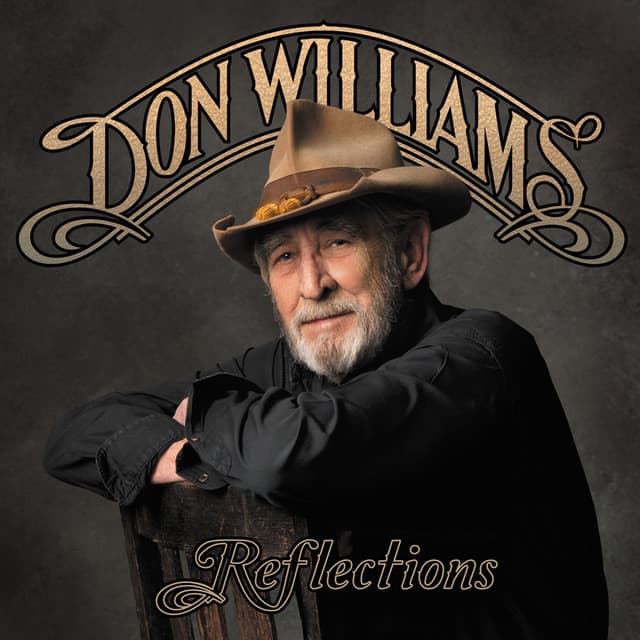
The Gentle Giant’s Hymn of Redemption: An In-Depth Analysis of Don Williams’ “Sing Me Back Home”
In the vast, rich tapestry of American Country Music, few voices command the quiet, unwavering respect elicited by Don Williams. Known affectionately as the “Gentle Giant,” Williams possessed a smooth, resonant baritone and a laid-back delivery that stood in stark contrast to the flamboyant outlaws and slick countrypolitan stars of his era. When discussing his masterful repertoire, his interpretation of “Sing Me Back Home” stands as a monumental achievement in narrative balladry. While the song is inextricably linked to its writer, Merle Haggard, Don Williams’ rendition transcends mere imitation, transforming a gritty, sorrowful prison tale into a universal, spiritual meditation on mortality, memory, and the transcendent power of music.
To fully understand the gravity of Williams’ version, one must first acknowledge the song’s profound origins. “Sing Me Back Home” was penned by Merle Haggard in 1967, deeply inspired by his own harrowing experiences as an inmate in California’s notorious San Quentin State Prison. The lyrics recount the chilling, true-to-life reality of a condemned prisoner being led down the hallway to the execution chamber. In his final moments, the doomed man makes a poignant request: he asks a fellow inmate to play a song on the guitar, a melody that will transport him away from the cold steel and impending death, back to the warmth of his childhood, his mother, and a time of innocence. Haggard’s original was laced with the raw, lived-in grit of a man who had narrowly escaped that very fate.
However, when Don Williams approached this sacred text of country music, he brought an entirely different emotional palette to the canvas. If Haggard’s version is a journalistic recounting from the prison yard, Williams’ interpretation is a pastoral elegy delivered by a compassionate chaplain. Released on his 1976 album Harmony, Williams’ “Sing Me Back Home” is a masterclass in subtlety and emotional restraint, hallmarks of his distinguished career.
Vocal Delivery and Phrasing
The sheer mechanics of Don Williams’ vocal delivery are central to the success of this track. Williams was never a shouter; he was a crooner of the highest order, an artist who understood that less is almost always more. As he sings the opening lines—“The warden led a prisoner down the hallway to his doom”—there is no melodrama, no theatrical sorrow. Instead, his deep baritone washes over the listener with an unhurried, stoic warmth.
Williams utilizes a conversational phrasing technique that makes the listener feel as though he is sitting directly across from them, recounting a tragic memory in a quiet room. His voice acts as a comforting blanket wrapped around the harsh reality of the lyrics. When he reaches the chorus—“Sing me back home, a song I used to hear / Make my old memories come alive”—the slight, deliberate vibrato at the end of his phrases imbues the words with a profound ache. It is not the sound of a man panicking in the face of death, but rather a soul seeking a peaceful transition to the other side. By smoothing out the rough edges of the honky-tonk original, Williams elevates the song from a localized prison narrative to an existential hymn.
Musical Arrangement and Production
In true Don Williams fashion, the musical arrangement of “Sing Me Back Home” is stripped of any unnecessary ornamentation. During the 1970s, much of country music was being heavily produced with lush string sections and backing choirs (the “Nashville Sound”). Williams, however, championed a more organic, acoustic-driven sound that predated the Americana movement.
The track is built upon a foundation of gentle acoustic guitar strumming and a steady, heartbeat-like bassline. The tempo is purposefully languid, forcing the listener to slow down and absorb the weight of the narrative. A weeping pedal steel guitar—the quintessential instrument of country music melancholy—drifts in and out of the arrangement, acting almost as the ethereal voice of the memories the condemned man is desperately trying to grasp. The instrumentation never competes with the vocal; rather, it creates a sparse, atmospheric landscape that allows the lyrics to breathe. This minimalist approach requires immense confidence, demonstrating Williams’ trust in the song’s inherent strength and his own storytelling abilities.
Thematic Resonance and the Power of Music
At its core, “Sing Me Back Home” is an exploration of the ultimate power of music itself. It posits the idea that a simple song can act as a vessel, capable of defying the physical confines of a prison cell and the temporal finality of death. When Williams sings, “Take me away and turn back the years / Sing me back home before I die,” he is tapping into a universal human longing for sanctuary.
In Williams’ hands, the concept of “home” takes on a dual meaning. On a literal level, it is the childhood home, the church choir, and the nostalgic comfort of a mother’s presence. On a spiritual level, “home” represents the afterlife, a state of grace and redemption. Williams’ inherent vocal dignity grants the condemned man an profound sense of humanity and respect. The listener is not asked to judge the prisoner for the crimes that led him to death row; instead, they are invited to mourn the loss of his innocence and empathize with his final, humble request.
Cultural Impact and Legacy
Don Williams’ interpretation of “Sing Me Back Home” solidifies his legacy as one of the greatest interpreters of song in American music history. He bridged a crucial gap in country music, proving that traditional, story-driven country songs did not need to be abrasive or overly stylized to be authentic. His rendition introduced Haggard’s masterpiece to an audience that gravitated towards softer, adult-contemporary country, without sacrificing an ounce of the song’s emotional devastation.
In conclusion, Don Williams’ “Sing Me Back Home” is much more than a cover song; it is a profound reimagining. By marrying Merle Haggard’s brilliant, tragic lyricism with his own velvet baritone and acoustic minimalism, Williams created a recording that is both deeply sorrowful and incredibly comforting. He reminds us that at the end of our road, regardless of the paths we have taken, we all share the same fundamental desire: to be comforted by the familiar, to be forgiven, and to be sung back home. For anyone wishing to understand the soul of traditional country music—its capacity for empathy, its storytelling prowess, and its deep understanding of the human condition—this track remains an essential, timeless listening experience.
 Oldies Songs