
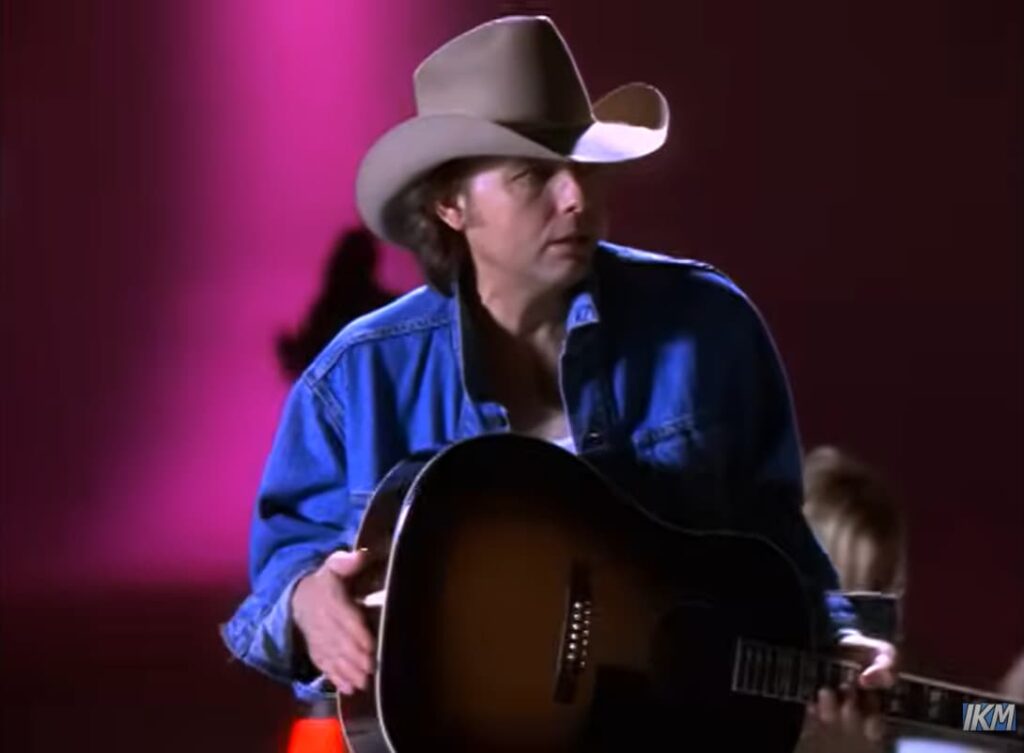
A sharp question wrapped in honky-tonk steel, “What Do You Know About Love” confronts illusion with experience, exposing the quiet distance between words and true feeling
When Dwight Yoakam released “What Do You Know About Love” in 1986 as part of his breakthrough album “Guitars, Cadillacs, Etc., Etc.”, he was not merely adding another track to a debut record—he was deepening the emotional vocabulary of a movement that sought to bring country music back to its roots. While the song itself was not issued as a major standalone single like “Honky Tonk Man” or the title track “Guitars, Cadillacs,” it played an essential role in shaping an album that would eventually reach No. 1 on the Billboard Top Country Albums chart and earn platinum certification in the United States.
At a time when country music was leaning toward polished production and crossover appeal, Dwight Yoakam stood apart with a sound that felt both rebellious and reverent. Drawing heavily from the Bakersfield sound, inspired by artists like Buck Owens, Yoakam infused his music with twang-heavy guitars, tight rhythms, and a vocal delivery that carried both restraint and quiet intensity. “What Do You Know About Love” embodies this aesthetic perfectly—lean, direct, and emotionally unguarded.
The song itself is built on a deceptively simple premise: a question. But it is not asked out of curiosity—it is asked out of experience, perhaps even disappointment. “What do you know about love?” becomes less of an inquiry and more of a challenge, directed at someone whose understanding of love seems shallow or untested. There is a subtle bitterness beneath the surface, but it is never overstated. Instead, it lingers quietly, like a thought that has been carried for far too long.
Listening closely, one begins to sense that the narrator is not only questioning another person, but also reflecting inward. This duality gives the song its emotional depth. It is not about accusation alone; it is about realization—the kind that arrives slowly, often too late to change what has already been lost.
Musically, the arrangement is spare yet purposeful. The electric guitar cuts cleanly through the mix, its tone bright but not overwhelming. The rhythm section moves steadily, never rushing, allowing the lyrics to breathe. And then there is Yoakam’s voice—clear, slightly nasal, but filled with nuance. He does not push the emotion; he allows it to settle naturally, trusting the listener to feel what lies between the lines.
What makes “What Do You Know About Love” particularly compelling is its honesty. There is no attempt to romanticize or dramatize. Love, in this song, is not idealized—it is examined. It is shown as something that can be misunderstood, misused, or simply taken for granted. And in that portrayal, there is a quiet truth that resonates deeply.
The broader context of “Guitars, Cadillacs, Etc., Etc.” further enhances the song’s significance. The album marked the beginning of what would become the neotraditional country movement, a return to the genre’s core elements after years of stylistic drift. Alongside artists like Randy Travis and George Strait, Dwight Yoakam helped redefine what country music could be—stripped of excess, grounded in storytelling, and emotionally authentic.
There is also something timeless in the way “What Do You Know About Love” unfolds. It does not rely on trends or production techniques that might date it. Instead, it leans on fundamentals—melody, lyric, voice. This simplicity allows the song to endure, to feel as relevant now as it did upon release.
Listening today, one cannot help but feel a certain stillness within the song. It invites reflection, not reaction. It asks the listener to consider their own understanding of love—their own experiences, their own regrets, their own quiet realizations.
And perhaps that is the lasting power of Dwight Yoakam’s work here. He does not offer answers. He does not resolve the question. He simply asks it—and in doing so, leaves it echoing long after the music fades.