
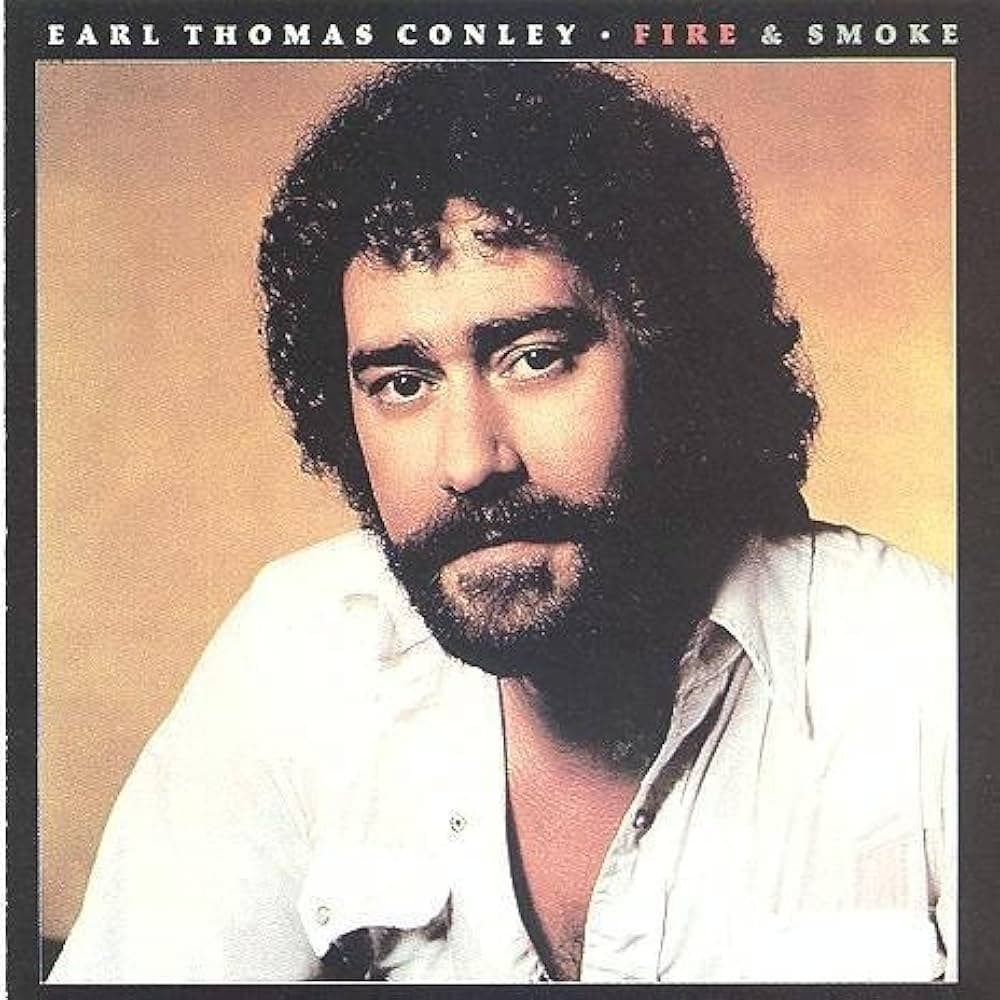
A slow-burning farewell where pride, regret, and longing rise together like fire and smoke
When Earl Thomas Conley released “Fire and Smoke” in January 1981, he was not merely offering another country single to radio — he was stepping into a defining moment of his career. The song became his first No. 1 hit on the Billboard Hot Country Singles chart, reaching the top spot in April 1981. It also marked the beginning of one of the most remarkable streaks in country music history: Conley would go on to score 18 No. 1 country hits during the 1980s, more than any other artist in that decade except Alabama.
“Fire and Smoke” was included on his 1981 album Fire & Smoke, a record that further established Conley as one of the architects of what would soon be known as “thinking man’s country” — emotionally intelligent, introspective, and subtly progressive. The album itself performed strongly on the country charts, reinforcing the arrival of a voice that was both contemporary and deeply rooted in tradition.
Written by Earl Thomas Conley and his longtime collaborator Randy Scruggs, “Fire and Smoke” tells the story of a man standing at the edge of a relationship’s collapse. But what sets it apart is not simply heartbreak — country music has never lacked for that — it is the psychological tension woven into the lyric. The narrator is torn between pride and vulnerability, between wanting to hold on and refusing to beg. The imagery of “fire and smoke” becomes more than metaphor; it becomes emotional architecture. Fire represents passion, anger, intensity. Smoke is what lingers afterward — the memory, the doubt, the residue of something once bright.
By the early 1980s, country music was undergoing a transformation. The Urban Cowboy movement had brought polished production and crossover appeal. Yet Conley’s approach was different. His voice carried a conversational intimacy, almost a confessional tone. There was no theatrical excess in “Fire and Smoke.” Instead, there was restraint. His delivery feels as though he is thinking out loud, carefully choosing words that might either mend the fracture or widen it.
The production reflects that tension. Gentle electric guitar lines, steady rhythm section, and understated backing vocals create a sonic atmosphere that feels warm yet unsettled. The arrangement never overwhelms the lyric. Instead, it allows Conley’s phrasing — slightly drawn out, tinged with gravel — to carry the emotional weight. When he sings about love slipping away, one senses not melodrama, but quiet desperation.
What makes “Fire and Smoke” endure is its honesty. The narrator does not claim innocence. He does not place blame entirely on the other person. There is a maturity in acknowledging that sometimes relationships fade not in explosive endings, but in slow, smoldering silences. The song captures that fragile moment when both parties know something precious is ending, yet neither can fully articulate how to save it.
In retrospect, the success of “Fire and Smoke” signaled more than a chart achievement. It announced that Earl Thomas Conley had found his artistic identity. Throughout the 1980s, with hits like “Holding Her and Loving You” and “Nobody Falls Like a Fool,” he would continue exploring the emotional gray areas of love — the spaces between right and wrong, desire and duty. But this was the spark that ignited it all.
Listening today, decades removed from its chart-topping run, the song feels almost cinematic. It conjures images of dimly lit rooms, conversations unfinished, and memories that refuse to fade. There is something deeply human in its restraint — the understanding that pride can stand in the way of reconciliation, that sometimes the heart burns long after the flames have died down.
Earl Thomas Conley’s “Fire and Smoke” remains a testament to the power of subtle storytelling in country music. It reminds us that the most profound emotions are often expressed not in grand declarations, but in quiet admissions — in the lingering smoke that tells us a fire once burned bright.
 Oldies Songs