
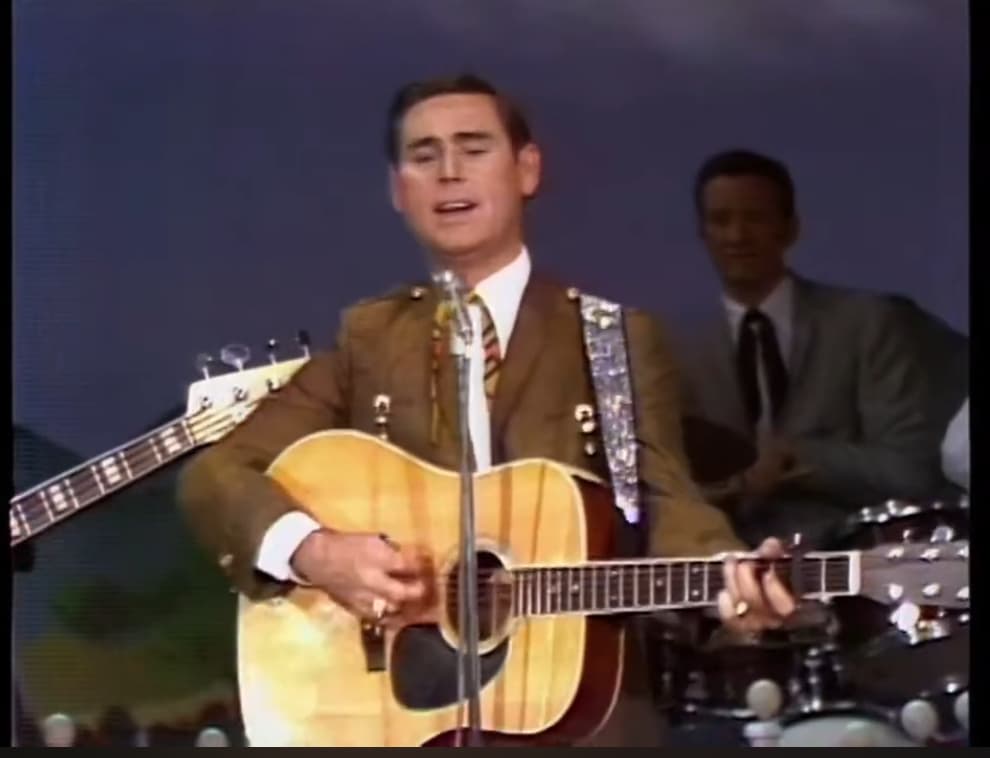
Love as a Race No One Truly Wins — “The Race Is On” Captures the Emotional Urgency and Honky-Tonk Brilliance of George Jones
In the long history of country music, certain songs feel less like entertainment and more like snapshots of human emotion caught in motion. “The Race Is On” is one of those songs. When George Jones performed it live in the early 1970s, audiences heard more than a lively honky-tonk tune. They heard the voice of an artist who could turn a clever metaphor into something deeply personal, something that lingered long after the final note faded.
Originally released in 1964, “The Race Is On” became one of the most memorable hits in the career of George Jones, reaching No. 3 on the Billboard Hot Country Singles chart. Written by the prolific songwriter Don Rollins, the song stood out immediately because of its unique concept. Instead of telling a straightforward story about heartbreak, Rollins framed the emotional collapse of a relationship as if it were a horse race.
This unusual metaphor gave the song its irresistible charm. The narrator describes the moment when love begins to fall apart, comparing it to the frantic energy of a racetrack where different emotions surge forward like competing horses. Pride, heartbreak, and loneliness are all “running” in the race, each struggling to reach the finish line first.
When George Jones recorded the song, he brought a remarkable balance of humor and sorrow to the performance. That ability to blend lighthearted storytelling with genuine emotional depth was one of the defining characteristics of his singing style.
By 1964, Jones was already becoming one of the most respected voices in country music. Earlier in his career, he had achieved his first No. 1 country hit in 1959 with “White Lightning,” a lively song that introduced many listeners to his powerful vocal delivery. Over the following years, he continued to build an extraordinary catalogue of recordings that would eventually earn him the reputation as “the greatest country singer of all time” among many critics and musicians.
Yet “The Race Is On” revealed another side of his artistry. Unlike the deeply sorrowful ballads that would later define much of his work, this song carried a faster tempo and a playful lyrical structure. The music moves forward with the energetic rhythm typical of classic honky-tonk country. Steel guitar, piano, and driving percussion combine to create the atmosphere of a lively dance hall.
Despite that upbeat sound, the emotion beneath the surface remains unmistakably serious. The narrator knows that the race he describes is not one he can win. Each metaphorical “horse” in the race represents a feeling that arrives when love fades away.
This contrast between lively music and emotional vulnerability became one of the reasons the song resonated so strongly with audiences. Country music has always thrived on that delicate balance between joy and sorrow.
When George Jones performed “The Race Is On” live around 1970, the song had already become one of his signature numbers. Live performances revealed how naturally he connected with the material. His delivery felt relaxed and spontaneous, yet every line carried the unmistakable emotional precision that made his voice so distinctive.
On stage, Jones often allowed the humor of the lyric to shine through. The racing imagery—complete with references to odds, betting, and the unpredictable outcome of a race—gave audiences moments to smile even as the deeper meaning unfolded.
But beneath the playful metaphor lay a universal truth. Love, like a race, moves quickly. Emotions surge forward unexpectedly, sometimes leaving people struggling to keep up with their own feelings.
Listening to “The Race Is On” today offers a glimpse into the golden era of country music when storytelling remained at the heart of every great recording. The song demonstrates how a simple idea, when delivered by the right voice, can become something unforgettable.
And few voices carried that power quite like George Jones. His ability to transform a clever lyric into a deeply human experience ensured that songs like “The Race Is On” would continue to echo across generations.
Even now, decades after those early live performances, the race described in the song still feels strangely familiar. Pride, heartbreak, and memory continue to run their unpredictable course through the human heart.
And somewhere in the distance, the voice of George Jones still calls the race, reminding us that in matters of love, the finish line is never quite where we expect it to be.