
A Young Voice Carrying the Spirit of Honky Tonk — “Pass Me By (If You’re Only Passing Through)” Reveals the Honest Country Soul of Johnny Rodriguez
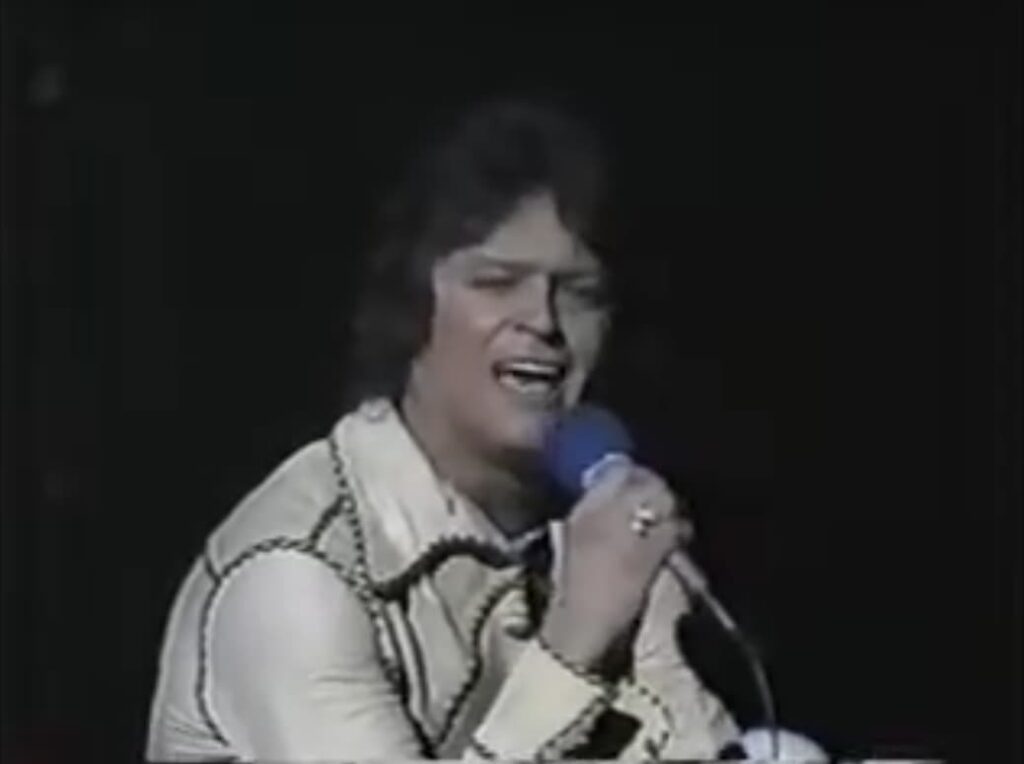
When Johnny Rodriguez stepped onto the stage at the 1974 Country Music Association Awards, he was not merely performing another country hit. His rendition of “Pass Me By (If You’re Only Passing Through)” represented something larger: the arrival of a new voice in country music, one that carried both youthful energy and the deep emotional traditions of classic honky tonk storytelling.
Originally released in 1973, “Pass Me By (If You’re Only Passing Through)” became the very first single of Johnny Rodriguez’s career—and it immediately made an impact. The song climbed to No. 9 on the Billboard Hot Country Singles chart, an impressive achievement for a debut artist. Even more remarkably, Rodriguez followed this success with a string of chart-topping hits, including “You Always Come Back (To Hurting Me)” and “Ridin’ My Thumb to Mexico,” both of which reached No. 1 on the same chart in 1973.
The song itself was written by the respected country songwriter H. B. Hall, whose ability to capture emotional simplicity gave the composition its quiet power. The lyric tells the story of a man who has grown weary of temporary affection. He longs for something lasting, something real. The narrator’s message is direct but heartfelt: if love is only fleeting, it would be kinder to walk away rather than leave behind another broken memory.
In many ways, “Pass Me By (If You’re Only Passing Through)” reflects the very soul of traditional country music. The song does not rely on dramatic storytelling or complicated metaphors. Instead, it expresses a universal truth about relationships—the longing for sincerity in a world where promises are sometimes made too easily.
When Johnny Rodriguez recorded the song, he brought with him a voice that felt both fresh and deeply rooted in country tradition. Born in Sabinal, Texas, Rodriguez had grown up surrounded by the sounds of Tex-Mex, honky tonk, and traditional country radio. His musical influences ranged from George Jones to Lefty Frizzell, and those influences can be heard in the relaxed phrasing and emotional authenticity of his singing.
What made Rodriguez especially unique at the time was his ability to blend classic country with subtle Latin influences, reflecting his Mexican-American heritage. Though “Pass Me By (If You’re Only Passing Through)” remains firmly within the traditional country style, his voice carries a warmth and melodic phrasing that set him apart from many of his contemporaries.
The performance at the 1974 CMA Awards captured this quality beautifully. Rodriguez appeared onstage with the calm confidence of a rising artist who understood the emotional weight of the song he was singing. There were no elaborate theatrics—just a steady voice, a gentle rhythm section, and the timeless storytelling that has always defined country music at its best.
The early 1970s were an exciting time in Nashville. New artists were emerging while still honoring the traditions established by earlier legends. Johnny Rodriguez quickly became part of this new generation, helping to bridge the gap between the classic honky tonk sound and the evolving country music landscape.
His debut album, Introducing Johnny Rodriguez (1973), further cemented his place in the industry. The record showcased his natural storytelling ability and demonstrated that his success was not a one-time moment but the beginning of a lasting career.
Listening to “Pass Me By (If You’re Only Passing Through)” today reveals why the song resonated so strongly when it first appeared. There is something disarmingly honest about its message. The narrator is not asking for grand declarations or romantic drama. All he wants is sincerity—the kind of love that stays rather than simply drifting away.
That emotional clarity became one of the defining qualities of Johnny Rodriguez’s early recordings. His voice carried a sense of lived experience, even in his twenties, giving his songs a credibility that listeners immediately recognized.
And so when the final notes of “Pass Me By (If You’re Only Passing Through)” fade away, the song leaves behind more than just a melody. It leaves the quiet reflection that has always been at the heart of great country music: the understanding that real love is not something that simply passes through life—it is something that stays, grows, and endures long after the music has ended.