
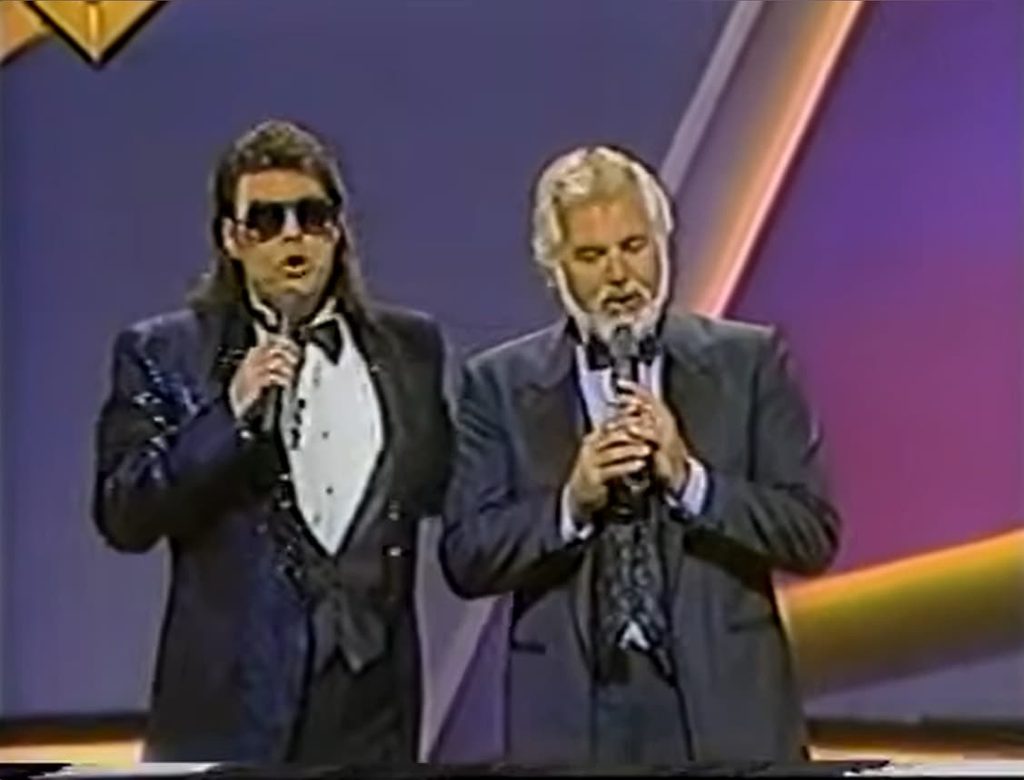
How Two Distinctive Country Voices Turned A Song About Love, Jealousy And Rivalry Into A Grammy Winning Duet That Topped The Country Charts
In the summer of 1987, two of country music’s most recognizable voices came together for a duet that turned a familiar romantic dilemma into a memorable musical confrontation. Kenny Rogers and Ronnie Milsap recorded “Make No Mistake, She’s Mine,” a song in which two men insist that the woman they love belongs with them. Released as a single in June 1987, the recording climbed to No. 1 on Billboard’s Hot Country Singles chart and also topped Canada’s country chart. The following year, it earned the pair a Grammy Award for Best Country Vocal Performance, Duet, cementing its place among the standout country collaborations of the late eighties. The song was not built around a conventional love duet in which two singers express affection for one another. Instead, Rogers and Milsap faced each other musically as rivals, each convinced that his feelings were genuine and that the woman at the centre of the story had already made her choice.
The song was written by Kim Carnes, whose own recording history gave it an interesting earlier life. In 1984, Carnes recorded “Make No Mistake, He’s Mine” with Barbra Streisand for Streisand’s album Emotion. That original version told the story from the perspective of two women claiming the same man. When Rogers and Milsap recorded it three years later, the pronouns were reversed, transforming the story into a contest between two men. The change was simple, but it gave the song an entirely different character. Rather than merely copying an earlier hit, the country version found a new setting for the same emotional conflict, allowing two male singers with very different musical identities to inhabit the story.
What made the pairing work was the contrast between the singers. Kenny Rogers had one of the most recognizable voices in popular music, with a grainy warmth that could make a dramatic lyric sound personal and conversational. By the late eighties, he had already enjoyed enormous success with songs such as “The Gambler,” “Lucille,” “Lady” and “Islands in the Stream.” Ronnie Milsap, meanwhile, brought a different musical background to the collaboration. A gifted pianist and vocalist, he blended country, pop, rhythm and blues, and adult contemporary influences into a sound that had produced a remarkable run of country hits. Milsap’s expressive delivery could be smooth one moment and powerful the next. Together, the two singers gave the song the tension it needed: neither voice overwhelmed the other, and their contrasting styles made the disagreement feel convincing rather than theatrical.
The recording appeared on both artists’ albums in 1987. For Milsap, it was included on Heart & Soul, released in February, while Rogers featured it on I Prefer the Moonlight, released on August 3. The single was produced by Rob Galbraith and Kyle Lehning, who helped shape the polished country pop sound that was popular during the period. Its success also arrived at a significant moment for both performers. Milsap was enjoying another strong stretch of chart success, while Rogers continued to demonstrate that his voice and musical instincts could adapt to changing trends without losing their identity. Their collaboration was a meeting of two established stars, but it never sounded like a contest over who possessed the greater reputation. The competition belonged to the characters in the song, and that distinction gave the performance its charm.
When the 30th Annual Grammy Awards took place in 1988, “Make No Mistake, She’s Mine” won the award for Best Country Vocal Performance, Duet. The honour recognized not simply the popularity of the single, but the effectiveness of the two voices working together. The song had already reached the top of the country charts, yet its Grammy victory gave the collaboration an enduring place in the history of both singers’ careers.
Listening to “Make No Mistake, She’s Mine” today, the appeal lies in the way the story unfolds through the voices themselves. Rogers brings his familiar, lived in warmth, while Milsap answers with the clarity and emotional intensity that defined so many of his recordings. Neither singer needs to turn the performance into a vocal competition. Their restraint makes the disagreement more believable, and the melody gives the song a tenderness that balances its possessive lyrics. It remains a memorable meeting between two artists who had already built extraordinary careers of their own, joined by a song that gave each of them room to make his case.