
A Voice That Carried the Old West Into the Living Room, Where Storytelling Became Something Deeply Personal
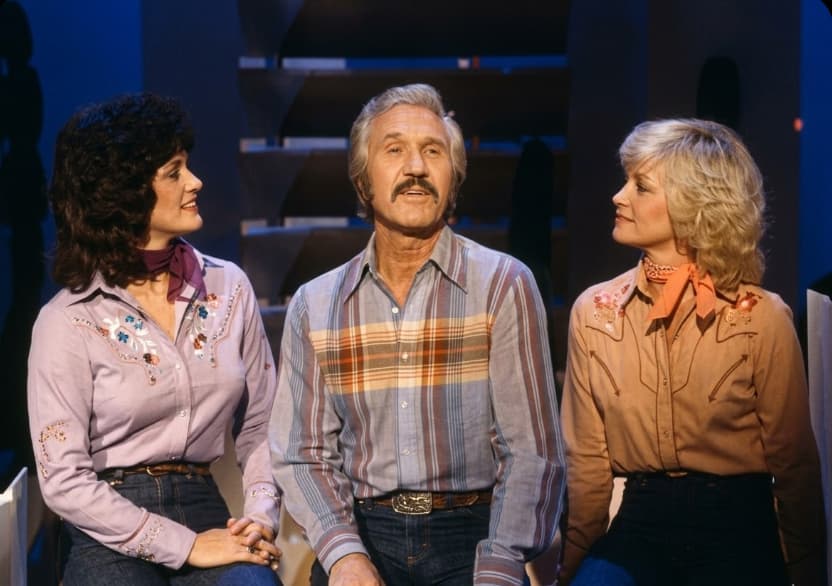
In 1980, when Marty Robbins appeared on “Barbara Mandrell and the Mandrell Sisters Show”, it was more than just another television performance. It was a moment where one of country music’s most enduring storytellers stepped into a setting that blended entertainment with intimacy, bringing with him a lifetime of songs that had already shaped the genre. By that time, Marty Robbins was not simply a successful recording artist — he was a figure whose work had consistently reached the highest levels of recognition, including classics like “El Paso”, which had achieved No. 1 on the Billboard Hot 100 in 1960, and remained one of the defining narrative songs in country music history.
His presence on the show carried the quiet authority of someone who no longer needed to prove anything. The Mandrell program, known for its mix of musical performances and light-hearted segments, offered a different kind of stage — one that allowed artists to be seen not only as performers, but as individuals. For Marty Robbins, this environment revealed something essential about his artistry. Stripped of the vastness of concert halls and the structure of studio recordings, his voice seemed even more direct, more immediate.
By 1980, Robbins had already built a career that spanned genres within country music — from western ballads to honky-tonk, from gospel to pop-inflected recordings. Yet, no matter the style, there was always a consistent thread: his ability to tell a story with clarity and restraint. Watching his performance on “Barbara Mandrell and the Mandrell Sisters Show”, one can sense that same discipline. He does not overextend. He does not seek to dominate the moment. Instead, he allows the song — whichever he chooses to deliver — to unfold naturally, trusting in its structure and its meaning.
The significance of this appearance lies not in chart positions tied to that specific performance, but in the broader context of Robbins’ legacy. By this point, he had accumulated numerous Top 10 hits on the Billboard Hot Country chart, along with multiple No. 1 records. Songs like “Devil Woman”, “Don’t Worry”, and “My Woman, My Woman, My Wife” had already secured his place among the greats. But television appearances such as this offered something that records could not fully capture — a glimpse of the man behind the voice, the ease with which he carried himself, the quiet confidence that came from years of experience.
There is also something deeply reflective in the timing. The early 1980s marked a period when country music, like many genres, was beginning to evolve in new directions. Production styles were changing, audiences were shifting, and the industry itself was becoming more polished, more commercially driven. In that environment, Marty Robbins represented continuity. His presence served as a reminder of where the music had come from — of a time when songs were built on narrative, when the strength of a lyric could carry an entire performance.
The emotional core of his appearance lies in that sense of continuity. Whether he was performing a well-known hit or engaging in conversation, there is a feeling that he is not merely revisiting the past, but carrying it forward. His voice, still steady and controlled, holds within it the echoes of earlier decades. It does not strain to adapt. It simply remains true to itself.
For those watching at the time, the performance may have felt like a familiar comfort — a recognition of something that had been present for years and continued to endure. For those looking back now, it carries an additional layer of meaning. It becomes a document of presence, a moment where an artist who had already given so much to music stands quietly, offering it once more without embellishment.
In the end, Marty Robbins’ appearance on “Barbara Mandrell and the Mandrell Sisters Show” is not defined by spectacle or novelty. It is defined by authenticity. It reminds us that music, at its most powerful, does not require reinvention at every turn. Sometimes, it simply requires honesty — the kind that comes from understanding both the song and the life behind it.
And in that quiet understanding, Marty Robbins leaves something lasting. Not just a performance, but a presence — steady, unhurried, and deeply rooted in the tradition that shaped him.
 Music Legend