
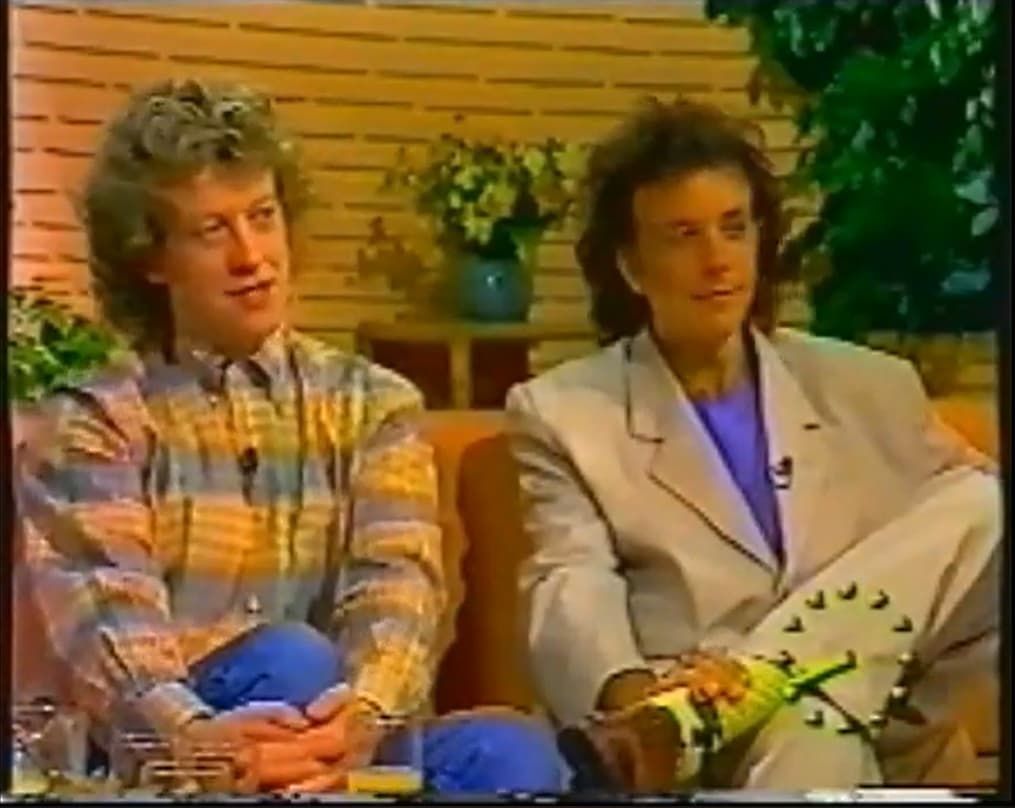
A warm reunion of two defining voices of the 1970s, where memory, music, and time gently intertwine in conversation.
There is something quietly profound about watching Noddy Holder and David Essex sit side by side on Good Morning Britain in August 1990, reflecting on a decade that had long since passed but never truly faded. The program, hosted by Lorraine Kelly and Richard Keys, was not merely an interview—it became, in many ways, a living archive of the 1970s, told through the voices of two men who had once stood at the very center of it.
To understand the emotional texture of that conversation, one must first recall what these artists represented in their prime. Noddy Holder, as the unmistakable frontman of Slade, helped define the sound of British glam rock. Between 1971 and 1976, Slade achieved an extraordinary run of six UK No. 1 singles, including “Coz I Luv You” (1971), “Cum On Feel the Noize” (1973), and the enduring holiday anthem “Merry Xmas Everybody” (1973). Their raw, chant-driven sound and working-class exuberance made them one of the most beloved bands of the era. Songs like “Skweeze Me, Pleeze Me” and “Mama Weer All Crazee Now” weren’t simply hits—they were communal experiences, built for crowded halls and shared voices.
Alongside this energy stood David Essex, whose musical identity leaned toward something more introspective. His breakthrough single “Rock On” (1973) reached No. 3 in the UK and later No. 5 on the Billboard Hot 100, introducing a hypnotic, almost spoken-word style that set him apart. Then came “Gonna Make You a Star” (1974), a song that climbed to No. 1 in the UK, capturing both the allure and illusion of fame with a melodic sincerity that still resonates. Where Holder’s voice roared with celebration, Essex’s often carried a quieter kind of longing.
By 1990, the landscape of popular music had shifted dramatically. The glitter and grit of the 1970s had given way to new sounds, new faces, and new cultural rhythms. Yet, watching these two artists revisit that earlier time, one senses not loss, but a kind of gentle acceptance. There is laughter in their recollections, certainly, but also a subtle awareness of how fleeting those moments were.
What makes this television appearance particularly compelling is its absence of performance in the traditional sense. There are no grand stages, no amplifiers, no roaring crowds. Instead, there is conversation—unhurried, reflective, and quietly revealing. Noddy Holder speaks with the same unmistakable warmth that once powered Slade’s anthems, while David Essex offers his thoughts with a calm, measured tone that suggests years of contemplation.
The “song,” in this case, is not a single track but the collective memory of an era. The meaning lies not in lyrics, but in what is remembered—and what is left unsaid. It is about youth, certainly, but also about the passage of time, about how success is experienced differently when viewed from a distance. There is an unspoken understanding between them: that the music they created has outlived the moment in which it was born.
For those who remember the rise of Slade or the quiet magnetism of David Essex, this conversation carries a resonance that goes beyond nostalgia. It becomes a mirror, reflecting not just the artists’ journeys, but the listener’s own passage through time. The songs that once filled dance halls and radio waves now exist as markers of memory—each note tied to a moment that cannot be repeated, only revisited.
And perhaps that is the enduring significance of this 1990 appearance. It reminds us that music is never truly confined to the charts, though those numbers—six UK No. 1 hits for Slade, a string of top-ten successes for David Essex—tell an important part of the story. The deeper truth lies in how those songs continue to live, quietly, within the hearts of those who heard them when they were new.
As the conversation draws to a close, there is no grand conclusion, no dramatic statement. Just a sense of continuity. The past has not disappeared; it has simply settled into something softer, something more reflective. And in that quiet space, the voices of Noddy Holder and David Essex remain—no longer at the height of their fame, but perhaps closer than ever to the essence of what made their music endure.