
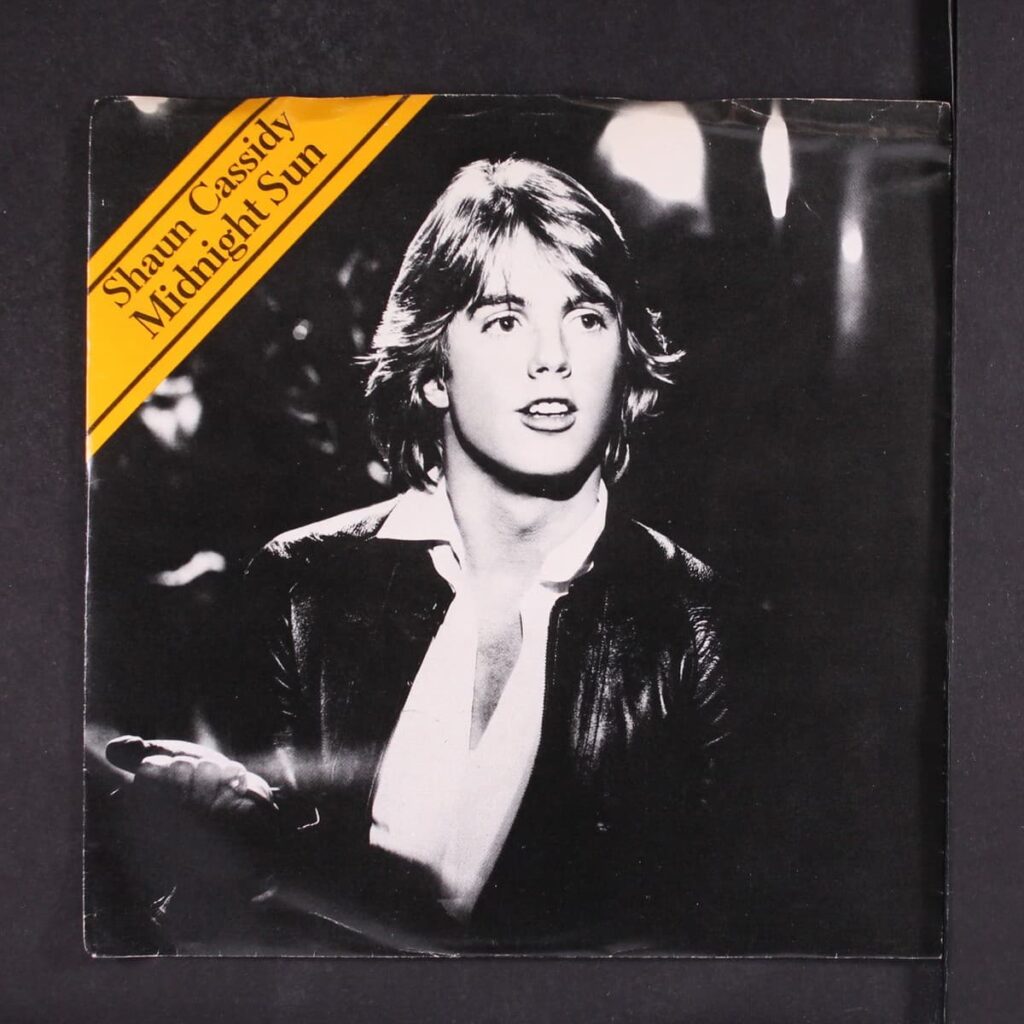
A reflective moment where brightness fades into twilight, and youthful confidence quietly gives way to introspection
When Shaun Cassidy released Midnight Sun, it felt like a subtle shift in tone, a song arriving not with fanfare, but with contemplation. By the late 1970s, Cassidy had already experienced the extraordinary velocity of pop stardom, carried by chart dominating singles and a public image defined by light, speed, and immediacy. Midnight Sun arrived as something different. It suggested pause. It suggested awareness. It suggested that even at the height of visibility, there are moments when one begins to look inward.
Midnight Sun was released in 1978 as a single from the album Under Wraps, a record that marked an important transitional phase in Shaun Cassidy’s recording career. While it did not achieve the commercial impact of earlier hits such as Da Doo Ron Ron or That’s Rock ’n’ Roll, the song reached the Billboard Hot 100, peaking in the lower half of the chart, and performed more strongly on the Adult Contemporary chart, where its reflective mood found a more receptive audience. The album Under Wraps itself entered the Billboard 200 and confirmed that Cassidy was seeking artistic growth rather than repetition.
The story behind Midnight Sun is closely tied to that moment of transition. As public fascination began to soften and the machinery of teen pop moved on, Cassidy found himself at a crossroads familiar to many artists who rise quickly. The song does not address fame directly, yet its atmosphere suggests someone aware of time passing, of brightness lingering longer than expected, yet inevitably changing.
Lyrically, Midnight Sun uses natural imagery to explore emotional uncertainty. The idea of sunlight at midnight carries an inherent contradiction, beauty that feels temporary and slightly disorienting. It reflects moments in life when clarity and confusion coexist, when happiness remains present but no longer feels permanent or guaranteed. Rather than dramatizing this realization, the song accepts it quietly.
Musically, the arrangement supports that emotional balance. Soft rock textures dominate, with gentle keyboards and a measured rhythm that allows the melody to unfold slowly. There is no rush toward a chorus designed to overwhelm. Instead, the song moves patiently, as if aware that reflection cannot be hurried. This restraint sets Midnight Sun apart from Cassidy’s earlier, more exuberant recordings.
Vocally, Shaun Cassidy delivers one of his most controlled performances. His voice sounds thoughtful, even cautious, as though the song requires honesty rather than charm. He does not lean on youthful brightness. He leans on phrasing, on tone, on the spaces between lines. The result feels intimate, as though the song were meant to be overheard rather than announced.
Within the context of Under Wraps, Midnight Sun plays a crucial role. The album as a whole leaned toward introspection, signaling Cassidy’s growing interest in storytelling and emotional nuance. It foreshadowed his eventual transition away from recording toward writing, producing, and working behind the scenes, where observation and reflection would become central strengths.
The meaning of Midnight Sun deepens with time. It is a song about living in between states, between day and night, certainty and doubt, arrival and departure. It does not mourn change, nor does it resist it. Instead, it acknowledges that moments of beauty often exist precisely because they are fleeting.
What gives the song its lasting resonance is its emotional maturity. It understands that growth often arrives quietly, without ceremony. Shaun Cassidy does not attempt to redefine himself here. He simply allows space for complexity. That choice gives the song a dignity that continues to resonate long after the charts have faded from memory.
Listening to Midnight Sun now feels like revisiting a moment suspended in amber. The melody still glows softly, but its warmth is tempered by awareness. It reminds us that some songs are not meant to capture a moment of triumph, but a moment of understanding.
In Shaun Cassidy’s catalog, Midnight Sun stands as a reflective chapter rather than a headline. It may not have defined an era, but it defined a state of mind. And in doing so, it offered something rare in pop music: a quiet acceptance of change, sung with grace, patience, and thoughtful restraint.