
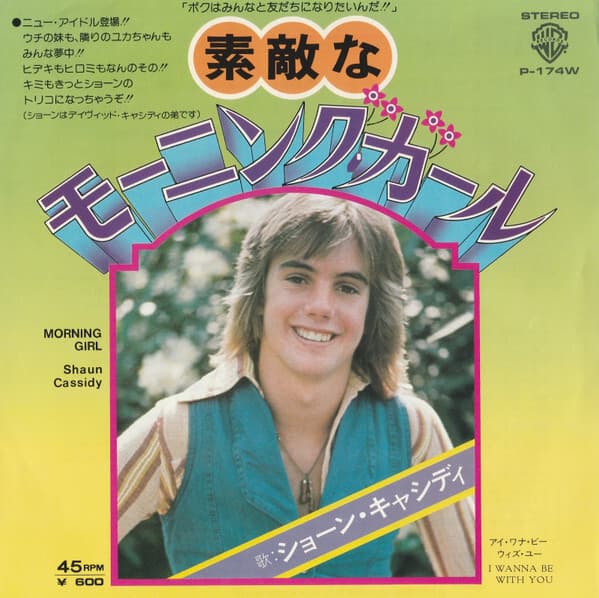
A gentle awakening where youthful warmth meets reflection and the promise of a new day
When “Morning Girl” was released by Shaun Cassidy in 1977, it arrived not as a declaration of rebellion or heartbreak, but as something far rarer in popular music a moment of calm affection and emotional openness. Issued as a single from the album “Born Late”, the song reached No. 10 on the Billboard Hot 100, confirming Cassidy’s ability to mature beyond teen idol status and step into a more thoughtful musical space. By the time “Morning Girl” found its audience, Cassidy was already a familiar voice on the radio, yet this recording revealed a quieter confidence that lingered long after the charts moved on.
Originally written and recorded by The Bee Gees in 1968, “Morning Girl” was a song rooted in tenderness rather than drama. Shaun Cassidy’s interpretation respected that spirit while reshaping it for a new decade. Where the original carried the gentle optimism of late sixties pop harmony, Cassidy’s version softened the edges even further, leaning into warmth, sincerity, and a sense of emotional steadiness. It was not a reinvention, but a careful continuation.
The placement of this song within “Born Late” is significant. The album itself marked a turning point in Cassidy’s career, released as he began distancing himself from the frenzy of his early fame. “Morning Girl” stands as one of the album’s emotional anchors. It does not rely on catchy hooks or flashy production. Instead, it invites the listener into a private emotional space, one shaped by reassurance and presence rather than urgency.
Lyrically, “Morning Girl” speaks in simple language, yet carries a depth that grows with time. The song is built around the idea of greeting someone at the start of the day, not with grand promises, but with quiet certainty. There is comfort in its repetition, in the way it acknowledges vulnerability without fear. Love here is not dramatic or uncertain. It is steady. It exists in small gestures and shared silence.
Shaun Cassidy’s vocal performance is key to the song’s lasting appeal. His voice, often associated with youthful excitement in earlier hits, is restrained and reflective here. He sings not to impress, but to reassure. There is a softness in his delivery that suggests emotional awareness rather than innocence. This subtle shift allowed listeners to hear him differently, not just as a familiar voice from posters and television screens, but as a singer capable of emotional nuance.
The success of “Morning Girl” on the charts reflected a broader moment in popular music during the late seventies. Audiences were beginning to embrace songs that offered emotional refuge rather than spectacle. In that environment, Cassidy’s version felt timely. It acknowledged change without resisting it, and growth without abandoning warmth.
The song’s origins with The Bee Gees add another layer of meaning. By choosing to record “Morning Girl”, Cassidy aligned himself with a tradition of melodic storytelling rooted in sincerity. The Bee Gees’ songwriting emphasized emotional clarity, and Cassidy honored that by avoiding excess. The arrangement remains clean and unforced, allowing the melody to breathe and the words to settle naturally.
Over time, “Morning Girl” has become one of those songs that quietly remains. It may not dominate retrospectives or compilation albums, yet it holds a special place for those who remember its presence on the radio during quieter hours. It feels less like a hit and more like a memory, one that returns unexpectedly and brings with it a sense of emotional balance.
In the larger arc of Shaun Cassidy’s career, “Morning Girl” represents maturity without loss. It shows an artist willing to slow down, to speak softly, and to trust that sincerity carries its own strength. The song does not ask to be remembered loudly. It simply stays, like the first light of morning, steady and unassuming, reminding us that some emotions do not fade, they just learn how to wait.