
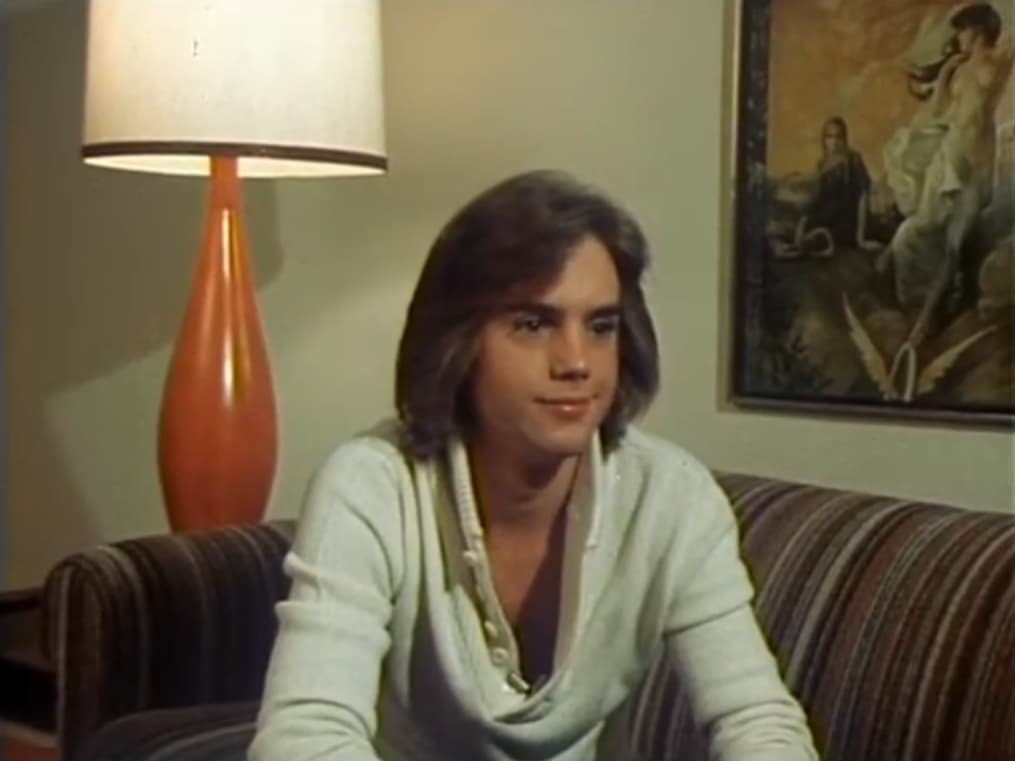
A Moment When Television Fame and Pop Stardom Collided, Revealing the Thoughtful Young Voice Behind the Teenage Idol
In 1977, few young performers embodied the whirlwind of television fame and pop music success quite like Shaun Cassidy. That year marked the height of his cultural impact. His chart topping single Da Doo Ron Ron had already reached No. 1 on the Billboard Hot 100 in July 1977, and his debut album Shaun Cassidy had turned him into one of the most recognizable faces in American pop culture. At the same time, millions of television viewers were tuning in each week to watch him star alongside Parker Stevenson in the hit television series The Hardy Boys/Nancy Drew Mysteries, where Cassidy portrayed the adventurous teenage detective Joe Hardy.
The interview now preserved in the Reelin’ In The Years Productions archive offers something rare: a glimpse behind the carefully polished image of a young star whose life was moving faster than most people could imagine. Watching that 1977 conversation today, one immediately senses the strange balance Cassidy was learning to maintain. On one side was the music industry, eager to shape him into a pop sensation. On the other was television, where the character of Joe Hardy had already made him a weekly presence in living rooms across America.
What makes this interview fascinating is not just the fame surrounding him at the time but the thoughtful way Cassidy spoke about his work. Despite being only nineteen years old, he often sounded reflective, almost cautious about the sudden explosion of attention that followed his success. In many ways, that attitude set him apart from the stereotype of the carefree teen idol. Cassidy seemed aware that fame could be fleeting, and he approached his music and acting with an unusual seriousness.
The year 1977 was particularly intense. After “Da Doo Ron Ron” conquered the charts, Cassidy followed it with another hit, That’s Rock ‘n’ Roll, which climbed to No. 3 on the Billboard Hot 100. The songs themselves were carefully chosen pieces of pop craftsmanship. “Da Doo Ron Ron,” originally recorded by The Crystals in 1963, carried the nostalgic energy of the early rock era while introducing it to a new generation of listeners. Cassidy’s version was bright, energetic, and youthful without sounding disposable. It felt like a bridge between the innocence of early 1960s pop and the polished production of the late 1970s.
During the interview, Cassidy often returned to the idea that music and acting demanded different kinds of discipline. Television required long days on set, memorizing scripts and hitting precise marks for the camera. Recording music, on the other hand, asked for emotional openness. In a studio environment, he had to trust producers and musicians while still finding his own voice within the arrangement. It was a learning process happening in real time.
Another interesting element revealed in the conversation is Cassidy’s awareness of legacy. As the son of Jack Cassidy and Shirley Jones, he had grown up surrounded by professional performers. His half brother David Cassidy had already experienced the overwhelming pressures of teen stardom earlier in the decade through The Partridge Family. That family history gave Shaun Cassidy a perspective that many rising stars never had. He knew what success looked like from the inside, and perhaps more importantly, he understood how quickly the spotlight could move elsewhere.
The tone of the interview feels remarkably calm considering the frenzy that surrounded him in 1977. Teen magazines were printing his photograph on countless covers. Concert venues filled with screaming fans. Yet in the archive footage, Cassidy often appears thoughtful rather than overwhelmed. He speaks carefully about the responsibility of performing for audiences who felt emotionally connected to his work.
Looking back now, the interview preserved by Reelin’ In The Years feels less like a promotional appearance and more like a time capsule from a specific moment in American pop culture. It captures the intersection of television storytelling and radio friendly pop music during an era when a single performer could dominate both mediums at once.
What remains most striking is how young Cassidy was while navigating it all. The charts, the television ratings, the screaming crowds were all part of the spectacle. But behind the headlines stood a thoughtful performer trying to understand what his sudden success meant for the future.
And in that quiet reflection lies the real story of Shaun Cassidy in 1977. Not simply a teen idol, but a young artist standing at the crossroads of music, television, and fame, learning in real time how quickly the world can start listening.