
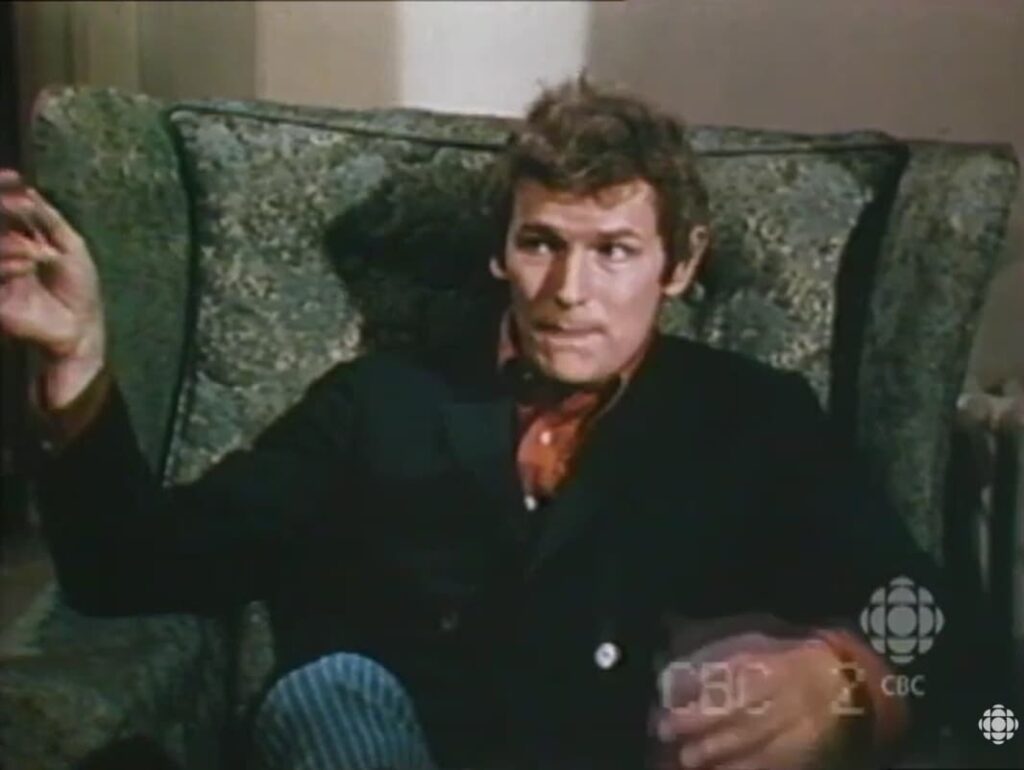
A quiet craft of truth and melody—where words are not written, but patiently discovered within the music itself
In 1967, at a time when folk music stood at the crossroads of tradition and transformation, Gordon Lightfoot offered a rare and thoughtful glimpse into his creative process—an insight that feels as timeless as the songs he would come to define. In this remarkable clip, Gordon Lightfoot does not present songwriting as a sudden burst of inspiration, nor as a calculated craft. Instead, he speaks of it as something far more delicate: a gradual unfolding, where melody leads and words follow, almost as if they had been waiting quietly to be found.
By 1967, Gordon Lightfoot was already establishing himself as one of the most respected voices in contemporary folk. His album Lightfoot! (1966) had introduced a wider audience to his deeply personal style, while songs like “Early Morning Rain” and “For Lovin’ Me” had begun to circulate widely—recorded by artists such as Peter, Paul and Mary and Ian & Sylvia. Although his own chart success would peak later—with “If You Could Read My Mind” (1970) reaching No. 5 on the Billboard Hot 100, and “Sundown” (1974) climbing to No. 1—the foundation of his artistry was already firmly in place during this earlier period.
What makes this 1967 reflection so compelling is its honesty. Lightfoot describes how a melody often comes first—simple, sometimes incomplete, yet carrying within it a certain emotional direction. From there, the words are not forced into place but allowed to emerge naturally. He speaks of searching for phrases that feel true to the mood of the music, as though the song itself dictates what it needs to say. It is a process rooted not in speed, but in patience.
There is something deeply revealing in this approach. In an era when many songs were being written quickly to meet the demands of a rapidly expanding music industry, Gordon Lightfoot chose a different path. His songs were not products; they were reflections—carefully shaped, emotionally grounded, and unmistakably personal. Listening to him speak, one senses that for him, songwriting was less about expression and more about discovery.
This philosophy helps explain the enduring quality of his work. Songs like “Early Morning Rain” do not rely on elaborate arrangements or dramatic shifts. Instead, they draw strength from their simplicity—the quiet image of an airplane, the feeling of longing, the sense of distance both physical and emotional. These are not grand narratives, but intimate moments, rendered with precision and care.
It is perhaps no surprise, then, that Bob Dylan—himself a master of lyrical storytelling—once remarked that when he heard a Gordon Lightfoot song, he wished “it would last forever.” This is not merely praise; it is recognition of a rare quality. There is something in Lightfoot’s music that resists conclusion, that lingers just beyond the final note, inviting the listener to remain within its atmosphere.
The 1967 clip captures Lightfoot at a moment of quiet confidence. He is not yet the chart-topping figure he would become, but there is already a sense of certainty in his voice—a clear understanding of what matters in his work. He does not speak of trends or audiences. Instead, he speaks of feeling, of alignment between melody and meaning.
There is also a certain humility in the way he describes his process. He does not claim mastery over the song; rather, he positions himself as a participant in its creation. The song exists first as a feeling, then as a melody, and only later as words. This order is essential, for it ensures that the final piece remains true to its original emotion.
Listening to this reflection today, one cannot help but feel a sense of stillness—a contrast to the often hurried pace of modern creation. Gordon Lightfoot reminds us that some of the most lasting art is not born from urgency, but from attention. From the willingness to wait, to listen, and to trust that the right words will come when they are ready.
In the end, what this 1967 moment reveals is not just how Gordon Lightfoot wrote songs, but why they endure. They are built on a foundation of sincerity, shaped by patience, and guided by an instinct for truth. And like the melodies he so carefully crafted, they continue—quietly, steadily—on and on, long after the final chord has faded.