
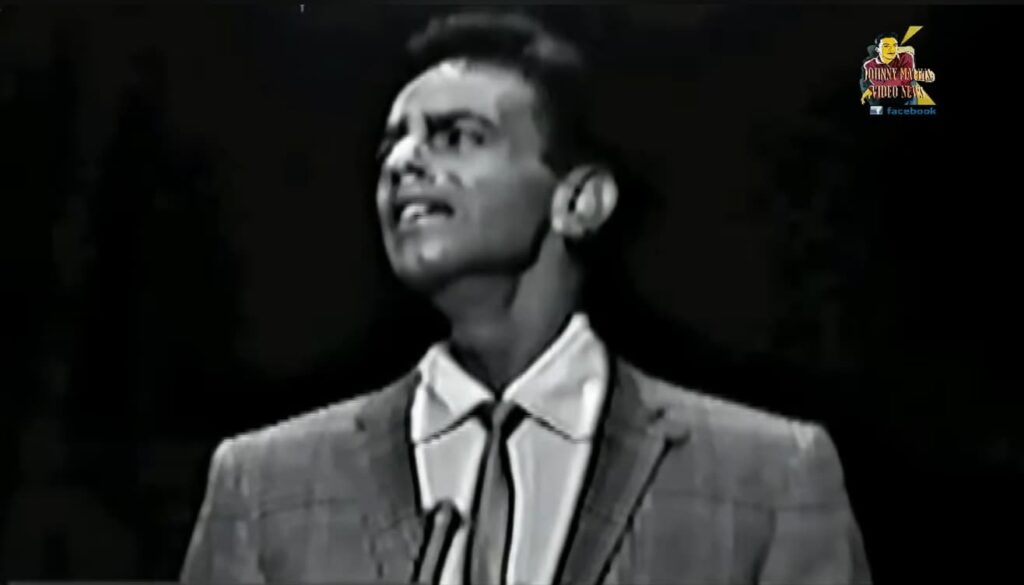
A tender vow carried on a velvet voice—where love is not fleeting, but quietly promised to endure beyond time
In the early 1960s, when popular music was still deeply rooted in orchestral elegance and lyrical sincerity, Johnny Mathis recorded “My Love for You”, a song that would come to represent the very essence of his artistic identity—romantic, restrained, and profoundly heartfelt. Released in 1961, the song formed part of the album Portrait of Johnny, a collection that further solidified his standing as one of the most refined interpreters of love songs in American popular music.
While “My Love for You” was not among Mathis’s highest-charting singles, it emerged during a period when his presence on the charts remained remarkably consistent. By this time, he had already achieved major success with “Chances Are” (1957)—which reached No. 1 on the Billboard Most Played by Jockeys chart—and “Misty” (1959), which became one of his signature recordings. These earlier triumphs created a context in which even his less commercially prominent recordings, like “My Love for You,” were received with a sense of quiet reverence by listeners who had come to trust his voice as a companion to their own emotional lives.
What distinguishes “My Love for You” is not its ambition, but its intimacy. The song unfolds gently, without urgency, as though it were meant to be discovered rather than announced. The melody, simple yet deeply expressive, provides the perfect canvas for Johnny Mathis’s unmistakable vocal tone—soft, controlled, and imbued with a warmth that feels almost conversational.
There is a certain purity in the way the song approaches its central theme. Love here is not dramatic or conflicted. It is steady, unwavering, and quietly assured. The lyrics speak not of longing or loss, but of presence—of a feeling that exists fully in the moment, without the need for validation or resolution. It is this emotional clarity that gives the song its enduring appeal.
The arrangement reflects the musical sensibilities of its time. A lush orchestral backdrop—strings that rise and fall with gentle precision, subtle woodwinds that add color without distraction—supports the vocal without ever overshadowing it. This balance was a hallmark of Mathis’s recordings during this era, guided by producers and arrangers who understood that his voice was the true centerpiece. Listening to “My Love for You” today, one is struck by its sense of restraint. In a musical landscape that would soon shift toward more immediate and amplified expressions, this song remains rooted in a quieter tradition. It invites the listener to slow down, to listen closely, to feel rather than react. There is no excess here—only intention.
It is also worth considering the broader context of Johnny Mathis’s career at this point. By 1961, he was no longer a newcomer, but an established figure whose style had already proven remarkably resilient. His ability to maintain artistic consistency in a rapidly changing industry speaks to a deeper understanding of his own strengths. He did not chase trends; he refined a sound that was uniquely his own. In “My Love for You,” that refinement reaches a particularly graceful expression. The song does not attempt to redefine the genre or push boundaries. Instead, it perfects a mood—a quiet, reflective space where emotion is conveyed through nuance rather than declaration.
There is something profoundly comforting in that approach. The song feels less like a performance and more like a private moment shared. It carries with it the sense of an unspoken promise, one that does not need to be repeated to be understood. And perhaps that is why it continues to resonate. Long after the final note fades, the feeling remains—soft, steady, and enduring. Much like the voice that brought it to life, “My Love for You” does not demand attention. It simply stays, gently, in the heart.