
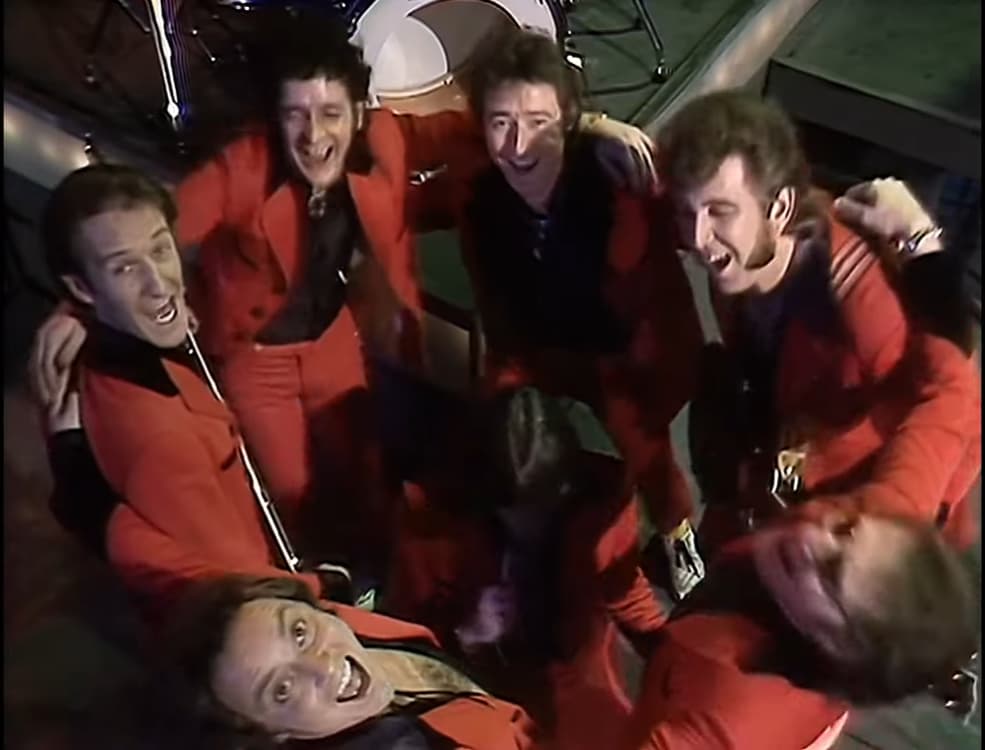
A revival of youthful rhythm and shared memory, where an old rock and roll spirit returns not as nostalgia alone, but as something still alive, still moving.
When Showaddywaddy performed “Dancin’ Party” on Top of the Pops on November 3, 1977, they were not simply promoting a single—they were sustaining a movement that had quietly resisted the passing of time. The song itself, a cover of the 1962 hit by The Shirelles, carried with it the echo of an earlier era, yet in the hands of Showaddywaddy, it found a new audience and a renewed sense of purpose. Released in 1977, “Dancin’ Party” climbed to No. 4 on the UK Singles Chart, reaffirming the band’s remarkable ability to bring vintage rock and roll back into the mainstream during a decade otherwise dominated by glam, disco, and the emerging edge of punk.
By that point, Showaddywaddy had already established themselves as one of Britain’s most consistent chart acts. Their formula was clear but never careless: take the heartbeat of 1950s and early 1960s rock and roll, preserve its warmth, and present it with a polish that fit contemporary radio. “Dancin’ Party” is a perfect example of that balance. The song does not attempt to reinvent its origins; instead, it leans into them fully, with harmonies that feel hand-crafted and rhythms that seem to sway rather than push. It is music that invites participation rather than admiration, something to be lived in rather than analyzed.
The performance on Top of the Pops holds its own quiet significance. In a program known for capturing the shifting face of popular music week by week, Showaddywaddy often appeared almost out of time, as though they had stepped in from another decade without asking permission. And yet, they never felt out of place. There was something reassuring in their presence—striped jackets, synchronized movements, and a sense of joy that never appeared forced. When they sang “Dancin’ Party,” it was not presented as a revival act looking backward, but as a living continuation of something that still mattered.
The story behind the song’s endurance lies partly in its simplicity. At its core, “Dancin’ Party” is about gathering, about the shared experience of music filling a room and bringing people closer together. There are no grand statements, no heavy themes—just the promise of a night where worries are set aside, if only for a while. In 1977, that message carried a particular weight. The world outside was changing rapidly, and music itself was becoming louder, sharper, more confrontational. Against that backdrop, Showaddywaddy offered something different: not an escape, but a reminder. A reminder of how it once felt when a song could define an evening, when a dance floor could become its own small universe.
There is also a certain craftsmanship in how Showaddywaddy approached their material. Unlike many revival acts, they were not content to simply imitate. Their recordings, including “Dancin’ Party,” were carefully arranged, with layered vocals and a rhythm section that understood restraint as much as energy. This attention to detail allowed the song to resonate beyond novelty. It did not feel like a relic; it felt like something rediscovered and gently restored.
Watching that Top of the Pops performance now, one cannot help but notice the audience—how they respond, how they move, how easily they are drawn into the song’s orbit. There is no irony in their reaction, no distance. The connection is immediate and unguarded. It speaks to a kind of authenticity that is increasingly rare: music that does not demand to be taken seriously, yet becomes meaningful precisely because of that honesty.
In the years since, “Dancin’ Party” has remained one of those songs that quietly endures. It may not always be at the forefront of discussion, but it lingers, carried in memory and rediscovered in moments when its warmth is needed most. The 1977 performance stands as a snapshot of that endurance—a reminder that while styles may change and trends may come and go, the simple act of gathering around a song, of moving together in time, is something that never truly fades.