
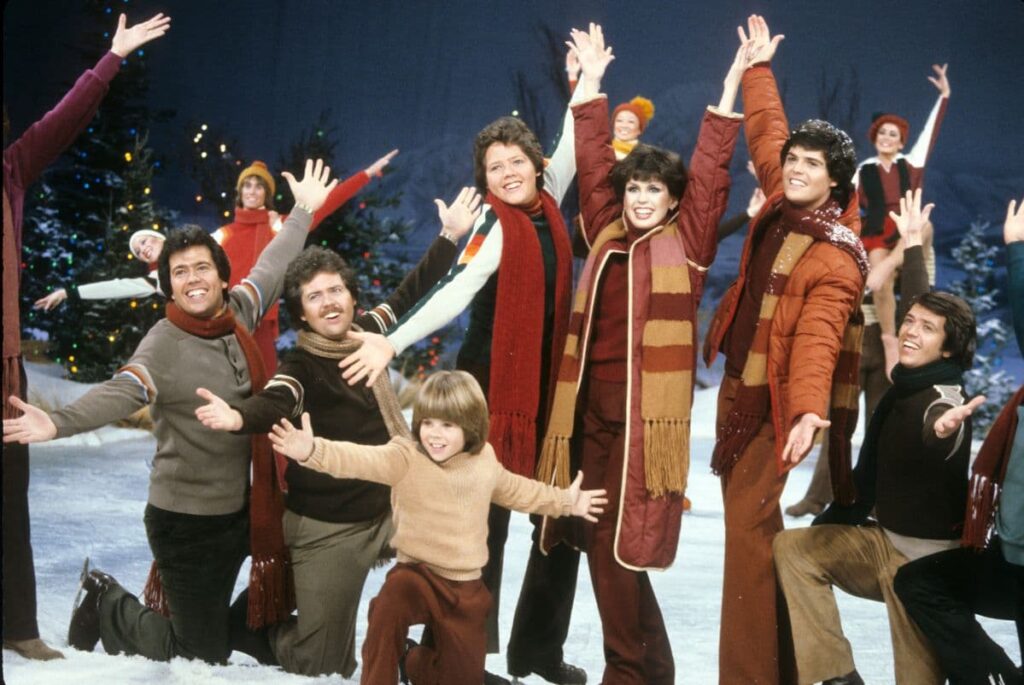
A gentle Christmas waltz where harmony, faith, and family warmth move in quiet circles of memory
When The Osmonds recorded “The Christmas Waltz,” they were not chasing novelty or seasonal spectacle. They were stepping into a song already rich with history, intimacy, and restraint, and choosing to let its grace speak for itself. Originally written in 1954 by Sammy Cahn and Jule Styne, the song had been introduced to the world by Frank Sinatra, becoming one of the most understated and enduring pieces in the American Christmas canon. By the time The Osmonds approached it in 1970, the song no longer belonged to a single era. It belonged to memory.
Their version appeared on The Osmonds’ Christmas Album released in 1970, an album that reached number 1 on Billboard’s Christmas Albums chart and peaked at number 13 on the Billboard Top LPs chart. While “The Christmas Waltz” itself was not issued as a charting single, its presence on a widely successful album ensured that it reached millions of homes during the holiday season. More importantly, it reached them quietly, without fanfare.
At that moment in their career, The Osmonds occupied a unique space in popular music. They were a family group whose appeal crossed generations, known equally for youthful energy and disciplined harmony. Yet on “The Christmas Waltz,” they set aside brightness and momentum. What remains is poise. The song unfolds at an unhurried pace, true to its waltz rhythm, allowing each harmony to settle naturally. Nothing is rushed. Nothing is forced.
The heart of “The Christmas Waltz” lies in its simplicity. There are no dramatic revelations, no declarations of joy shouted from rooftops. Instead, the song observes Christmas as it is lived quietly: a room softly lit, familiar voices nearby, the slow turning of time measured not by clocks but by shared presence. The lyrics describe the season as something gently felt rather than loudly celebrated. In this sense, it is less a carol and more a reflection.
The Osmonds understood this instinctively. Their arrangement favors blend over individuality. No voice demands attention. The harmonies move together, creating a sense of closeness that mirrors the song’s message. It feels less like a performance and more like a family gathered around a piano after the evening has grown still. This restraint is what gives the recording its emotional weight.
Behind the song is a deeper tradition of American songwriting that values understatement. Sammy Cahn and Jule Styne wrote “The Christmas Waltz” not as a religious hymn or a festive anthem, but as a human moment placed gently inside the season. That quality carries through The Osmonds’ interpretation. They do not attempt to redefine the song. They honor it by keeping it intact.
There is also something quietly symbolic about a family group recording a song centered on closeness and continuity. The Osmonds had built their career on shared voices and shared values, and “The Christmas Waltz” becomes an extension of that identity. It speaks to the idea that Christmas, at its most meaningful, is not about excess or spectacle but about returning to something familiar and steady.
Over the years, many versions of “The Christmas Waltz” have been recorded, yet the charm of The Osmonds’ rendition lies in its humility. It does not compete with earlier interpretations. It simply takes its place among them, offering warmth rather than reinvention.
Listening today, the song feels suspended outside time. It carries the sound of a particular era, yet its emotional center remains unchanged. The waltz rhythm continues to turn slowly, like seasons themselves, reminding us that some songs endure not because they demand attention, but because they wait patiently to be heard again.
In “The Christmas Waltz,” as sung by The Osmonds, Christmas is not announced. It arrives quietly, settles in the room, and stays just long enough to be remembered.