
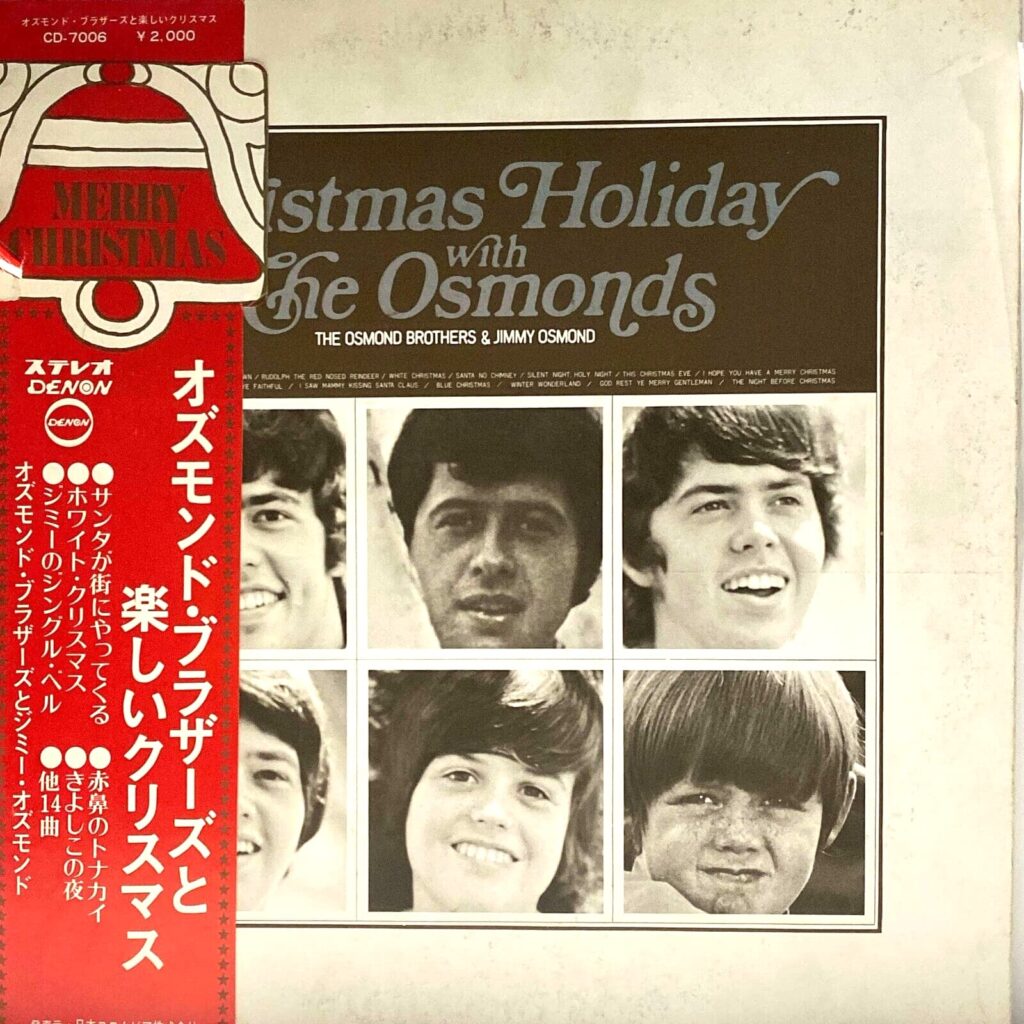
A Classic Reborn with Family Warmth and Gentle Harmony
There are songs that transcend generations, and “White Christmas” stands among the few that feel eternal — a melody that has drifted through living rooms, radio waves, and snowy evenings for over eight decades. When The Osmonds recorded their rendition of the beloved classic in 1976 for their holiday album The Osmond Christmas Album, they brought something uniquely their own: the warmth of family harmony and the sincerity of a simpler time. Though countless artists have covered the song since its original release by Bing Crosby in 1942, The Osmonds’ version carries a special kind of tenderness — one that reflects the closeness, optimism, and wholesome spirit that defined both their sound and their legacy.
Originally penned by Irving Berlin, “White Christmas” first became a phenomenon when Crosby’s version topped the Billboard charts in 1942, remaining one of the best-selling singles in history. By the time The Osmonds took on the song, it was already a sacred piece of American musical tradition — a song not just about snow, but about home, memory, and yearning. Their challenge was not to reinvent it, but to rediscover its heart — and they succeeded by letting their harmonies tell the story anew.
The Osmonds’ recording of “White Christmas” is striking in its restraint. Unlike many versions that aim for grandeur, theirs feels personal, intimate — almost like a family gathering around the piano on a quiet December evening. The arrangement opens softly, with gentle strings and light orchestration framing the lead vocal, which carries the melody with a calm sincerity. Soon, the trademark Osmond harmonies enter, smooth and balanced, transforming the familiar tune into something that feels both nostalgic and freshly human. It’s not a performance meant to dazzle — it’s meant to comfort.
At its core, “White Christmas” has always been a song about longing. Its power lies in its simplicity — a few words that awaken an entire world of emotion: “I’m dreaming of a white Christmas, just like the ones I used to know.” For listeners of The Osmonds’ generation, the song evoked memories of family, of childhood winters, of a world that once felt gentler and more certain. And when performed by a group whose entire musical identity was built on togetherness and family, those emotions deepened. The Osmonds didn’t just sing the song; they embodied it.
By the mid-1970s, The Osmonds had already achieved enormous fame, with their clean-cut image and tight harmonies earning them comparisons to earlier family acts like The Andrews Sisters. Yet, in “White Christmas,” they stepped away from pop spectacle and returned to the roots of vocal harmony — to the art of blending voices in the service of feeling. Their version reflects maturity — less about youthful excitement and more about reflection, about gratitude for the past and hope for what’s to come.
The recording’s emotional depth is amplified by its timing. Released during a period when the world was changing rapidly — politically, culturally, and musically — “White Christmas” by The Osmonds offered a moment of stillness, a pause to remember what endures. For older audiences, it rekindled the warmth of family gatherings and simpler celebrations; for younger ones, it offered an introduction to a timeless piece of musical history delivered by voices that felt safe and familiar.
Listening to The Osmonds – “White Christmas” today is like opening an old photo album — one filled with candlelight, laughter, and the faint crackle of a vinyl record playing in the background. Their harmonies remind us that the essence of the holiday season isn’t found in spectacle or perfection, but in connection — in the shared comfort of familiar songs, familiar faces, and the quiet beauty of togetherness.
The brilliance of The Osmonds’ version lies not in innovation but in reverence. They approach “White Christmas” with the understanding that some songs are not meant to be reimagined — they are meant to be remembered. Their voices, rich with warmth and familial closeness, invite listeners not to dream of distant snowfalls, but to feel at home wherever they are.
Even now, when those first gentle notes play, the world seems to slow just a little. The lights glow softer, the memories grow nearer, and for a few fleeting moments, we are all once again “dreaming of a white Christmas.” And that, perhaps, is the quiet magic that keeps this song — and The Osmonds’ heartfelt version — forever alive.