
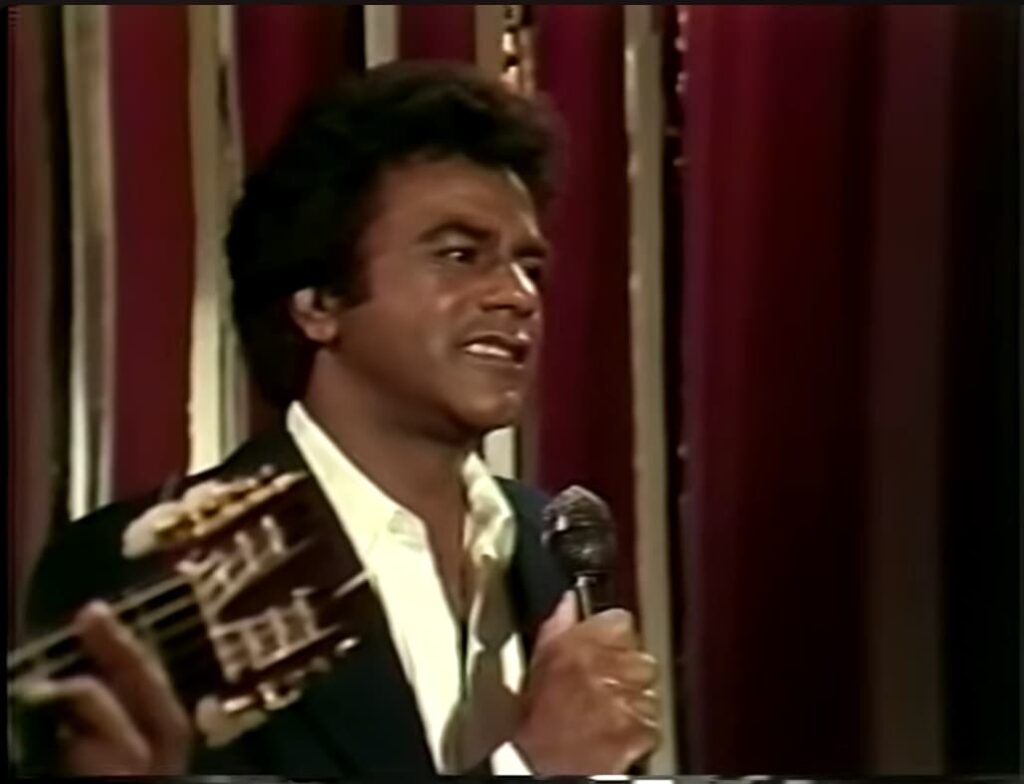
A promise that refuses time itself—when love is measured not in years, but in forever
When Johnny Mathis recorded “The 12th of Never” in 1957, he was still at the beginning of what would become one of the most enduring careers in popular music. Released as the B-side to his No. 1 hit “Chances Are,” the song carried a quiet strength that would outlive its original placement. While it did not chart separately at the time of release, its association with “Chances Are” helped define a moment when Mathis’s voice was becoming synonymous with romance itself. Over the years, “The 12th of Never” would grow far beyond its initial role, becoming one of the signature pieces in his repertoire and a lasting emblem of timeless devotion.
The song itself was written by Jerry Livingston and Paul Francis Webster, two craftsmen who understood how to translate emotion into something both simple and enduring. Their lyrics do not rely on complexity. Instead, they lean into a poetic impossibility—the idea of loving someone “till the twelfth of never,” a date that does not exist, a time that cannot be reached. It is not a promise meant to be measured. It is a promise meant to be felt.
Mathis’s interpretation transforms that idea into something deeply personal. His voice, soft yet unwavering, carries a sense of sincerity that feels untouched by time. There is no strain, no attempt to overpower the listener. Instead, he invites the listener inward, into a space where emotion unfolds gently, almost imperceptibly. It is this restraint that gives the song its lasting power.
Listening to “The 12th of Never”, one begins to notice how carefully everything is constructed. The orchestration is lush but never overwhelming, allowing the melody to breathe. The phrasing is deliberate, each line delivered with a quiet patience that suggests understanding rather than urgency. There is a sense that the song is not trying to convince—it simply exists, confident in its own truth.
Behind this recording lies a moment in music history when vocalists were often defined by their ability to convey emotion without excess. In 1957, the landscape of popular music was beginning to shift, with rock and roll rising and changing the tone of what audiences expected. Yet Mathis remained anchored in a different tradition—one that valued clarity, warmth, and emotional precision. “The 12th of Never” stands as a reflection of that tradition, offering something steady in a time of change.
Over the decades, the song has taken on new meanings, not because its lyrics have changed, but because the listener has. What once might have felt like a simple declaration of love begins to reveal deeper layers. The idea of “forever” becomes less about permanence and more about intention—the choice to hold onto something, even when time insists on moving forward.
There is also a quiet vulnerability within the song. To promise something that cannot be measured is, in its own way, an admission of uncertainty. It acknowledges that love cannot be guaranteed by time alone. And yet, the promise is made anyway, not because it is logical, but because it is necessary.
In the years that followed, Johnny Mathis would continue to perform “The 12th of Never,” carrying it with him through decades of changing audiences and evolving musical landscapes. Each performance added another layer to its meaning, not altering the song, but deepening its resonance.
Today, the song remains what it has always been—a quiet conversation between voice and feeling. It does not demand attention. It does not rely on grandeur. Instead, it lingers, much like the promises it describes, existing somewhere beyond time, beyond explanation.
And perhaps that is why it endures. Not because it offers certainty, but because it captures something more fragile—the willingness to believe in something that cannot be proven, to speak of forever even when the world insists on limits. In that space, “The 12th of Never” continues to live, carried forward by a voice that never needed to be loud to be unforgettable.