
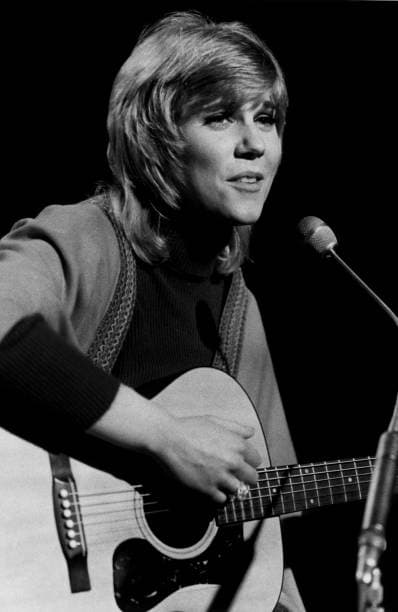
A Quiet Song About Displacement, Belonging, and the Moment Love Begins to Slip Away
Released in February 1971, A Stranger in My Place stands as one of the most quietly affecting recordings in Anne Murray’s early career. It arrived as the second single from her breakthrough album Straight, Clean and Simple, at a moment when her voice was becoming synonymous with emotional restraint, clarity, and an almost disarming honesty. On the charts, the song performed solidly and respectably. It reached number 1 on the Canadian RPM Country Tracks chart, affirming Murray’s growing stature at home, and peaked at number 27 on the Billboard Hot Country Singles chart in the United States, where her presence was still gently unfolding rather than loudly announced.
Those numbers, however, only tell part of the story. The deeper significance of A Stranger in My Place lies not in its chart position, but in how precisely it captures a universal emotional condition. It speaks to the moment when love does not end with anger or drama, but with something far more unsettling. The feeling of being emotionally displaced while still standing in familiar rooms.
Written by Kenny O’Dell, a songwriter known for his sensitivity to everyday emotional truths, the song is constructed with remarkable economy. There is no bitterness in the lyric, no accusation, no raised voice. Instead, it unfolds as a quiet realization. The narrator understands that something essential has changed, and that the change is irreversible. The most painful truth is not that love has left, but that it has left so gently that no one noticed when it happened.
This is where Anne Murray’s interpretation becomes essential. Her vocal approach is famously restrained, but in this song, restraint becomes the emotional center rather than a stylistic choice. She sings as someone who has already accepted the truth, yet has not quite learned how to live with it. The sadness does not swell. It lingers. Each line feels measured, careful, as if spoken by someone who knows that raising their voice will not bring anyone back.
The production on Straight, Clean and Simple supports this mood perfectly. The arrangement is uncluttered, leaning on soft country instrumentation and subtle pop phrasing. Nothing competes with the vocal. There are no dramatic crescendos, no orchestral flourishes designed to manufacture emotion. Instead, the song trusts silence, space, and tone. This was a hallmark of Anne Murray’s early work and a key reason why her music resonated so strongly with mature listeners who valued emotional truth over spectacle.
At its core, A Stranger in My Place is a song about identity as much as it is about love. The title itself suggests a profound loss of self. To be a stranger in one’s own place is to realize that emotional security has quietly eroded. The home remains, the relationship technically exists, but the sense of belonging has vanished. This theme connects deeply with listeners who have lived long enough to understand that not all endings are dramatic, and not all heartbreak announces itself.
In the early 1970s, country music was beginning to bridge traditional storytelling with pop accessibility. Anne Murray occupied a unique position in that transition. She did not rely on exaggerated emotion or rural archetypes. Instead, she sang about internal landscapes. About feelings that were difficult to name, but instantly recognizable once heard. A Stranger in My Place exemplifies that approach. It does not ask for sympathy. It offers recognition.
Looking back more than five decades later, the song remains remarkably intact. It has not aged because its emotional terrain is timeless. Love still fades quietly. People still wake up one day feeling unfamiliar in their own lives. And voices like Anne Murray’s, calm, steady, and deeply human, continue to matter precisely because they do not overstate what they have to say.
For listeners who have lived, loved, and endured change, A Stranger in My Place is not merely a song from 1971. It is a companion. One that understands without explaining too much, and remembers without asking to be remembered.