
A Familiar Melody Returns Like a Memory, Where Youthful Love Is Revisited Through the Gentle Lens of Time
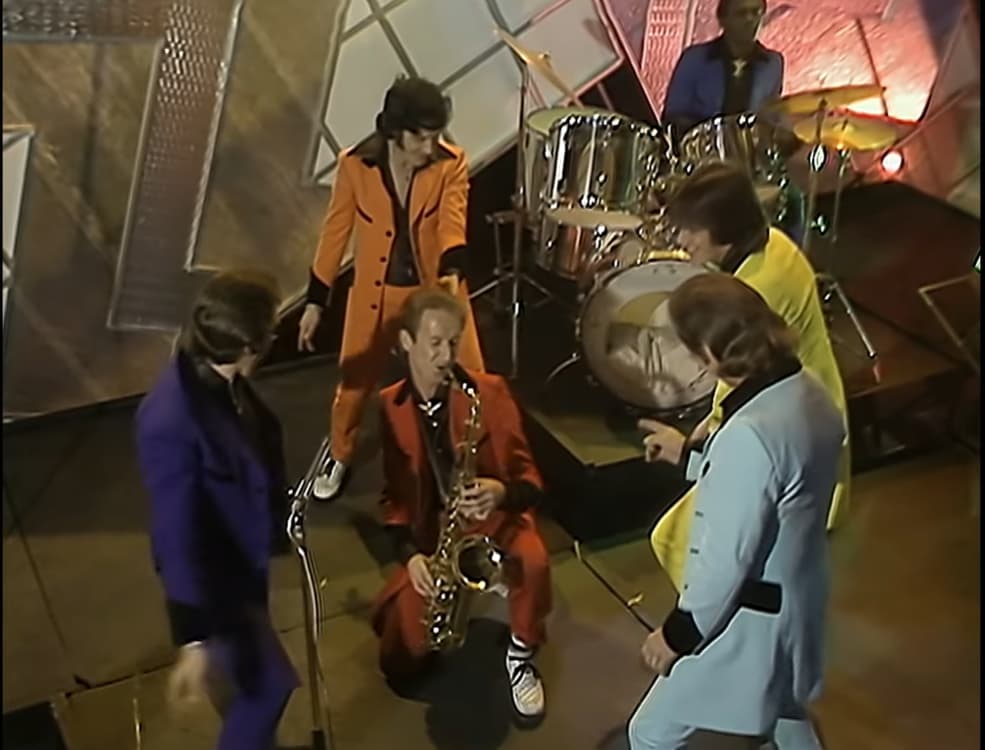
When Showaddywaddy performed “Pretty Little Angel Eyes” on Top of the Pops on October 19, 1978, it was more than a television appearance — it was a moment where past and present quietly met. The song itself, originally recorded by Curtis Lee in 1961, had once reached No. 7 on the Billboard Hot 100, capturing the innocence and melodic charm of early 1960s pop. Nearly two decades later, Showaddywaddy’s revival carried that same melody back into the charts, climbing to No. 5 on the UK Singles Chart in 1978, reaffirming the band’s remarkable ability to bring old songs back to life without losing their original spirit.
By the time of that Top of the Pops performance, Showaddywaddy had already established themselves as custodians of a certain kind of musical memory. While much of the late 1970s was defined by change — the urgency of punk, the experimentation of new wave — this group chose a different path. They looked backward, not out of resistance, but out of understanding. They recognized that some songs are not bound by time, that certain harmonies and sentiments continue to resonate long after their first moment has passed.
“Pretty Little Angel Eyes” fits perfectly within that philosophy. The song is built on a simple foundation — a gentle rhythm, a clear melody, and lyrics that speak of admiration and affection without complication. There is no dramatic conflict, no sense of urgency. Instead, it offers something quieter: a moment of appreciation, of noticing beauty and holding onto it, however briefly. In the hands of Curtis Lee, it was youthful and immediate. In the interpretation by Showaddywaddy, it becomes something slightly different — still warm, still melodic, but touched by reflection.
The performance on Top of the Pops carries its own significance. There is a certain atmosphere to that stage, especially in the late 1970s — a blend of immediacy and familiarity, where artists presented their work not just to an audience in the studio, but to countless homes. On that October evening, as Showaddywaddy delivered the song, the setting itself became part of the experience. The lighting, the arrangement, the presence of the band — all of it contributed to a feeling that was both current and quietly nostalgic.
Behind the scenes, the decision to record “Pretty Little Angel Eyes” was consistent with the band’s broader approach. They were not attempting to reinvent these songs, nor to modernize them beyond recognition. Instead, they treated them with a kind of respect, preserving their structure while allowing their own identity to come through. This balance is not easy to achieve. Too much change, and the original feeling is lost. Too little, and the recording risks becoming imitation. Showaddywaddy managed to find that middle ground, where the past is honored but not confined.
The meaning of the song, in this later context, takes on an added layer. What was once a straightforward expression of affection begins to feel like a reflection on memory itself. The “angel eyes” are no longer just a figure in a moment of youthful admiration, but a symbol of something remembered — a face, a feeling, a time that lingers even as it moves further away. The repetition of the melody reinforces this sense, as if the song itself is circling back, returning again and again to something it cannot quite let go.
Listening to that 1978 performance now, there is a quiet comfort in its simplicity. It does not demand attention in the way more contemporary sounds might. It does not seek to surprise or challenge. Instead, it offers recognition — the kind that comes from hearing something familiar, something that feels like it has always been there.
And perhaps that is the enduring strength of Showaddywaddy’s “Pretty Little Angel Eyes”. It reminds us that music does not always need to move forward to remain meaningful. Sometimes, it simply needs to return, carrying with it the echoes of earlier days. In doing so, it becomes more than a revival. It becomes a continuation — a way of keeping certain feelings alive, even as the world around them continues to change.
In that Top of the Pops moment, the song does not belong entirely to 1961 or 1978. It exists somewhere in between, shaped by both times, yet defined by neither. And in that space, it finds its true voice — soft, steady, and enduring.