
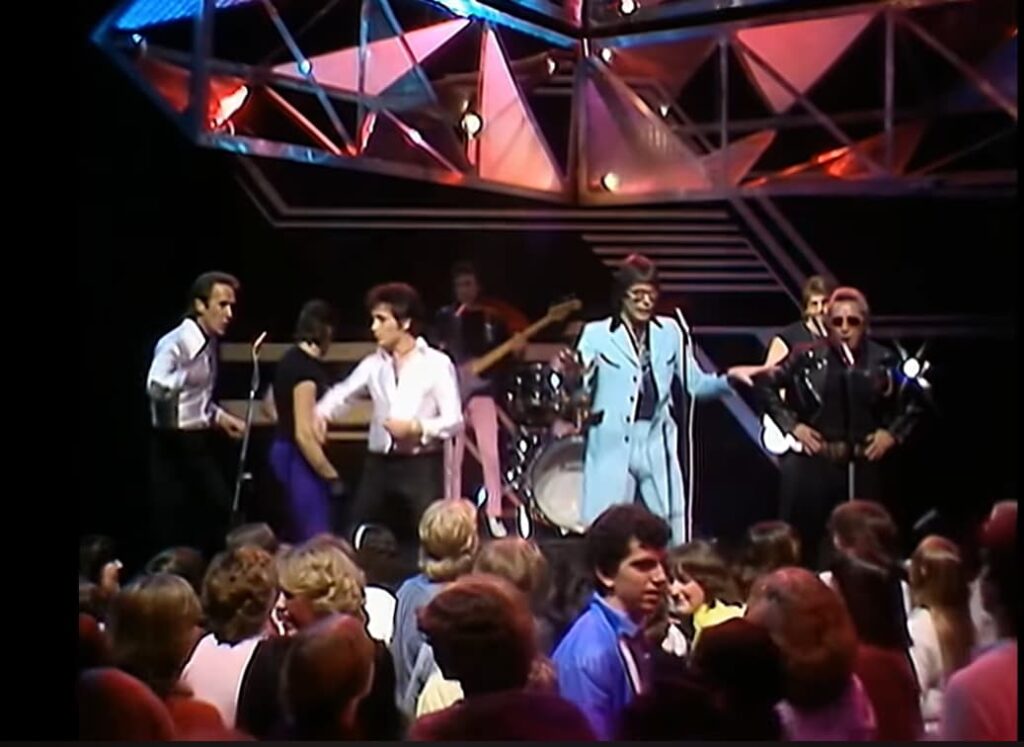
A timeless serenade to longing and quiet reflection, where Showaddywaddy captures the gentle ache of love under the moonlight.
When Showaddywaddy performed “Blue Moon” on Top of the Pops on 27 November 1980, it was more than a television appearance—it was a moment steeped in nostalgia, a nod to the era of romantic yearning that the band so effortlessly embodied. By this time, Showaddywaddy had already established themselves as custodians of rock and roll’s golden age revival, turning the spirit of the 1950s into a lively, contemporary expression that appealed to both older audiences who remembered the originals and younger fans discovering that sense of innocence for the first time.
The song itself, a rendition of the classic standard originally penned by Richard Rodgers and Lorenz Hart, carried a gentle wistfulness that resonated profoundly. While “Blue Moon” was not positioned to top the charts upon this particular release—its commercial impact in the UK hovered modestly around the lower reaches of the Top 40—it achieved something far more enduring: it reaffirmed the ability of music to connect hearts across generations. There is a quiet honesty in the delivery of Showaddywaddy, a warmth in the harmonies and the careful phrasing that made the words feel intimate, as if whispered under a shared night sky.
The story behind the song’s televised performance adds another layer of charm. In late 1980, Top of the Pops was still a central fixture of British popular culture, a weekly ritual where families gathered around the television to witness the latest hits. When Showaddywaddy took the stage in their signature retro attire, complete with matching jackets and slicked-back hair, the performance evoked a sense of familiarity and comfort. It was a deliberate celebration of continuity: the music of the past presented with energy, yet tinged with a reverence for its origins. For viewers, the experience was almost cinematic, conjuring memories of first dances, quiet nights, and the kind of love that lingers in memory long after it has faded in reality.
Musically, the arrangement stayed true to the song’s traditional roots while embracing the upbeat polish that Showaddywaddy brought to all their recordings. The gentle rhythm, delicate vocal harmonies, and restrained instrumentation created a canvas for emotion rather than spectacle. In an era increasingly dominated by synths and the emerging new wave, the band’s performance was a deliberate act of nostalgia, a reminder that some emotions—especially those of longing and melancholy—transcend trends.
“Blue Moon” also stands as a testament to the enduring appeal of simplicity in storytelling through song. There is no overcomplication here, no attempt to modernize at the expense of feeling. Instead, the performance invites listeners to pause, to breathe, and to reflect on their own moments of quiet yearning. For those who watched it live or caught reruns in later years, the image of the band performing under the studio lights, voices interweaving in tender harmony, became inseparable from the song’s emotional resonance.
Looking back now, nearly half a century later, the performance captures a fleeting but poignant intersection: a band at the height of its nostalgic revival powers, a song whose lyrical innocence seemed almost sacred, and an audience eager to be transported to another time. In that brief televised moment, Showaddywaddy reminded everyone that music can act as a bridge between decades, carrying memory and sentiment with effortless grace.
The charm of “Blue Moon” lies not only in its melodic beauty but in its invitation to remember, to feel, and to linger in the soft glow of a shared human experience. It is a song that speaks gently to the heart, a reminder that even in the hustle of modern life, there is room for reflection, for longing, and for the quiet magic of moonlight witnessed through music that truly endures.