
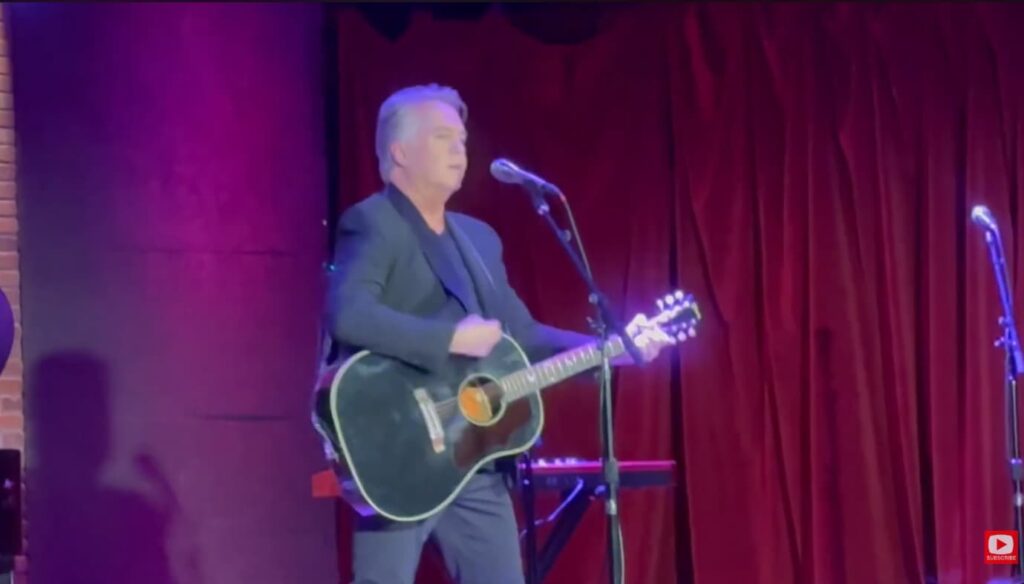
A quiet journey back through time, where familiar songs become bridges between who we were and who we have become
On January 4, 2026, at the Mesa Arts Center, Shaun Cassidy stepped once again into the soft glow of the stage lights with “The Road to Us”—a live performance that was far more than a concert. It was, in many ways, a reflection. A return. A quiet conversation between past and present, carried through melodies that have endured far longer than anyone might have expected.
To understand the emotional weight of that evening, one must look back to the late 1970s, when Shaun Cassidy first emerged as a defining voice of youthful pop. His 1977 breakout hit, “Da Doo Ron Ron”, soared to No. 1 on the Billboard Hot 100, transforming him almost overnight into one of the era’s most recognizable figures. Shortly after, “Hey Deanie” reached No. 7, and “That’s Rock ’n’ Roll” climbed to No. 3—songs that captured not just chart success, but a certain innocence, a fleeting moment when music felt uncomplicated, immediate, and deeply personal.
Yet, unlike many artists of his time, Cassidy chose a different path. At the height of his popularity, he gradually stepped away from the spotlight, turning instead toward writing and producing for television. It was a decision that puzzled some, but in hindsight, it revealed something essential about him—an artist less interested in maintaining fame than in pursuing meaning. For decades, his voice, once so omnipresent, became a memory more than a presence.
And perhaps that is what made “The Road to Us Live” such a profound experience.
This was not simply a return built on nostalgia. It was something more layered, more reflective. The title itself—“The Road to Us”—suggests not a destination, but a journey shared between artist and audience. It acknowledges time, distance, and change, yet gently insists that something remains unbroken.
As Shaun Cassidy revisited songs like “Da Doo Ron Ron”, they no longer carried the same youthful urgency. Instead, they arrived with a quiet maturity, shaped by years of silence and rediscovery. His voice, naturally altered by time, did not attempt to recreate the past. Rather, it embraced the present—softer in places, more measured, yet perhaps even more sincere.
There is a particular kind of beauty in hearing a familiar song sung decades later by the same voice. The melody remains, the lyrics unchanged, but the meaning deepens. Lines that once felt light now carry weight. Moments that once passed quickly now linger. In this way, the performance became less about entertainment and more about reflection—a shared recognition of time’s passage.
The setting of the Mesa Arts Center only heightened this atmosphere. Known for its intimate acoustics, the venue allowed every nuance to be felt—the slight tremor in a note, the pause between phrases, the quiet connection between performer and listener. It was not a spectacle. It did not need to be.
What made that night memorable was not perfection, but honesty.
There is, after all, something profoundly human about returning to where one began—not to relive the past, but to understand it. Shaun Cassidy did not come back to reclaim former glory. He came back to reconnect—with the music, with the audience, and perhaps with a part of himself that had never truly disappeared.
In a world where music often moves too quickly, where new voices replace old ones with little ceremony, moments like this feel increasingly rare. They remind us that songs are not simply products of their time. They are companions—quiet witnesses to the lives unfolding around them.
And on that evening in January 2026, as the final notes faded into the stillness of the hall, it became clear that “The Road to Us” was never just about one man’s return. It was about continuity. About memory. About the enduring power of music to carry us, gently and faithfully, back to ourselves.