
A Bright, Carefree Pop Moment That Captured the Innocence Before Glam Rock Took Hold
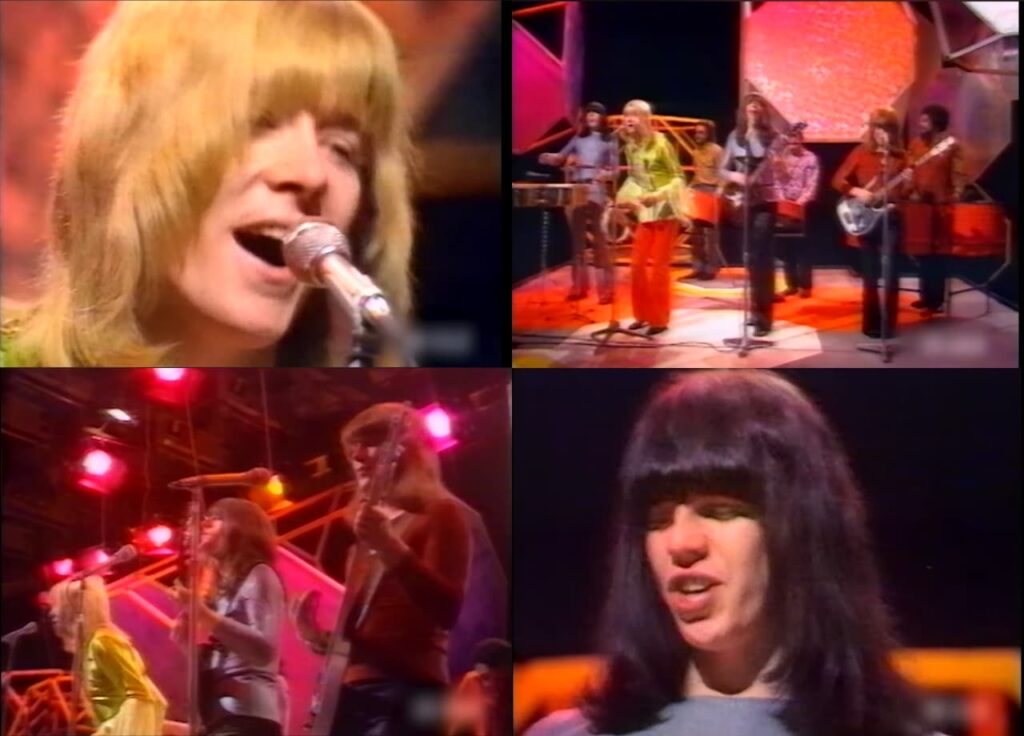
When “Co-Co” by Sweet burst onto the airwaves in 1971, it carried with it a lightness that felt almost deceptively simple—yet beneath that cheerful exterior lay the early blueprint of a band on the brink of transformation. Released at a time when the group was still finding its identity, the single quickly climbed the charts, reaching an impressive No. 2 on the UK Singles Chart in June 1971. It was, without question, one of their earliest commercial triumphs, and its performance on Top Of The Pops on June 17, 1971, cemented its place in the public consciousness.
Written by the prolific songwriting duo Nicky Chinn and Mike Chapman, “Co-Co” belongs to what many now look back on as Sweet’s “bubblegum pop” phase—a period that the band itself would later view with mixed feelings. At the time, however, it was precisely this polished, catchy style that allowed them to break through in a fiercely competitive pop landscape. The song’s structure is straightforward, its melody instantly memorable, and its chorus almost disarmingly joyful. And yet, perhaps that is exactly why it endured.
There is a certain charm in revisiting “Co-Co” today. It speaks of a time when pop music did not always strive for depth or complexity, but instead embraced the simple pleasure of melody and rhythm. The lyrics themselves are playful, even whimsical—centering around a mysterious girl named Coco, who seems to drift through the narrative more as a feeling than a fully formed character. She is less a person than a symbol: of fleeting attraction, of youthful curiosity, of those brief encounters that leave a surprisingly lasting impression.
For Sweet, this song marked both an arrival and a limitation. While it brought them chart success and widespread recognition, it also placed them within a genre that did not fully reflect their artistic ambitions. In later years, as they evolved into one of the defining acts of glam rock with harder-edged hits like “Ballroom Blitz” and “Fox on the Run,” the band would distance themselves from songs like “Co-Co.” But in doing so, they never quite erased its significance.
Listening closely, one can already detect hints of what was to come. Beneath the polished production lies a tight musical discipline—the harmonies are precise, the instrumentation crisp. There is an energy here that feels slightly restrained, as though the band is holding back something more powerful, waiting for the right moment to reveal it.
The cultural context of 1971 also plays an important role in understanding the song’s impact. This was a period of transition in popular music: the optimism of the 1960s was beginning to give way to something more experimental, more theatrical. Glam rock had not yet fully emerged, but its seeds were being planted. In that sense, “Co-Co” stands at an intersection—still rooted in the accessible pop sensibilities of the previous decade, yet quietly pointing toward a more flamboyant future.
There is also something deeply evocative about that Top Of The Pops performance. One can imagine the living rooms where families gathered around flickering television sets, the anticipation as the familiar opening notes began. Performances like that were not just broadcasts—they were shared moments, small rituals that brought music into everyday life in a way that feels almost distant now.
In retrospect, “Co-Co” may not be the song that defines Sweet’s legacy, but it remains an essential chapter in their story. It captures a band in motion, still shaping its voice, still navigating the delicate balance between commercial success and artistic identity. And perhaps that is why it continues to resonate—not as a grand statement, but as a gentle reminder of beginnings, of possibility, and of a time when even the simplest song could carry a world of feeling within it.